

I bought the Starmark Pro-Training Clicker expecting it to fix something. That was my first mistake, and it cost me about six weeks of doing the same thing I had always done while holding better equipment. The clicker does not fix anything. It is a small hand-held clicker with a stainless steel element inside that goes click, and for the first month mine mostly marked the wrong moment. June, my 3-year-old mixed-breed rescue, kept getting paid for standing up after a sit instead of for the sit itself. She was learning something. It just was not what I thought I was teaching. This is the review I wish someone had handed me before I spent money, and it is not the flattering version.
Here is what I will not do. I will not tell you that 0.4 ounces of training equipment repaired eighteen months of rehearsed habits. June came to me at 18 months old already expert at pulling toward anything interesting and shouldering through an open door, and she is 48 pounds of opinion about it. A clicker is a tool. A good tool makes consistent training easier to do, and consistent training is what actually changes a dog. Any review that promises the tool does the work is selling you a feeling, not a product.
The Quick Verdict
A well-built clicker with a loud, sharp, consistent click. Buy it if you are ready to fix your own timing. Skip it if your dog is sound sensitive or you want the equipment to do the thinking.
Amazon Check Today's Price →The hard part is your timing, not the plastic in your pocket
One clicker, one sound, no settings to fiddle with. If you are willing to spend two weeks clicking late and correcting yourself, this is the tool for that job. Read what other owners say before you commit.
Amazon Check Today's Price on Amazon →What the Starmark Clicker Actually Is
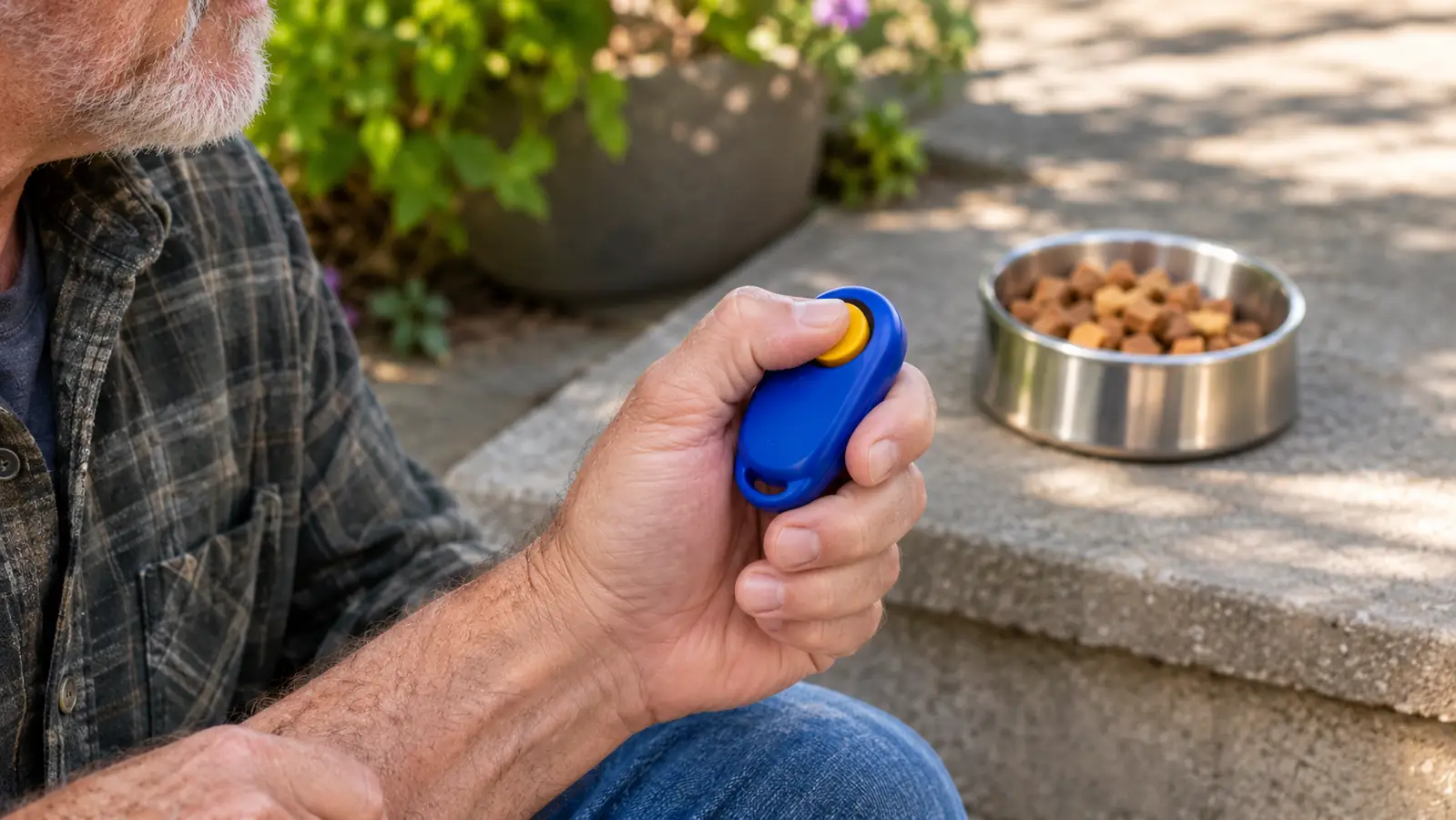
Strip the packaging away and here is the entire product. One training clicker. It measures 0.8 by 1.5 by 2.3 inches and weighs 0.4 ounces, or 11.34 grams. The clicker element is stainless steel, and Starmark notes it will not rust, which matters more than it sounds when the thing lives in a coat pocket through a wet Kansas spring. The listing rates it water resistant. Mine has been rained on twice and the sound has not changed.
The housing is built to sit in a hand rather than rattle around inside one. The listing calls the design ergonomic, which is the kind of phrase that means nothing until you have held a clicker that fights your thumb for ten minutes. Mine did not. I have small hands and I never once had to shake out a cramp mid-session. There is a keychain attachment point. I used it exactly once, decided I hated fishing for it in a bag, and moved the clicker loose into my jacket pocket where I can find it by feel. That is a preference, not a flaw.
How I've Used It With June
We train about 10 minutes, twice a day. Morning session before I leave for the school office, evening session after dinner in the backyard. That is the whole program, and the clicker lives in the pocket of the fleece I keep by the door so I am never hunting for it when June is already offering the behavior. The first week was not training. It was charging the click, which means click, treat, click, treat, with no behavior attached, maybe 20 reps until her ears came up at the sound. By day four she was visibly glad to hear it. That is the entire job of a marker. The click means food is coming, and it means nothing else.
Then came the part that humbled me. You are supposed to click at the exact instant the behavior happens, and I was consistently late. Sometimes by a full second. Sometimes by two. A late click does not mark the sit. It marks whatever the dog did after the sit, which for June was usually standing back up and looking at me. For two weeks I paid her for standing. There is nothing wrong with the Starmark clicker in that story. There was something wrong with the human holding it, and the clicker simply made my sloppiness audible in a way a spoken good girl never had.
The fix was a phone propped against a flowerpot recording our sessions. Watching it back, I could see the gap between the behavior and the click, and I could also see how often I clicked and then dug in a treat bag for four seconds. June is patient, but four seconds is long enough for a dog to lose the thread. I moved treats to a bowl on the patio step. I clicked with one hand. The reps got cleaner within a week, and so did my mood about the whole project.
Around week five, something landed. I stopped narrating. Every word I said during a rep was competing with the marker, so I said nothing at all, and the quiet made my timing better. Loose leash on our block went from constant tension to maybe two corrections a walk, not because June turned into a different dog overnight, but because slack leash finally got marked often enough that she started offering it on purpose. Door dashing came along slower. That one needed me to practice with the door shut and my hand on the frame, which is a me change, not a clicker change.
Five months in, here is the honest status of the object itself. The clicker has been dropped on a driveway, rained on twice, and carried in a pocket with loose change, and it sounds identical to the day I opened the package. The stainless steel element has no rust spotting. The housing has a scuff on one corner from the driveway and nothing else. Whatever else I think about this product, it is built to outlast the training project you bought it for, and that is more than I can say for the treat pouch I destroyed in three weeks.
The Click Is Louder Than You Expect
Nobody warns you about the volume. It is sharp, and it carries. Indoors it has a snap that made me flinch the first three or four times, and out on the sidewalk it is audible from the porch to the corner. For us that was a feature. A marker that cuts through wind, traffic and a neighbor's leaf blower is a marker that still registers when the world is more interesting than I am. If your dog startles at the smoke alarm or leaves the room when the vacuum starts, this is the specific thing to test before you commit.
The trade is obvious once you say it out loud. A sound big enough to travel across a yard is also a sound big enough to startle a nervous dog. There is no softer setting on this clicker, no volume control, no quiet mode. One press, one sound, every time, which is exactly what a marker needs to be and also exactly why it will not suit every household.
Loose leash on our block went from constant tension to about two corrections a walk. None of that came from the plastic in my pocket. It came from clicking the moment the leash went slack.
What Nobody Tells You About Clicker Training
The first thing nobody tells you is that clicker training is slower at the start, not faster. You are building a language before you can use it. Those early sessions look like a woman standing in a yard making a clicking noise at a dog who is doing nothing in particular. Then one day the dog offers the behavior on purpose, three times in a row, and you understand what you have been paying for. It is a front-loaded cost, and a lot of people quit during the front.
The second thing is that the clicker is the smallest part of the system. Food, timing, a short session, a quiet room and a plan all matter more. I could hand this exact clicker to a neighbor and it would do nothing for her dog, because she would click late and reward with a pat on the head instead of a piece of chicken. That is not a knock on the product. It is a warning about expecting equipment to carry a skill.
The third thing is the household problem. If two people train the same dog, they need two clickers and one set of rules, or the dog gets two slightly different languages and everyone gets frustrated. There is one clicker in this package. That is fine for one person doing most of the work. It is not fine for a family of four who all want to be the fun one, and I have watched that go sideways in a foster home I used to help at.
The fourth thing, and the one I would most want a new owner to hear, is that a marker does not replace management. June still dashes if the door is open wide enough and nobody is paying attention. The clicker helped me teach her what to do at a door, and it did not teach her to want to stay. That is why we still practice with the door on a leash and a bowl of treats on the step, and why I do not consider door manners a finished project.
One more thing worth saying plainly. Clicker training gets described as if the click is the reward. It is not. The click is information, and the food is the reward. If you click and then forget the treat, or click and hand over a piece of kibble the dog does not care about, the marker stops meaning anything and you are back to making noise in a yard. The people I know who quit on clickers almost always quit here, not because the tool failed but because the payoff behind it got sloppy.
What I Liked
- One consistent sound, rep after rep, with no voice drift
- Stainless steel clicker element that does not rust in a pocket
- Small and light enough to carry daily at 0.4 ounces and under 3 inches
- Ergonomic housing that did not cramp my hand in 10-minute sessions
- Water resistant, and it came through two rain showers unchanged
- Built to outlast the training project you bought it for
Where It Falls Short
- Loud and sharp, with no softer setting for sound-sensitive dogs
- One clicker per package, so a second trainer needs their own
- Keychain attachment is small for a heavy ring of keys
- A single-purpose object that a retractable pen can imitate

Where the Starmark Clicker Falls Short
Three complaints, all fair. First, one clicker per package, and one is rarely enough for a household with more than one trainer. Second, the sound is fixed and it is loud, so a sound-sensitive dog has no path forward with this specific clicker. Third, the keychain attachment is small enough that I would not hang a heavy ring of keys from it for years, though I know people who do. None of those are dealbreakers for me. All three would be for somebody.
There is a fourth, softer complaint. This is a single-purpose object, and you can get a similar result from a retractable pen or a spoken marker if the sound suits your dog better. I tried a word first and it did not work for me, because I talk too much and my voice changes when I get excited. A clicker cannot drift. It sounds exactly the same at rep one and rep four hundred. That consistency is what I was paying for, and it is the honest case for buying one of these instead of using what is already in a junk drawer.
I also want to be honest about what five months of this looked like in total. We did not become a household that clicks everything. Once June knew a behavior well, I faded the click out and kept the food, then faded the food to every third rep, then to a random one. The clicker earned its place in the first six weeks of each new skill and then sat in my pocket doing nothing. That is not a complaint. It is how markers are supposed to work, and if you are picturing daily use for years, you are describing a different training life than mine.
Who This Is For
This is for the owner who has already decided to train with food and short sessions and needs a marker that will not drift. It suits a dog who is not sound sensitive, a handler who is willing to fix their own timing, and a household where one person is doing most of the work. If you are teaching a sit, a name response, a hand target, or a loose leash, the Starmark clicker will carry all of it. It is also small enough to live in a pocket, which sounds trivial until you have owned a training tool that stayed in a drawer because it was a hassle to carry.
Who Should Skip It
Skip it if your dog startles at sharp sounds, if you are not ready to spend two weeks being bad at it, or if you want a device that trains the dog while you watch. Skip it if you have three people in the house who all want to train and you are buying only one. And skip it if you are looking for a fix for a serious behavior problem like reactivity or guarding, because that needs a qualified trainer and a plan, not a clicker in a coat pocket. This tool makes good training easier to repeat. It does not make a hard problem disappear.
Buy it for the sound. Keep it for the timing.
One clicker, stainless steel element, no settings to adjust. Pair it with a bowl of small treats and ten quiet minutes twice a day, and give it a month before you decide it did not work.
Amazon Check Today's Price on Amazon →