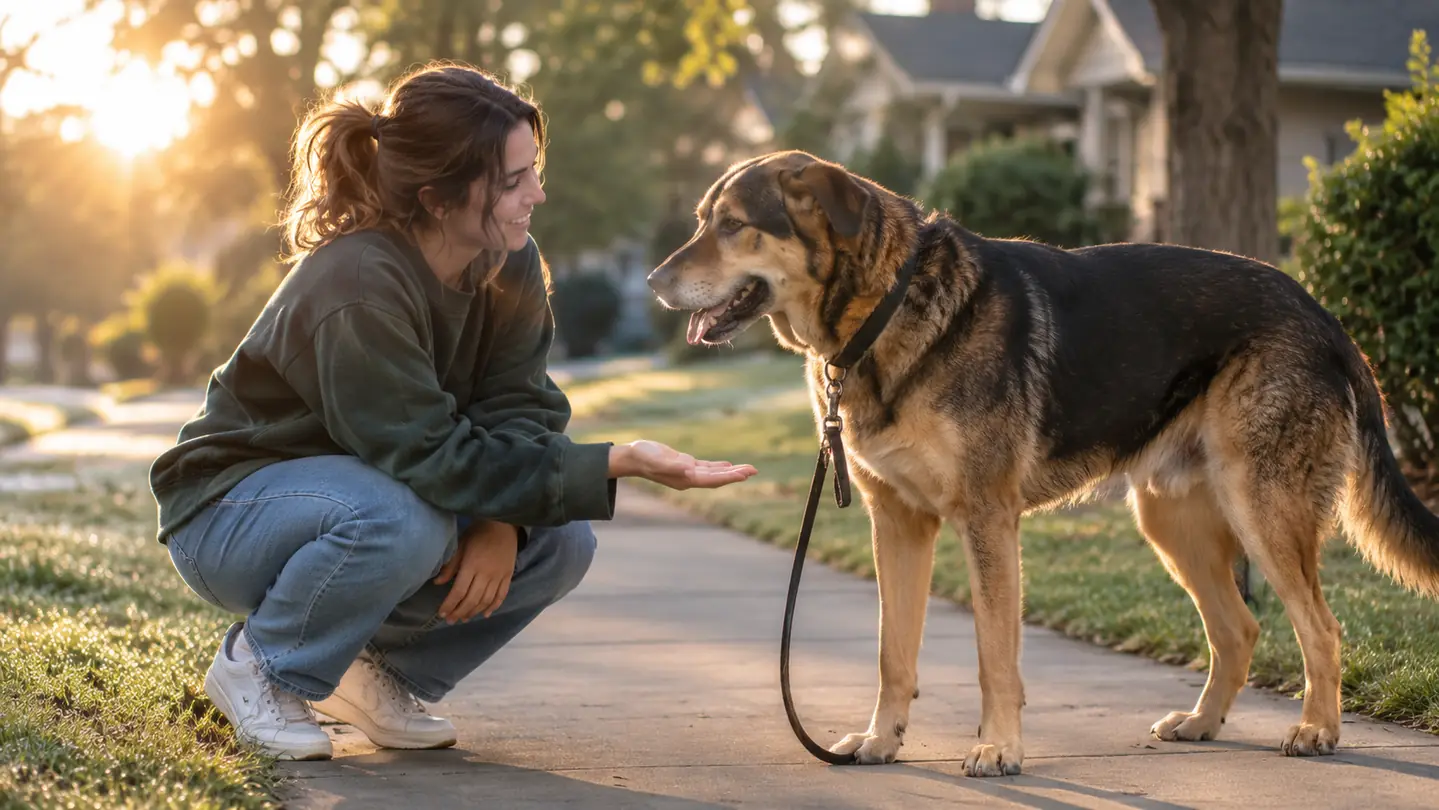
June came to us at eighteen months old with three habits we could not walk off. She pulled toward every squirrel in Sedgwick County. She shot through the front door the second it opened a crack. And she barked at the living room window like the mail carrier personally owed her money. For a year I tried what people suggest. A front-clip harness saved my shoulder and did nothing for her brain. A louder voice made her faster. A pocket full of treats with no way to mark the exact second she did the right thing was just a bag of snacks and a confused dog.
That is how a Starmark Pro-Training Clicker ended up in my jacket pocket. It is small, listed at 0.8 by 1.5 by 2.3 inches and about 0.4 ounces, with a stainless steel clicker element that the listing says will not rust. I have used it nearly every day for a little over three months, through two ten-minute sessions a day and a lot of real-world reps on the sidewalk, in the backyard, and at the front door. For a stretch in the middle of that, a foster dog was staying with us, so there were two dogs in the house. That turned out to be the most useful test of the thing.
The Quick Verdict
One sound, one stainless steel element, clipped to my keys, and the most repeatable marker I have used. It will not train your dog. It makes the timing part of training something a normal person can actually do.
Amazon Check Today's Price →The marker that rides on my keychain instead of living in a drawer
Lightweight, water resistant, and small enough that it leaves the house with your car keys. That is the entire reason this one worked for us and the last one did not.
Amazon Check Today's Price on Amazon →How I've Used It
My routine is boring on purpose. Ten minutes in the morning before I leave for the school office, ten minutes after dinner, food rewards cut small, one behavior per session. The morning one starts at 6:40, which I know because I run it while the coffee finishes and I have exactly until the pot stops gurgling. The first week I paired the click with a marker word every single time, click then word then treat, until the sound stopped being a noise to June and started meaning food was coming. I kept a tally on the back of an envelope that week and hit the high eighties in repetitions by Thursday, which sounds like a lot until you realize most of them were me clicking a dog for standing still in a kitchen. After that I used the click alone, and only for the moment I wanted to keep.
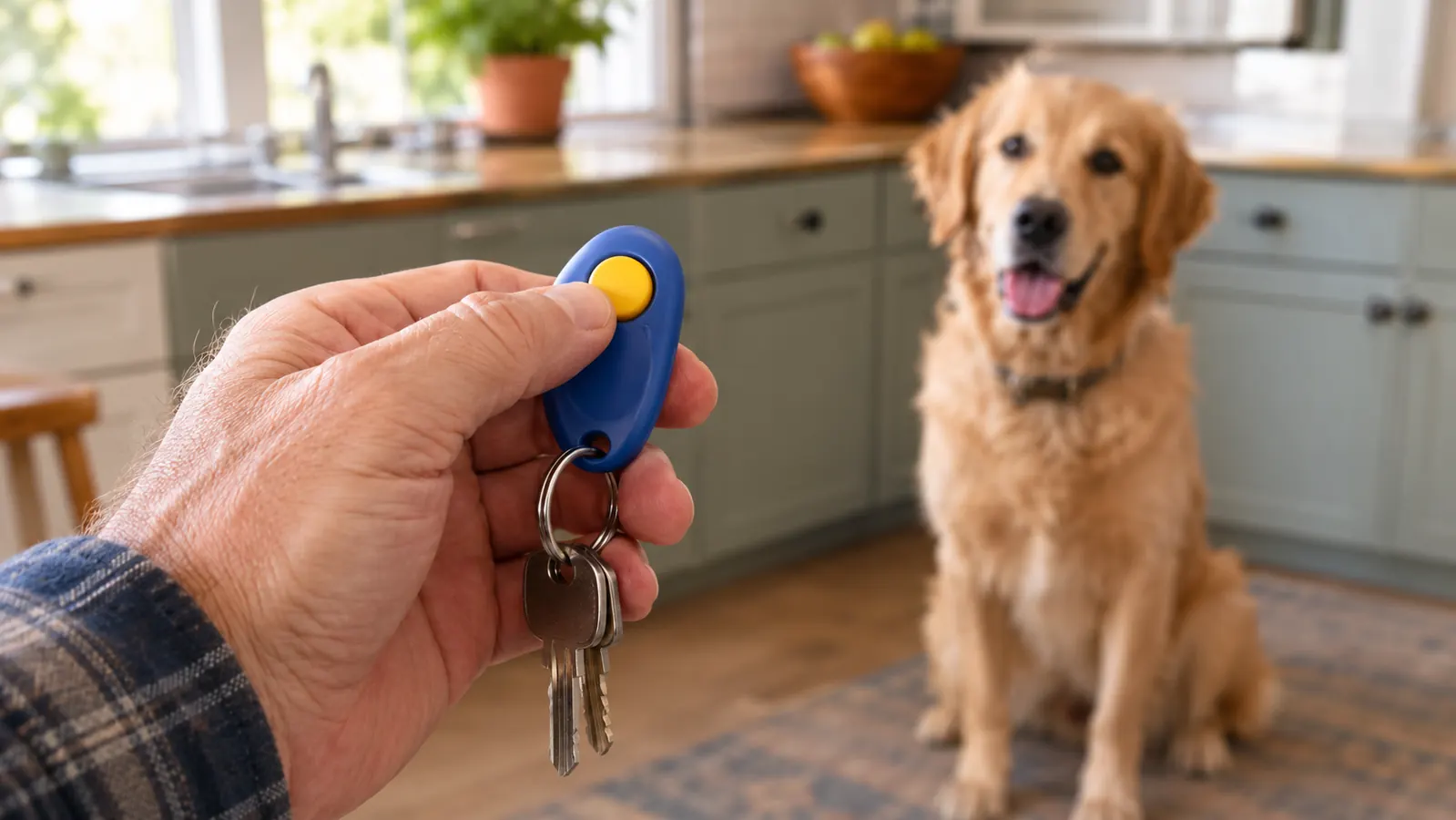
The rest of the day the Starmark clicker rides on my keychain. The listing says it attaches easily to a keychain, and it does, on the small ring it ships with. That sounds like a trivial detail until you have owned the other kind. My first clicker lived in a kitchen drawer, and a training tool in a drawer trains nothing. This one leaves the house with my car keys, so it is in my hand at the door, at the curb, and in the vet parking lot without me planning anything in advance.
I have used it in light rain and dropped it on wet grass. The listing calls it water resistant and I have not had a problem. I would not soak it. I also would not toss it into a toy bin where it disappears, because the whole value of a marker is being within reach at the exact second something good happens. A marker you have to go find is a marker you will not use.
What a Click Does That a Word Does Not
A marker has one job. It tells the dog the exact instant the reward was earned. Your voice is a wonderful tool and a terrible stopwatch. The word yes stretches out into a sentence. It changes pitch when you are tired, when you are proud, when you are irritated about something else entirely. June could not tell whether I meant that was a good sit or that was a good sit and also I am annoyed.
A click is one short sound of nothing. Same pitch every time, no emotion in it, no drift after the fourth repetition. That consistency is the entire mechanism, and it is also why the stainless steel element matters more than it sounds on paper. A marker that changes sound after a month of pocket lint and drizzle stops working as a marker, and you will not hear the difference even though your dog will.
Here is the part that made me keep using it. The click is fast enough that I could finally catch things I had been missing. Half a second of loose leash. A back foot stepping forward instead of a shoulder barging past me. When your timing gets better, your dog looks like she got better, and mostly what changed is that you started paying the right moment instead of the wrong one.
The Half of Training Nobody Mentions: The Reward
The click is not a reward. It is a promise that a reward is coming, and it only stays believable if you keep it. For the first month I paid every single click, no exceptions, with food June actually wanted. I used small pieces of chicken and cheese cut to about the size of a pea, kept in a pouch on my hip so I was not digging in a pocket while she lost interest. If you click and then fumble for thirty seconds, you are teaching her that the sound is unreliable.
I made one mistake early that is worth passing on. I started with her regular kibble because it was already in the bowl and convenient, and at the front door with a squirrel in view, kibble was not worth her attention. The click kept landing and the reward kept being inadequate, and for about a week she treated the sound roughly like the refrigerator hum. Cheese fixed it in a single session. That week cost me nothing but pride, and it taught me the reward has to be worth more than whatever the dog is currently looking at.
Later I thinned it out, paying every click but with lower-value food in easy situations and the good stuff for hard ones. That is the whole reward system and there is no trick to it. If you are not willing to carry food and pay the click, this tool is a plastic noisemaker. The clicker does not fix the reward side of training. It just makes it clear which behavior you are paying for.
Three Months With June, Session by Session
Weeks one through three were about the sound and nothing else. Click, treat. Click, treat. I did it while the television was on and while she was doing nothing in particular in the middle of the kitchen floor. If you skip this part, the click stays a strange noise and every session after it is uphill, because the dog has no reason to care that it happened.
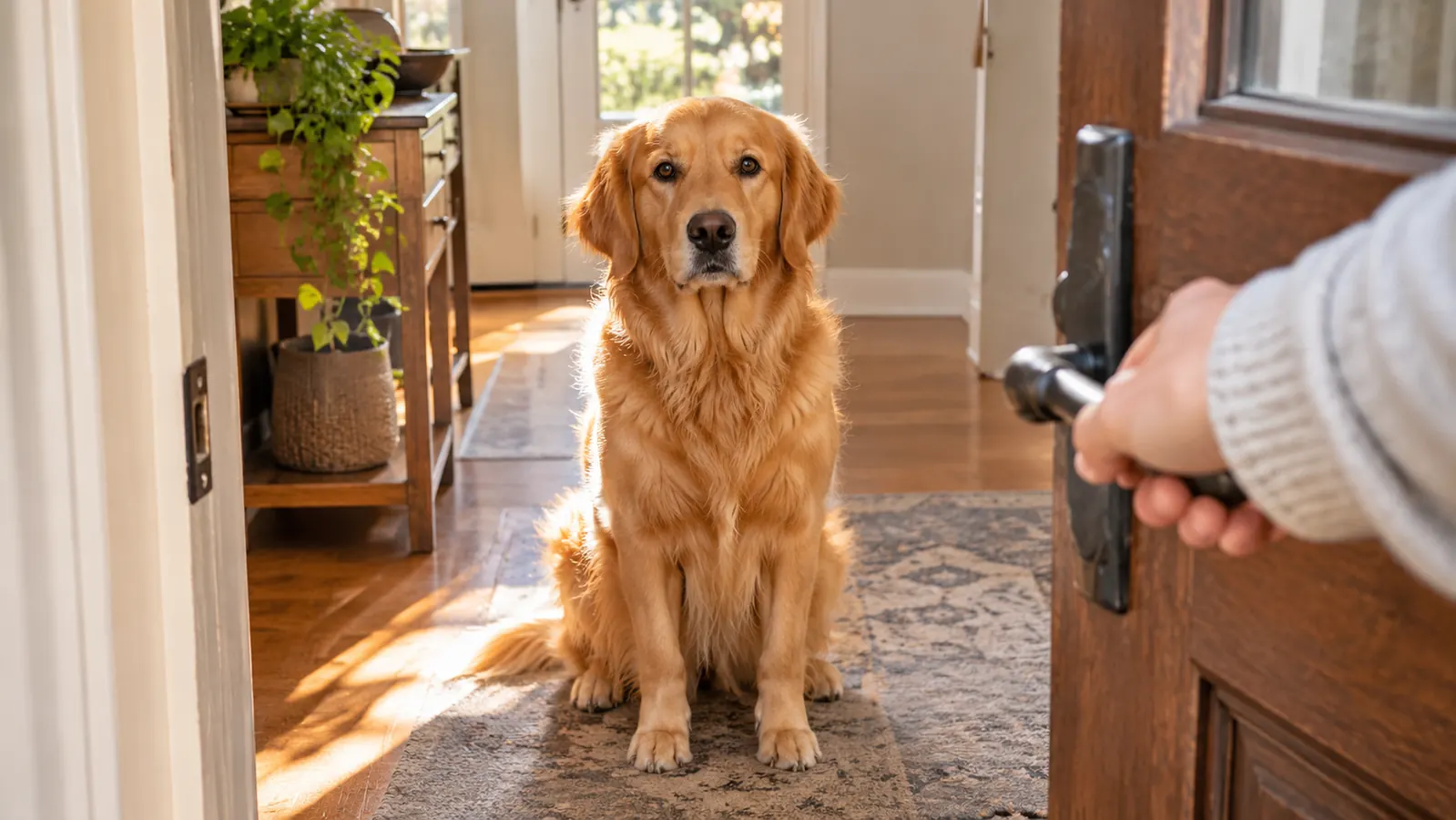
Weeks four through six I took it to the front door, which was our worst problem. The rule was simple. Any backward step away from the door earned a click. A rear end on the floor while I reached for the handle earned a click. I clicked maybe forty times across four sessions. It felt absurd at the time and it was the fastest change we have had on anything in three years. The turn came on a Thursday evening in the second week, when I got the door open to the width of my own body without her moving and stood there in the cold clicking a dog for sitting still while the neighbors walked past.
Two things I would do differently if I started over. I began with the door open about six inches, which was too much, and had to back up to barely a crack before she could succeed. And I was running those reps right after the school run, when she was already wound up from the car. Moving them to a quieter half hour would have saved us about a week.
Weeks seven through twelve moved outside. Loose leash is a slow skill with a young mixed breed and I will not pretend a clicker solved it. What changed is that I could pay the good moments and stop paying the bad ones. By the end of three months I could walk her past a barking dog across the street with the leash hanging loose for maybe fifteen feet. Before that, we were at the end of the leash and going sideways into a hedge.
It was not linear. There were two weeks in the middle where June decided the click meant she should offer every behavior she knew at once, and I got a lot of spinning and a lot of sitting with great enthusiasm. That is a training problem, not a clicker problem. The fix was shorter sessions and one criterion at a time, and it cleared up in about ten days.
Where It Fell Short
It makes one sound and only one sound. There is no adjustment on the Starmark clicker, and for most dogs that is exactly right, because a marker with settings invites you to fiddle. If your dog startles at sharp noises, this is the wrong first tool. No amount of treat pairing makes a sound-sensitive dog comfortable with a click, and forcing it sets you back weeks. Start with a soft marker word for that dog.
It is genuinely small. That is why it fits on a key ring and also why a larger hand may find it fussy for the first week or two. Mine adapted quickly, though my husband picked it up once and pressed it sideways. I also clicked it by accident twice while digging for my car keys in a coat pocket, and June got two free pieces of chicken for nothing. Not a disaster. Worth knowing before you decide it is broken. A coat pocket shared with keys and a phone is where it happens, because the clicker can be pressed against either one, and a marker that fires for no reason is worse than no marker at all that day.
And it will not do anything by itself. That is the honest limitation of every clicker ever made. The click has to be followed by something the dog wants, and it has to happen often enough to be worth the dog's attention. If you are not going to run short sessions most days, this tool will sit in a drawer and you will blame the tool instead of the schedule.
What Having Two Dogs in the House Changed
For about six weeks in the middle of this, we had a foster dog staying with us, so there were two dogs in the house and one clicker. A click marks one animal. That is not a design flaw, it is what a marker is. With both dogs loose in the same room, I clicked for June and the foster dog got the treat, which taught nobody anything good and confused both of them.
The foster dog learned the click faster than June did, which is its own small lesson about how much of this is the dog and how little is the tool. She would come running from the back room at the sound after two days. June would look at me and wait to see if I meant it. Same clicker, same kitchen, two completely different animals.
The fix was logistics. One dog behind a baby gate, one dog working, then swap. A second clicker would have made it easier and I got by with one because the sessions were short. If you have two dogs of your own and plan to train both at the same time, plan on a second clicker or plan on a lot of gate work. The tool is fine. The arithmetic is the problem.
What I Liked
- One consistent sound with no pitch drift and no emotion in it
- Stainless steel clicker element plus water resistance, so it survives a pocket
- About 0.4 ounces on a key ring, which means it is actually there when you need it
- Fast enough to mark half a second of good behavior before the dog moves on
- Simple enough that a first-time trainer uses it correctly on day one
Where It Falls Short
- One fixed sound with no adjustment, wrong for sound-sensitive dogs
- Small enough that larger hands fumble it at first
- Does nothing without food and repetition behind it
- One clicker per dog, which means a second purchase for a two-dog household
I clicked maybe forty times across four sessions at the front door. It felt absurd at the time and it was the fastest change we have had on anything in three years.
Who This Is For
This is for the owner who has already decided to train with food and short daily sessions and needs a marker that does not drift on them. It suits a first clicker, a spare clicker, and especially a keychain clicker for real-world reps at the door and on the sidewalk. If your last clicker died in a drawer, the key ring is the feature that changes that.
It also suits anyone who has been told their timing is bad and did not know what that meant. The Starmark clicker forces the issue. You cannot click halfway, you cannot click in a warm tone of voice, and you cannot click three seconds later and hope the dog connects it. That constraint is the teaching.
Who Should Skip It
Skip it if you want a device that changes behavior on its own, because no clicker does that and this one is honest about it. Skip it if your dog bolts at sharp sounds. Skip it if you already have a clicker that works and lives in your pocket, since a second identical tool buys you nothing. And skip it if you are not going to carry food, because the click without the reward is just a noise your dog learns to ignore.
If your timing is the weak link, this is the smallest fix available
Three months, two short sessions a day, one sound that never changes. June still pulls toward squirrels. She also stops at the door now, and that came from about forty clicks.
Amazon Check Today's Price on Amazon →