
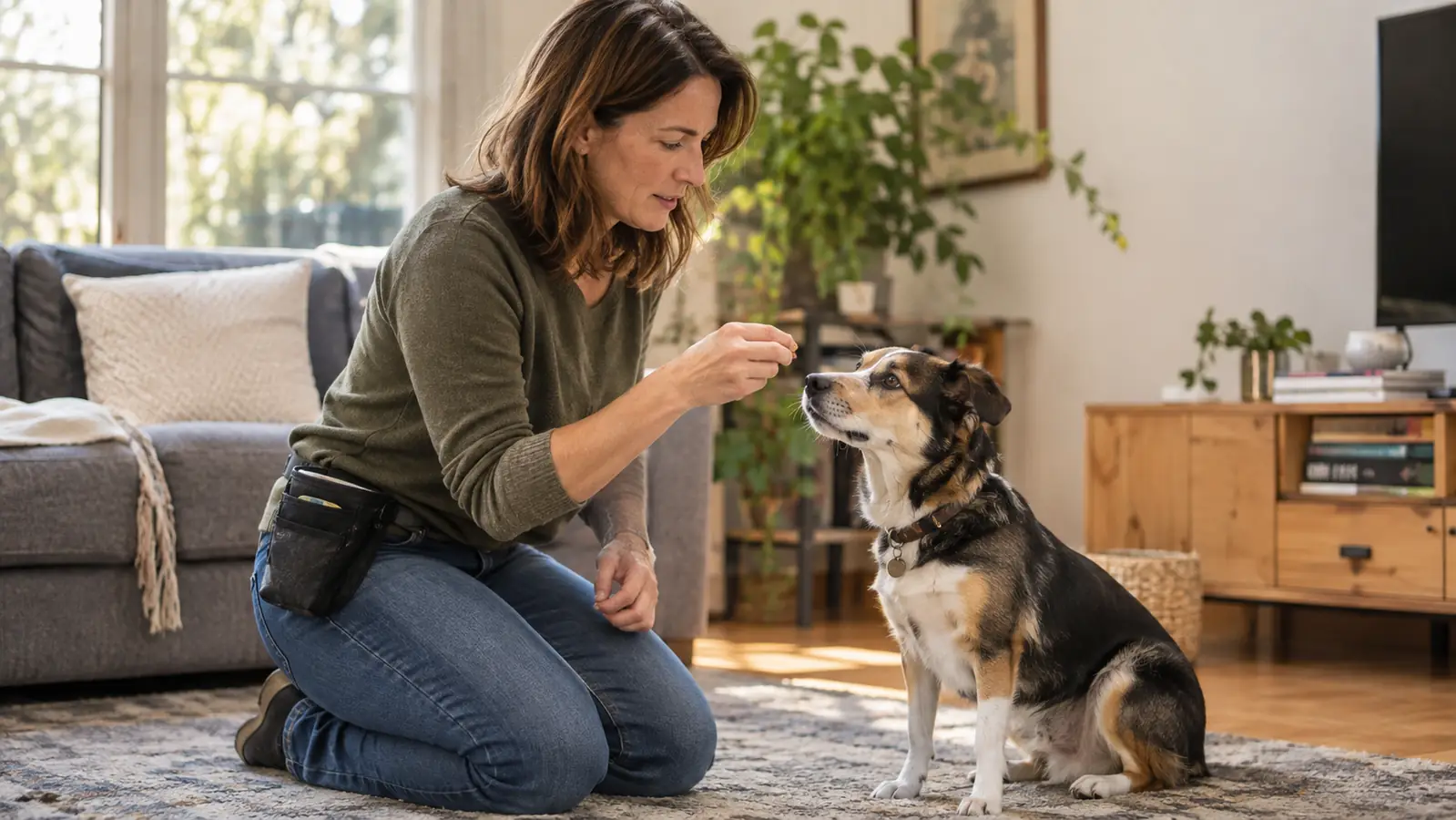
I compared the Starmark Pro-Training Clicker with a verbal marker word because I had already tried the word. For two months I used a cheerful 'yes' to mark the moment June did something right. It worked, sort of. My timing was loose, my tone changed when I was tired, and by the time I said the word, June had already moved on. The clicker gave me a signal that stayed the same. A marker word gave me freedom. After six weeks of switching between the two with June, a 3-year-old mixed-breed rescue who came to us at 18 months with leash pulling, door dashing and window barking, I would buy the Starmark clicker first for new behaviors. I would keep a marker word for distance and daily life. The short answer: the clicker wins for precision, the word wins for convenience, and most homes should use both.
June is about 48 pounds and still thinks the front door is a starting gate. We train in two short sessions a day, about 10 minutes each, with food rewards. That is the whole setup. No shock, no prong, no punishment. I am not a professional trainer. I am a school office manager outside Wichita who has fostered and walked shelter dogs for years, and I needed a system that worked on a Tuesday night when I was tired. That is why the clicker versus word question matters. The tool has to fit real life, not a perfect training video.
| Starmark Pro-Training Clicker | A verbal marker word | |
|---|---|---|
| Signal consistency | Same click every time, even when I am tired or rushed. | Tone, speed and word choice shift with mood and situation. |
| Timing precision | Marks the exact instant a paw lands or weight shifts. | Easy to deliver a half second late while moving. |
| Hands free | Takes one hand to hold and press. | Leaves both hands for leash, treats or the door. |
| Distance work | Harder to hear across a windy yard. | Carries across a yard once the dog knows it. |
| New behaviors | Best for sit, mat, door waiting and first leash steps. | Better after the behavior is already understood. |
| Everyday carry | Attaches to a keychain and weighs 0.4 ounces. | Always with you because it is your voice. |
| Sound-sensitive dogs | Some dogs need a slow introduction to the click. | A spoken word is familiar from day one. |
| Training with more than one person | Everyone produces the same click. | Different people say the word differently. |
| Weather and wear | Water resistant, with a stainless steel clicker element that won't rust. | No parts to dry, lose or replace. |
How I Tested the Starmark Clicker Against a Marker Word
I ran a simple comparison over six weeks. Week one and two, I used only a verbal marker word, 'yes', for every behavior I wanted to repeat. Week three and four, I used only the Starmark clicker. Week five and six, I used the clicker for new behaviors and the word for behaviors June already knew. I kept sessions short, about 10 minutes, twice a day, and I rewarded every marked behavior with food. I did not add extra cues until June was offering the behavior. I did not test on walks during the first two weeks because her leash pulling would have made the data messy. I started indoors, then moved to the backyard, then the front porch.
The verbal marker was easy to start. I could say 'yes' while holding a leash, opening a door or standing across the yard. The problem was me. I said 'yes' in different tones. I said it late. I said it when June was already sitting and then looked away, which marked the look away instead of the sit. A clicker does not care if I am tired. The Starmark clicker makes one click when I press it, and that click is the marker. The stainless steel clicker element is listed as rust resistant, the clicker is water resistant, and it attaches to a keychain, which matters because I lose small objects. The clicker is also light, 0.4 ounces, and the ergonomic design fits comfortably in my hand. I could hold it and a treat in the same hand without fumbling.
The trade-off showed up fast. With the clicker, I could mark the exact second June's paws hit the floor instead of the moment I noticed. With the word, I marked the moment I decided to speak. That half second matters. June is bright and quick, and a late marker teaches the wrong thing. The clicker also gave the same signal no matter who held it. Another person could click the same way I did. The word was less consistent between us. That said, the clicker took a hand. If I was holding a leash, a treat pouch and a door, the word was the only realistic option.
I judged both markers on four things: how fast I could deliver the signal, how often the signal was identical, whether I could use it with my hands full, and whether June offered the behavior again without a lure. I did not care which one felt more professional. I cared which one June could actually learn from. The clicker won the first two tests. The word won the third. The fourth was a tie once the behavior was strong. That is why the honest answer is not a single winner for every situation.
The clicker did not train June for me. It made my timing honest. The word was free and easy, but it often marked my reaction instead of her action.
Where Starmark Pro-Training Clicker Wins
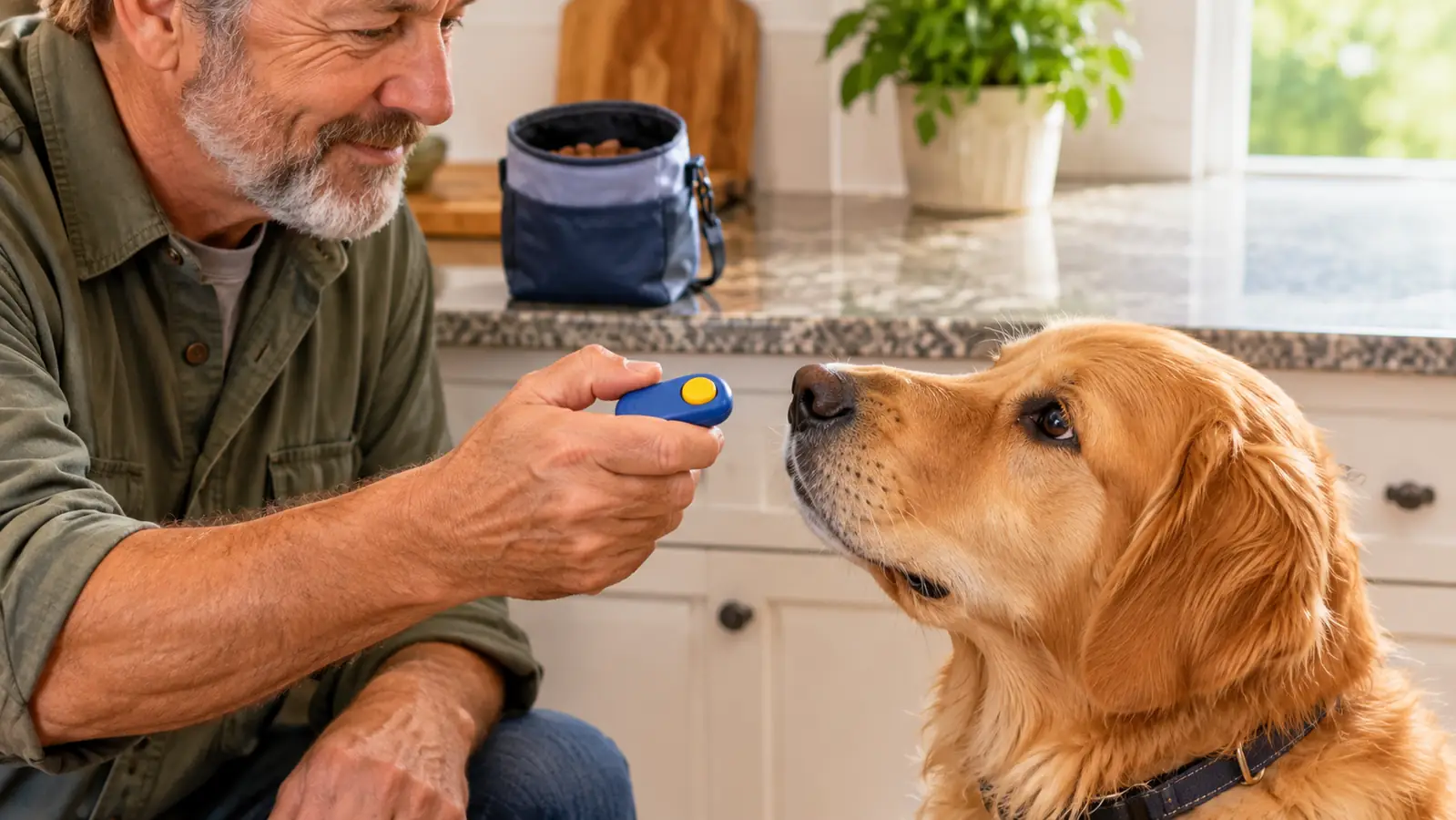
The Starmark Pro-Training Clicker wins on consistency. A click is not a mood. It does not speed up because I am late for work or soften because June looks cute. When I was teaching four-on-floor at the door, I needed to mark the instant her paws were on the floor and not the instant she stopped jumping. The clicker let me do that. It also let me reward the behavior I wanted without adding a word that June might hear in other contexts. I say 'yes' in normal conversation. I do not accidentally click when I am on the phone.
The clicker also wins on precision for new behaviors. I used it for a mat settle, a wait at the door, and the first few steps of loose-leash walking. Each time, the click landed on the behavior, then the treat arrived. June started offering the behavior more often because the marker was clear. The clicker is small, 2.3 by 1.5 by 0.8 inches, and it hangs on a keychain, so I could keep it by the door. The stainless steel element is meant not to rust, which is useful in a house with a water bowl that gets splashed. I would not leave any training tool in a puddle, but the water resistance is a sensible detail for real life.
The last win is household consistency. When more than one person trains the same dog, a spoken word can drift. One person says 'yes' sharp and quick. Another says it long and soft. One person says it after the dog stands up. A clicker removes that variation. Everyone presses the same clicker and gets the same signal. That matters more than most people think, because a dog does not know which human is right. The dog only knows which signal was followed by food. The Starmark clicker made that signal identical from person to person and from Monday to Sunday.
Where a Verbal Marker Word Wins
A verbal marker word wins on freedom. I can say 'yes' with my hands full, across the yard, through a screen door or while holding June's leash. That is not a small thing. Some of the most useful training moments happen when I am not set up. June started to offer a sit before I opened the door because I marked it with a word while my hand was on the knob. The word also works at a distance. A clicker can be heard in a quiet room, but I would not rely on hearing it across a windy Kansas backyard. The word carries.
The word is also familiar. June hears voices all day. She does not need an introduction to a spoken marker. If a dog is worried by a sharp noise, a word is a gentler place to start, and I would not force a clicker on a dog that flinches. The word is also forgiving. I can say it in a happy tone, and that tone can add energy when we are practicing recall. The clicker is neutral. That neutrality is an advantage for precision and a disadvantage for enthusiasm. For a dog that needs energy in your voice, the word can do something the clicker cannot.
The word also wins because it is always available. I do not have to remember it, charge it, dry it or attach it to anything. That sounds minor until you are standing in the rain with a leash wrapped around your wrist and a dog pulling toward a squirrel. In that moment, a marker word is the only tool I have. I still use 'yes' for recall in the backyard and for quiet moments on the porch. The clicker built the behavior. The word keeps it usable when my hands are full.
If your timing needs to be exact, start with the clicker
The Starmark Pro-Training Clicker gives you one signal that stays the same, even when you are tired, rushed or training with someone else. The stainless steel clicker element is rust resistant, it attaches to a keychain, and the ergonomic design fits comfortably in your hand. Use it for new behaviors, then keep a word for distance work. That combination is what worked for June.
Amazon See the Starmark Clicker on Amazon →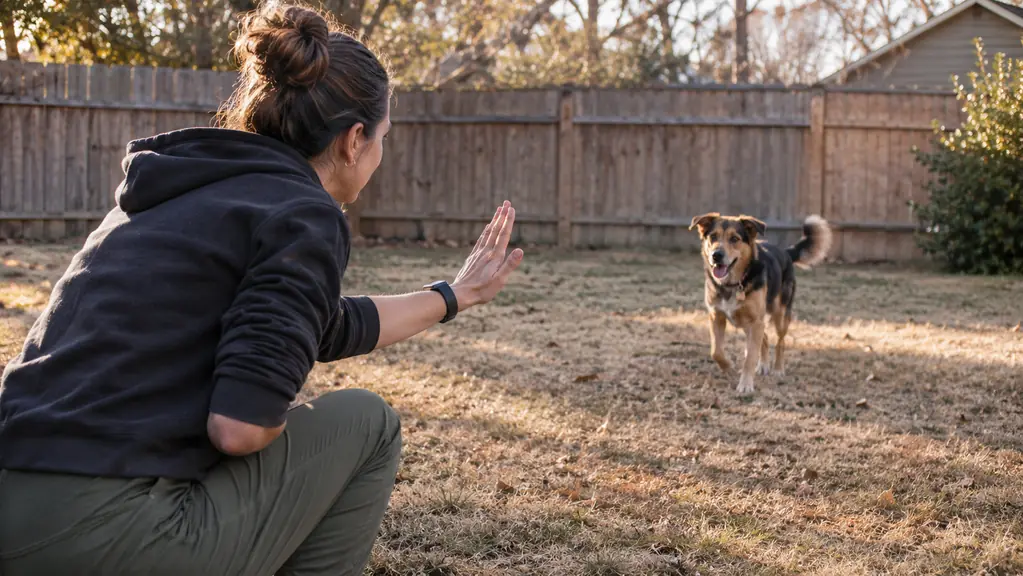
Who Should Buy Which
Buy the Starmark clicker first if you are teaching a new behavior and your timing is not yet reliable. That includes sit at the door, wait for food, mat settle, four-on-floor when guests arrive, and the first month of loose-leash work. The clicker is also the better choice in a household where more than one person trains the dog, because everyone can produce the same signal. It is the tool I would hand to someone who says their dog does not listen but who has never marked a behavior at the exact moment it happened.
Keep a verbal marker word if your dog already knows the behavior and you need to mark it at a distance, through a door, or with your hands full. The word is also the better starting point for a dog that startles at sharp sounds or a household that will not carry a clicker. I still use 'yes' for recall in the backyard and for quiet moments on the porch. The point is not to pick a side forever. Use the clicker to build precision, then transfer the behavior to a word you can say anywhere.
If you are not sure, run a two-week test. Use the clicker for one new behavior and the word for one known behavior. Count how many times you mark the behavior within half a second. The marker that lands on time is the one your dog is learning from. For June, that was the Starmark clicker for new work and the word for distance. I did not need a complicated chart. I needed to see which signal I could deliver cleanly when I was not at my best.
A Simple Way to Use Both Without Confusing June
Pick one behavior. I used a mat settle because it is calm and easy to repeat. Say the cue once, wait for the behavior, then click the instant it happens. Feed a treat. Do five repetitions, then stop. Do not click and treat for nothing. The click means the treat is coming, so the order matters: behavior, click, treat. If you click late, you are teaching the late behavior. If you click early, you are teaching the early behavior. The clicker does not fix bad timing. It just shows you what your timing actually is.
Once June was offering the mat settle reliably, I added the word. I would say 'yes' at the same moment I would have clicked, then treat. I did not say both at once. I did not click and say 'yes' together. That would have made two markers for one behavior. I kept the clicker for new behaviors and used the word for behaviors that were already strong. That kept the system simple. June did not have to sort out which marker meant what. She only had to repeat what worked.
The last piece is reward placement. I keep treats in a small pouch and deliver them where I want June to be. For mat settle, the treat goes on the mat. For door waiting, the treat goes between her paws on the floor. For loose-leash walking, the treat goes at my side. The marker tells June what she did right. The reward tells her where to stay. That is the whole method, and it works on a Tuesday night when I am tired and June is convinced the squirrel outside is a personal invitation.
Build the behavior with a clear signal, then keep it with a word
The Starmark Pro-Training Clicker is the tool I reach for when I need to mark a new behavior at the exact moment it happens. It is small, it hangs on a keychain, and the stainless steel clicker element is built not to rust. Start with one behavior, five clicks, five treats. Then use your marker word for the rest of the day.
Amazon Check Availability on Amazon →