
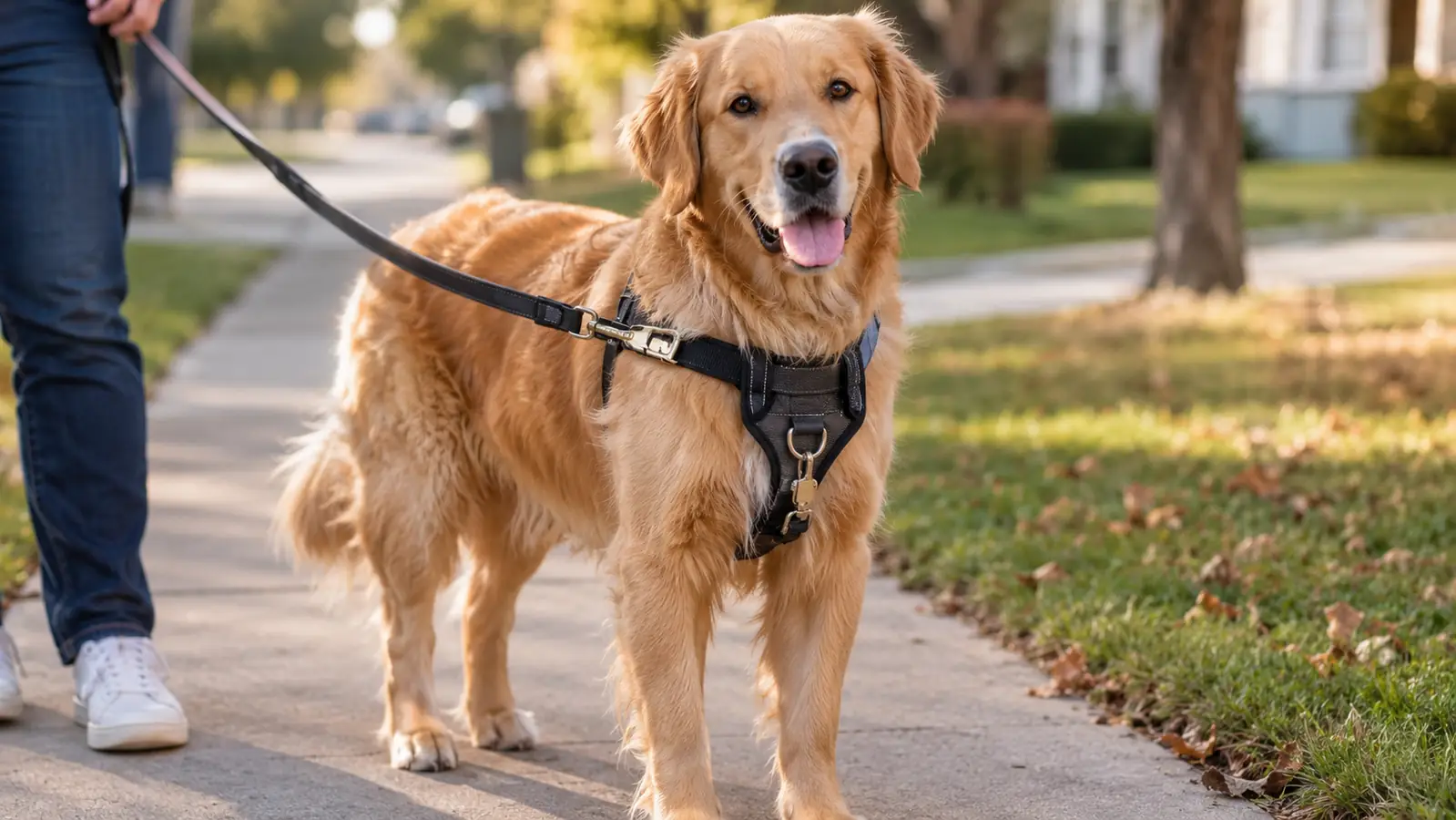
Short answer: when pulling is the problem, the PetSafe Easy Walk is the harness I hand people first. When staying on the dog is the problem, or when one household wants a single harness for training walks and lazy sniff walks alike, the rabbitgoo No Pull Harness is the better call. June is a 48-pound mixed-breed rescue who came to me at 18 months already committed to dragging me down the sidewalk, and I have walked her in both.
Here is the part that matters more than either brand name. Neither harness trains your dog. Both are steering tools. They buy you a loose leash long enough to reward it, and the reward is what teaches the behavior. The PetSafe Easy Walk is the more single-minded steering tool of the two. The rabbitgoo is the more adaptable one. Which one suits you depends on what your walks look like and on what your dog's body does the moment she decides she wants to be somewhere else.
| PetSafe Easy Walk | rabbitgoo No Pull Harness | |
|---|---|---|
| How it steers | Front chest ring plus a martingale loop that eases snug across the shoulders when your dog leans forward | Front and back leash rings, so you choose front-clip steering or a back-clip walk |
| Leash attachment points | One, on the chest | Two, chest and back |
| Getting it on | Over the head, then one quick-snap buckle at the shoulder, with a different color belly strap so you can tell front from back | Over the head with several straps to adjust and thread |
| Escape resistance | The loop closes if a dog backs out, which helps, but a narrow-chested dog can still slip it | More straps wrapping more of the body make it harder to reverse out of |
| Adjustability | Adjusts at the shoulders and chest, sized by weight range, with the Medium rated for 20 to 50 pounds | Adjusts at more points, which fits a wider spread of body shapes |
| Long-walk comfort | Thin nylon webbing, hand wash only, built to be light rather than cushioned | Padded lining along the straps that holds up better on an hour-long walk |
| Warranty | One year manufacturer warranty | Varies by seller listing |
| Best for | A hard puller who needs steering from the second you clip the leash | A dog who has slipped a harness, or a household that wants one harness for both training and everyday walks |
How I Tested Both on June
I am not a trainer. I am a 44-year-old school office manager in Wichita who has walked and fostered shelter dogs for years, and June is the dog I actually live with. My testing is two ten-minute sessions a day, most days, plus a longer neighborhood walk on weekends. Food rewards, a treat pouch on my hip, short sessions, and a lot of stopping.
Before either of these, I tried the two things most people try first: a flat collar on a six-foot leash, then a back-clip harness I already had in the closet. The collar left a red mark across my palm and a dog who had learned that leaning works. The back-clip harness gave her something to pull against, and she did, cheerfully, all the way to the corner and back. That is the history I brought into this comparison.
I rotated the two harnesses over a few weeks, starting in the last week of March and running into April, which in Kansas means one walk in a jacket and the next in a t-shirt. Both harnesses got the same weather and the same route: four blocks north, around the school parking lot, and home. On PetSafe days I clipped to the chest ring only, because that ring is the whole point of the design. On rabbitgoo days I split the time between the front ring and the back ring so I could feel the difference in my own arm. I paid attention to four things: how fast June stopped pulling, whether she could back out of the straps, whether anything rubbed behind her front legs, and whether I could get the harness on a wiggling dog in under a minute.
This is not a lab. It is one dog, one neighborhood, and one person with a sore shoulder. Read it as a report from a neighbor rather than a controlled study.
Where the PetSafe Easy Walk Wins
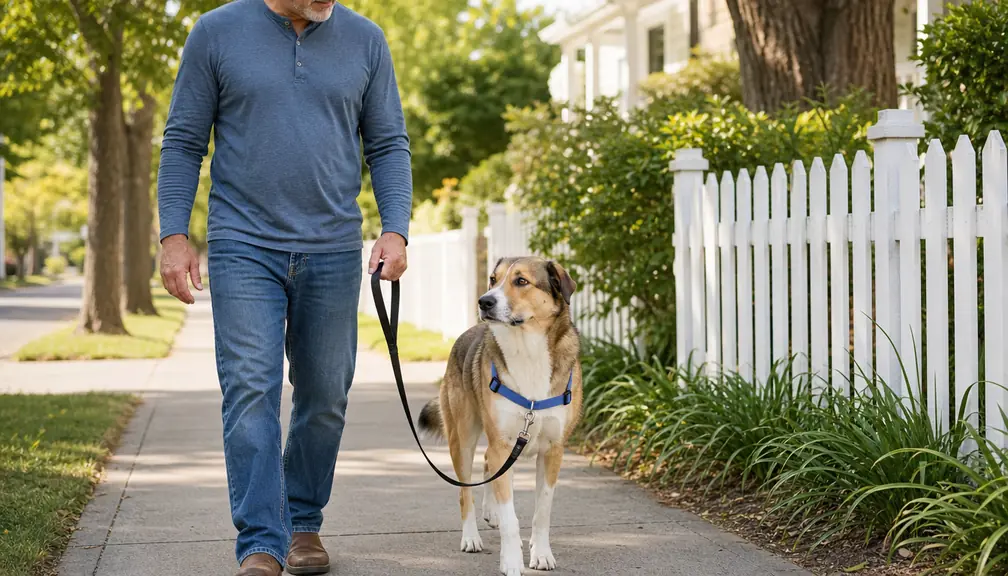
Steering, plainly. The Easy Walk has one leash ring and it sits on the chest, below the neck. When June surges forward, that front clip turns her shoulders back toward me instead of letting her drive straight ahead. The martingale loop adds a second thing: as she leans into it, the loop eases closed across her shoulders instead of letting her slide forward through the straps. Nothing about it is sharp or sudden. It just stops the pull from paying off.
The second thing it wins on is speed. Over the head, one quick-snap buckle at the shoulder, done. The belly strap is a different color from the rest of the harness, which sounds like a small detail until you are crouched on a dark porch trying to work out which side is up. PetSafe has been making this harness since a veterinary behaviorist designed it in 2004, and it shows in how little there is to fuss with. It weighs under four ounces, and the Medium is rated for 20 to 50 pounds, which puts June at 48 pounds near the top of that range.
The clearest demonstration came on a Tuesday when a squirrel crossed our path about six feet ahead. June lunged. The leash went taut, her front end swung toward me, and she ended up facing sideways with all four feet still on the ground. No cough, no jerk on my shoulder, no drama. With the collar, that same lunge used to leave me rubbing my collarbone on the walk home. I am not going to pretend she stopped wanting the squirrel. I am saying the wanting stopped moving us forward.
Where the rabbitgoo No Pull Harness Wins
Staying on the dog. Some dogs are built so that a front-clip harness with a single belly strap is a puzzle they can solve backwards. Narrow chest, wide hips, a good backward wiggle, and they are out. The rabbitgoo wraps more of the body and adjusts at more points. For a dog who has already learned that backing out of a harness ends the walk, that matters more than any steering feature.
I saw the difference in a parking lot in April. A delivery truck downshifted maybe twenty feet away, June startled, planted her feet, and reversed. In the Easy Walk, the loop snugged and held, but I could feel the whole harness shift up toward her shoulders before it caught. In the rabbitgoo there was more strap between her and the open air, and the reversal ended with a dog standing still rather than a dog halfway out. That is not a measurement. It is the difference between a near miss and a walk that continues.
The second advantage is that it does two jobs. Front ring for the structured training walk where you want steering. Back ring for the sniff-and-stroll where you just want a comfortable place to clip a leash. That is two harnesses in one, and for plenty of households that settles the decision on its own. The padding is also more forgiving on a long walk than the thin nylon webbing on the Easy Walk, which is built to be light rather than cushioned.
If your arm is what hurts after a walk, start with the front clip
The PetSafe Easy Walk is the harness I hand people first when the problem is pulling rather than escaping. One ring, one buckle, and a lot less thinking. Check the size chart before you order, because the 20 to 50 pound Medium is not right for every dog.
Amazon Check Today's Price on Amazon →A front clip does not teach your dog anything. It buys you the two seconds you need to reward the loose leash.
What the Martingale Loop Actually Does
The word martingale makes some people nervous, because it also shows up on training gear that works by tightening. This is not that. The loop on the Easy Walk is a short strap that connects the chest ring back to the body of the harness. When your dog pulls forward, the loop eases snug across the shoulders. It does not jerk, it does not choke, and it releases the moment your dog stops leaning.
What it does is take away the payoff for pulling. A dog pulls because pulling works: the smells get closer. When pulling produces a gentle snugging instead of forward motion, the behavior stops paying. That is the whole mechanism. Nothing is being corrected and nothing is being punished.
That same loop is why this design is harder to back out of than a plain front-clip strap. If your dog plants her feet and reverses, the loop closes rather than opening a gap. It is not escape-proof and I would not pretend otherwise. It just handles the average backward wiggle better than something this simple has any right to.
The Two-Week Transition Nobody Warns You About
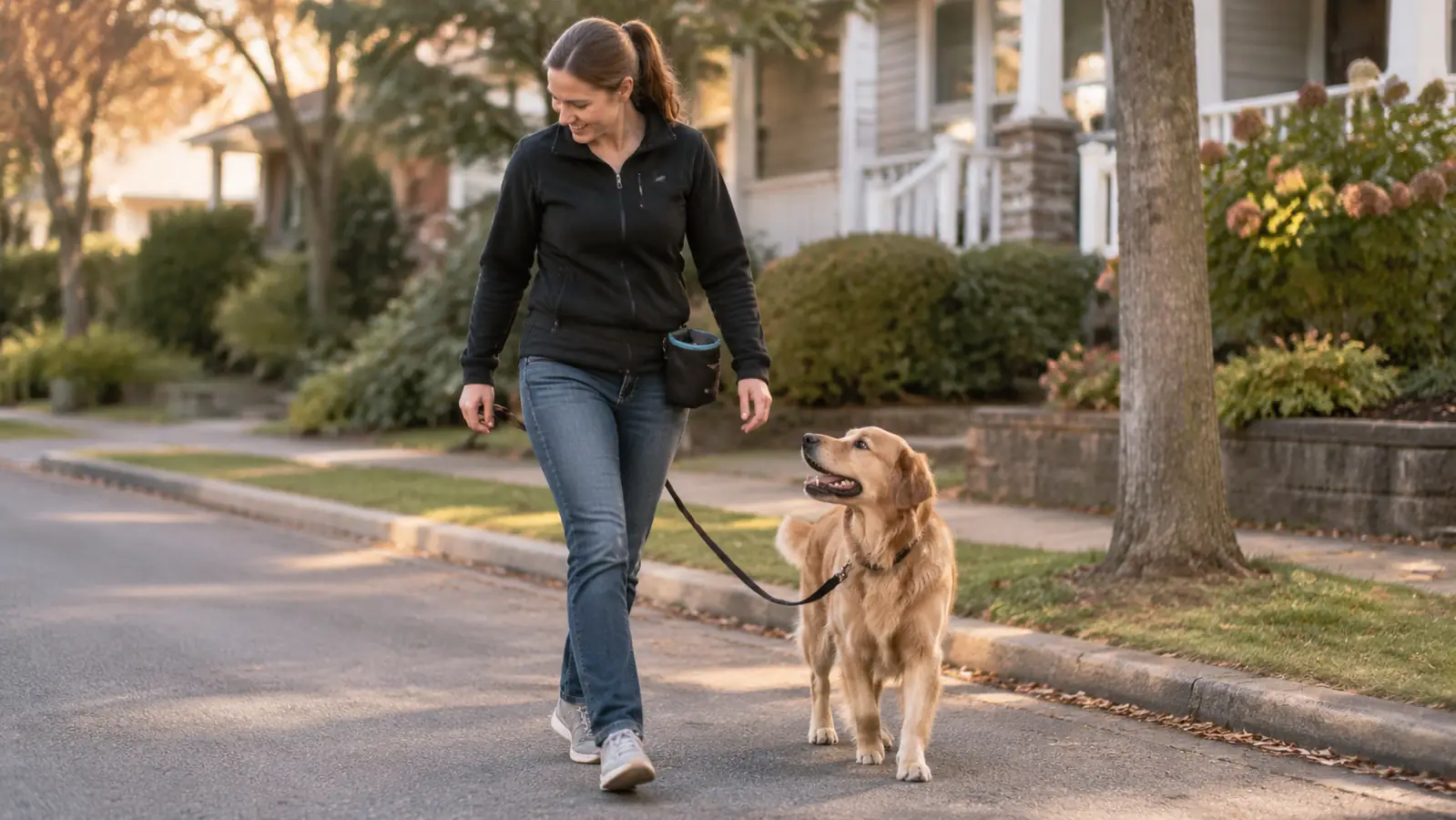
Switching to a front clip does not feel natural on day one, for either of you. The leash now hangs down your dog's chest instead of riding along her back, which means it sweeps across her front legs when she turns. Some dogs cross their feet and get briefly tangled. Most figure it out within a few walks.
The other thing that happens is the pulling gets worse before it gets better. June spent the first three days leaning into the new harness as hard as she could, testing whether it still worked the old way. It did not, and once that landed, the leash went slack in a way it never had before. If you quit on day two, you quit right before the useful part.
Day four is when most people give up, in my experience with shelter dogs and with June. The novelty has worn off, the treats feel like a chore, and your dog is still leaning at the end of the block. What actually changed for us was small: the leash went slack for maybe four seconds outside the third house on our street, and I dropped a piece of kibble between her front paws while it was still slack. By the end of that week the slack lasted long enough for me to notice it. By the end of the second week I was rewarding it without thinking about it.
Keep sessions short, reward the slack when it shows up, and do not expect the harness to do the teaching. Ten minutes twice a day beats an hour on Saturday.
The Retractable Leash Problem
Neither harness works well on a retractable leash. A flexi-lead keeps constant backward tension on the line, which means your dog is always leaning against something, and leaning is exactly the habit a front clip is trying to interrupt. Swap to a plain four or six foot leash while you are training and put the retractable away in a drawer.
Hold the leash in the hand on the same side as your dog, with the slack gathered in your fingers rather than wrapped around your wrist. It sounds fussy. It is the difference between a harness that steers and a harness that just decorates your dog.
The Fitting Mistake That Makes Either Harness Fail
Almost every complaint I hear about front-clip harnesses traces back to the fit, not the harness. The chest strap has to sit high, across the breastbone. If it slides down over the shoulders, your dog can pull against it and the steering simply stops working.
Two fingers under every strap, no more. Snug enough that you cannot rotate the harness around the ribcage, loose enough that you are not seeing rubbed hair behind the front legs. Check it again after a week, because nylon settles, and a harness that fit on day one can be loose on day ten.
And fit it with the dog standing, not sitting. A harness that looks right on a sitting dog can be wrong the second she stands up and leans into it.
What I Liked
- Front chest ring steers without any input from you
- One quick-snap buckle, so it goes on in seconds
- Belly strap is a different color, which makes orientation obvious
- Under four ounces, so it does not change how your dog moves
- One year manufacturer warranty
Where It Falls Short
- Thin nylon webbing with no padding for long walks
- Hand wash only
- Single leash attachment, so there is no back-clip option
- A narrow-chested dog can still back out of it
Who Should Buy Which
Buy the PetSafe Easy Walk if pulling is the specific problem and your dog is shaped so that a standard harness stays put. It is the simpler tool, it goes on in seconds, and it makes a loose-leash walk physically possible. Then do the training part, because the harness will not do it for you.
Buy the rabbitgoo if your dog has slipped a harness before, if you want one harness for structured training walks and relaxed sniffing walks both, or if your dog's shape has made other harnesses a fight to fit. It gives up a little of the single-minded steering of the Easy Walk in exchange for staying on and doing more jobs.
If you genuinely cannot tell, start with the fit. Measure the chest, check where your dog lands in the 20 to 50 pound Medium range on the Easy Walk, and be honest with yourself about whether she has ever backed out of anything. That answer picks the harness for you.
One ring, one buckle, and a walk you can both enjoy
The Easy Walk is not a fix. It is the tool that makes the ten minutes of training you were already going to do a lot more likely to stick. Measure the chest first and check that your dog lands inside the 20 to 50 pound Medium range before you order.
Amazon Check Today's Price on Amazon →