
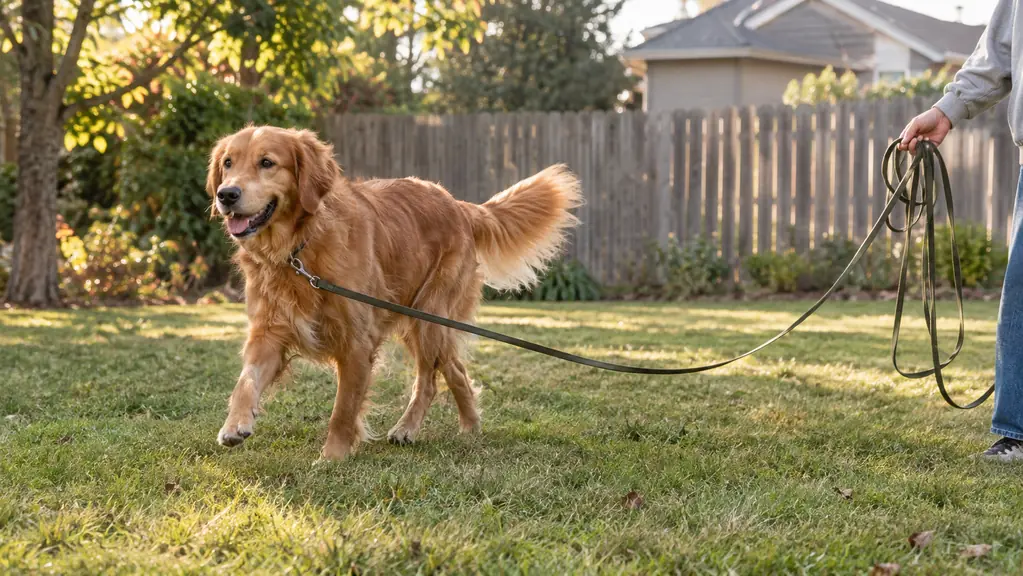
June came to us at 18 months old with a leash habit that made walks embarrassing. She is a mixed breed rescue, about 48 pounds, and the first time I clipped a standard six foot lead to her harness she hit the end of it before we cleared the driveway. For the next year I did what most people do. I bought a retractable leash, told myself the lock button was enough, and spent every walk with my shoulder braced and my wrist bent the wrong way.
The Hi Kiss 30 foot training lead is the tool that finally let me practice recall somewhere bigger than a hallway. It is 3/4 inch wide nylon, 30 feet long, with a swivel style bolt snap at the end. That is the entire product. No reel, no brake, no housing. What it buys you is thirty feet of slack for the dog to make a decision in while you keep a connection the whole time. I have used it almost daily for months, in a fenced backyard outside Wichita and along the empty edge of a park, and this is what that has looked like.
The Quick Verdict
A plain nylon long line that does one job well. The swivel snap and the 3/4 inch width are the reasons it works. The missing traffic handle and the constant line management are the reasons it is not a five.
Amazon Check Today's Price →Thirty feet of slack, one swivel snap, nothing to jam
This is the line I clip on for every recall session with June. 3/4 inch nylon, 30 feet long, swivel style bolt snap, 5.29 ounces. Simple on purpose.
Amazon Check Today's Price on Amazon →How I've Used It
First, the two dogs in the title. June is mine: 3 years old now, 48 pounds, adopted at 18 months. The other dog on this lead was never a second dog I owned. It was whichever foster was in the house that month while I put in volunteer hours for a small shelter. Foster dogs come and go, they do not get names in print, and none of them stayed long enough to matter to this review beyond one thing. A 30 foot line is the only gear I own that lets a strange dog practice coming when called at a real distance before they trust you.
The setup is boring. I clip the snap to the back ring of June's harness, never the collar, and I do not clip it to anything else. We work in the fenced backyard for about 10 minutes, twice a day, the same as every other thing I have taught her. I let the line drag. When I call her, I pick the line up off the grass and gather it rather than grabbing it tight. She gets a food reward every single time she turns around, including the times she takes four seconds to think about it.
The first session was a wash, honestly. June took the extra slack as permission to tour the entire yard and I spent ten minutes gathering nylon and about eight seconds training. What changed it was shortening the expectation, not the line. I started calling her only when she was already glancing back at me, and I rewarded the glance. Within a week she was checking in at 20 feet on her own. The lead did not teach her that. The lead made room for it.
What I do not do is yank. There is an idea going around that a long line is for correcting a dog at a distance. It is not, at least not the way I use it. The line is there so a recall can be rewarded instead of ruined. If June is 25 feet away and I call her and she ignores me, I can quietly gather the line, walk her back to me, and reward her at my feet. On a six foot leash she never gets far enough away for that to be a real rep. On a retractable she gets away and I have no way to bring her back without a fight.
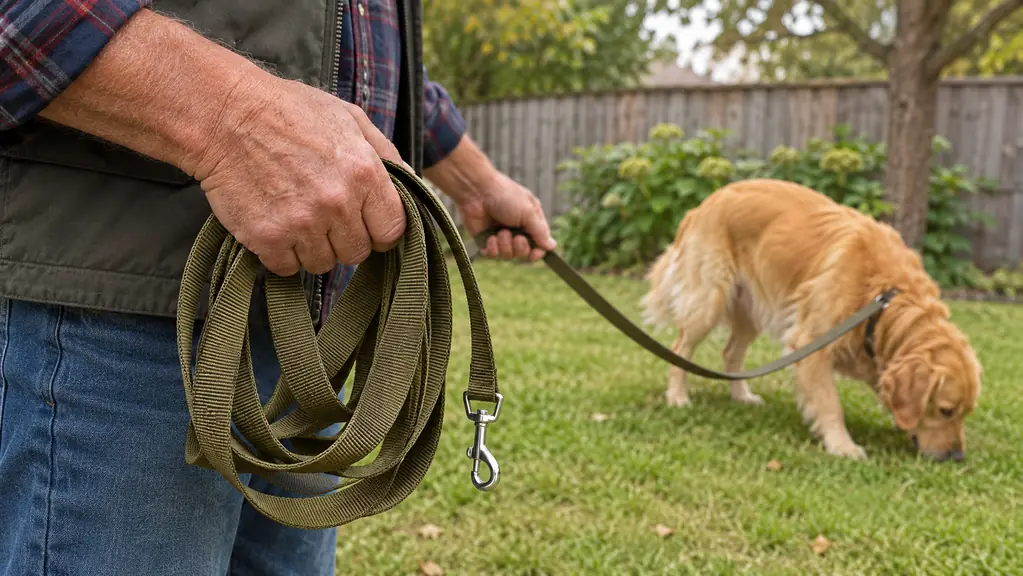
One handling note that took me two weeks to learn: I never let the line wrap my hand. I hold it in loose folds, or I lay it on the ground and step on the end when I need to stop her. Nylon under tension across a palm will burn you, and a dog hitting the end of 30 feet at a run can pull a finger out of joint. The lead itself has no stretch, which is worth saying plainly. Slack and quick hands, or nothing.
What 30 Feet Actually Changes
30 feet is roughly the width of my backyard, which is why the product makes sense for what I need. It gives June a genuine chance to make a bad choice and then change her mind. At 10 feet, a recall is a formality, because there is nowhere for the dog to go. At 30 feet there is grass to sniff, a squirrel line to consider, and a decision to make. That decision is the training. Everything else is decoration.
For a 48 pound dog, 30 feet is the length I would pick again. The Hi Kiss lead also comes in 15, 20, 50 and 100 feet. I have tried a 15 footer and it felt like a long leash rather than a long line, too short to work a real recall. A 50 footer is a different job, better suited to a field and a dog who already responds reliably, because 50 feet of wet nylon in one hand is a lot of rope to manage while you are also holding treats.
The useful test is this. Can you stand in one spot, let the dog get far enough away that you feel a small pang of doubt, and still have a way to bring them back? For June and me the answer at 30 feet is yes. At 20 feet I am too close to feel the doubt, and at 50 I am doing more rope management than training. If you are buying your first long line, buy the length that makes you slightly nervous and no longer.
The Snap, the Swivel, and the 3/4 Inch Nylon
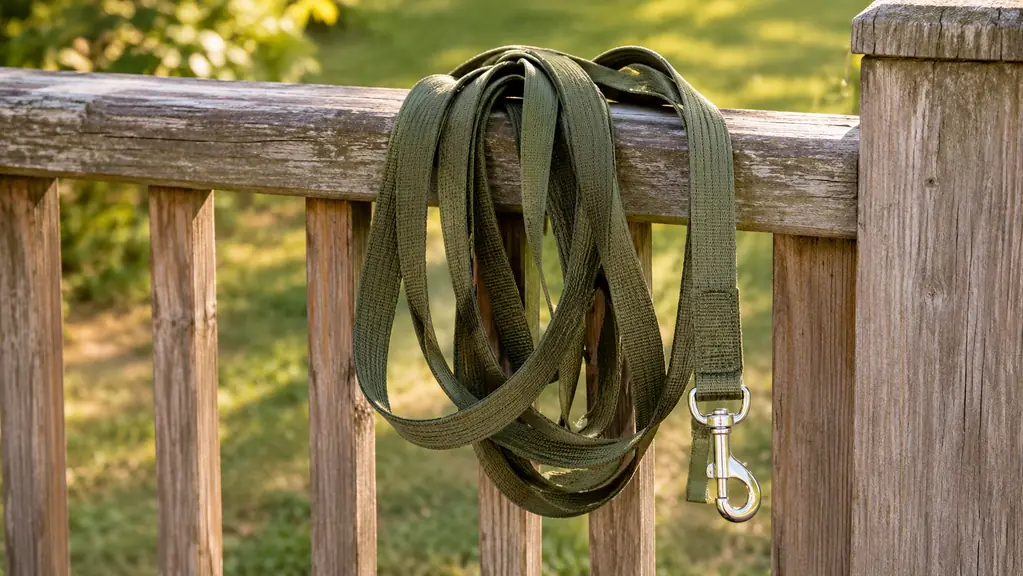
The swivel style bolt snap is the detail I did not expect to care about. A long line that cannot rotate twists into a spiral after about ten minutes of a dog circling, and a spiral of nylon whips around your legs. The swivel resists that. After months of use the snap still cycles freely and the line still falls straight when I pick it up off the grass instead of coiling on itself. If you have ever fought a twisted long line, you will understand why this is the part I would look at first.
The 3/4 inch width is the other half of why it works. It is wide enough that I can find it in the grass and get a grip in a hurry, and it is light enough that June does not notice it behind her. The whole lead is 5.29 ounces, 0.15 kg, so a 48 pound dog dragging it around the yard is not being dragged in turn. The listing puts the dog breed size at medium, and my experience agrees. This is a comfortable lead for a dog in the 30 to 60 pound range and a lot of strap for a toy breed.
The material is nylon, and it behaves like nylon. It does not soak up water the way cotton does, so a wet morning does not leave me with three pounds of wet rope. What it does do is get slick. Wet nylon in a loose fist will slide, so I am more careful about the wrap on rainy days than I am on dry ones. The snap closure has stayed shut on June's harness ring across every session, and I check it anyway, every time, the way I check a carabiner.
How It Has Held Up After Months of Daily Use
The honest report after months of near daily use: the snap works, the stitching at the snap loop has not moved, and the last few feet of the line have gone slightly fuzzy where it drags across the patio and the sidewalk. That fuzzing is cosmetic. I have not found a cut, a frayed core, or a soft spot I would not trust. I rinse it in the yard, hang it over the porch rail, and it dries in a couple of hours in Kansas wind.
The line does pick up the world. Burrs, grass clippings, a maple seed or two. It goes out clean and comes back looking like it has been doing yard work, because it has. That is not a defect of this lead specifically, it is what happens when 30 feet of nylon drags through a lawn. If dirty gear bothers you, this will bother you.
I have not had a snap failure, a stitching failure, or a break. I also would not expect one, because there is almost nothing here to break. That is worth saying out loud given how much training gear is sold with moving parts that stop moving.
Where It Gets Awkward
Line management is the real cost of a long line, and no product solves it. Thirty feet of nylon has to go somewhere. It tangles around June's back legs when she circles, it catches on a lawn chair, and it finds the one shrub in the yard every single time. My routine is to gather it in loose folds before I move and to keep it off the ground when we are near anything that could snag.
There is no traffic handle at the collar end. On a 30 foot lead that is close to unavoidable, but it means that when I need June close, in the vet's parking lot, near a road, at the front door, I am hand over handing the line to shorten it. A separate six foot leash lives by my door for exactly that reason. If you want one lead to do everything, this is not it.
The last one is a warning rather than a complaint. Nylon does not stretch, and a dog who sprints to the end of 30 feet is going to stop hard. I do not let June build speed on this line unless she is already turning back toward me. In a wide open field with a dog who bolts, that is a real risk, and no lead design fixes it. It is a handling problem, and it is on you.
What I Liked
- The swivel style bolt snap keeps the line from twisting into a spiral
- 3/4 inch nylon is easy to find in grass and light enough at 5.29 ounces that the dog ignores it
- 30 feet gives a real recall rep instead of a formality
- Simple construction with nothing to jam, unlike a retractable
- Rinses clean and dries fast
Where It Falls Short
- No traffic handle, so shortening up is hand over hand
- 30 feet of line tangles around legs and yard furniture
- Nylon gets slick when wet and has no give if a dog hits the end at speed
- Dragging it through a yard means it comes back dirty every session
- 3/4 inch width is a lot of strap for a small dog
On a six foot leash June never had a choice to make. At thirty feet she makes one, and about eight times out of ten she makes the right one.
Who This Is For
This is for the owner who has a dog with a decent foundation and no reliable recall at distance. You have taught the word at home, in the kitchen, at three feet. Now you need reps where the dog can actually leave. A 30 foot nylon long line is the simplest, least complicated way to get those reps, and the Hi Kiss version has held up to months of them.
It is also for the person doing shelter or foster work, which is where mine gets its second use. A dog you have known for a week will not respond to a leash correction and should not get one. A long line lets you reward a dog for choosing you, at a distance where the choice means something.
Who Should Skip It
Skip it if your dog has no recall at all, even at six feet. A long line does not teach the behavior, it gives you room to practice a behavior you have already started. If your dog does not come in the hallway, 30 feet of nylon will not fix that, and you will spend the session untangling instead of training.
Skip it if you want one leash for walks. This is a training tool that lives by the back door. It is not for the sidewalk, it is not for the vet, and it is not for a dog who lunges at other dogs, where 30 feet of slack is a liability rather than a help. Also skip it for a toy breed, where 3/4 inch nylon is more hardware than the dog needs.
If your dog already knows the word, give them thirty feet to prove it
3/4 inch nylon, 30 feet long, swivel style bolt snap, 5.29 ounces. The Hi Kiss lead I use for every recall session with June. Keep a six foot leash by the door for sidewalks and you have the whole setup.
Amazon Check Today's Price on Amazon →