
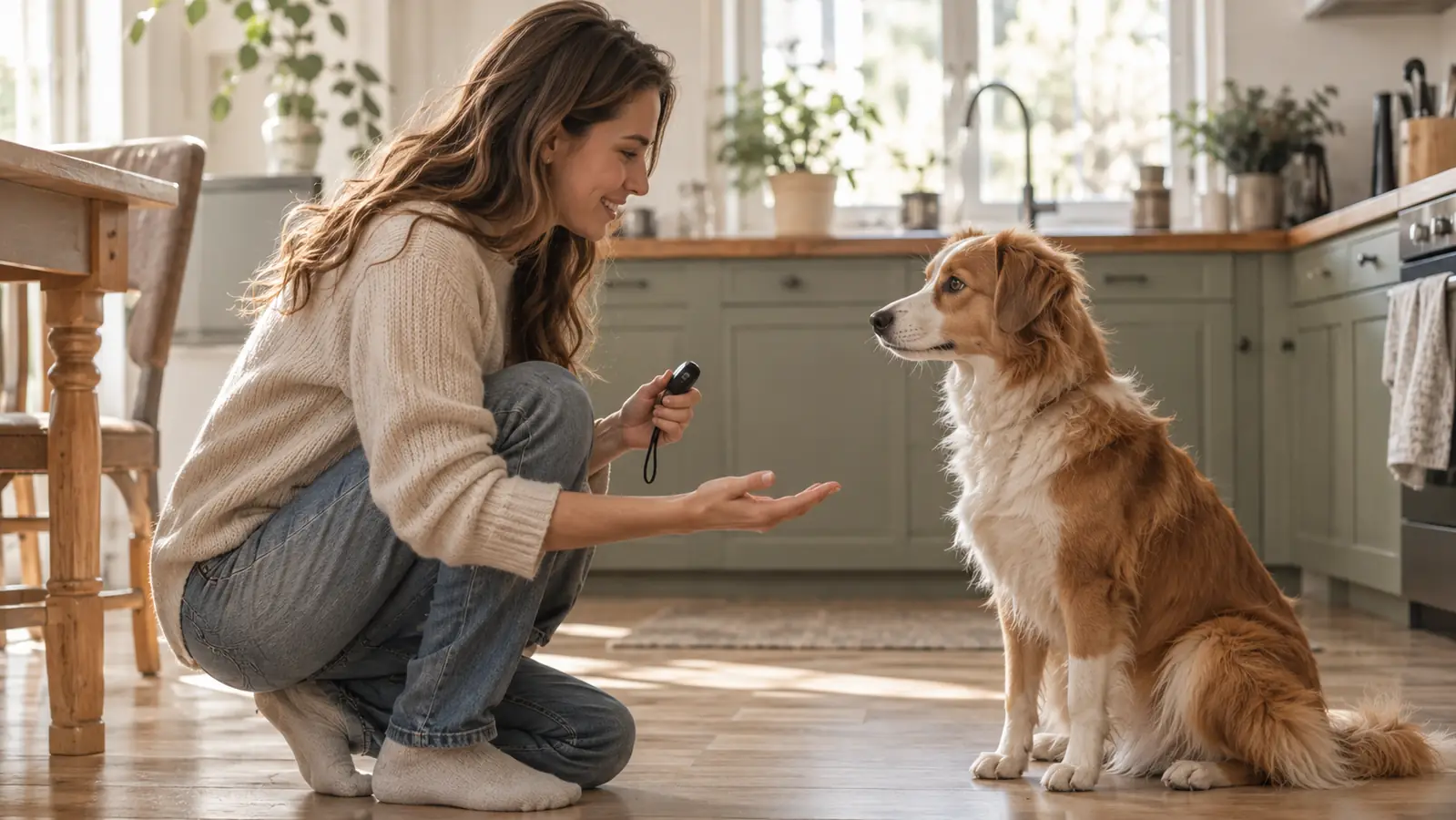
Juniper came to me at eighteen months old with a lot of opinions and no vocabulary. She pulled me down the sidewalk, shot through every open door, and barked at the front window like the mail carrier owed her money. Sit was easy enough to lure with a piece of cheese. Stay was the wall. I would say the word, take one step back, and she would already be up and following me, wagging like she had solved the problem herself.
For a long time I thought she was being stubborn. She was not. She was guessing. I was saying a word she had no clear picture of, at a moment I never defined, and then rewarding her for whatever she happened to be doing when the treat appeared. The Starmark clicker fixed the guessing part, because it marks one half-second with a sound that never means anything else. What follows is the order I use, and the order matters more than the speed. I train about ten minutes, twice a day, in the kitchen and in the fenced backyard outside Wichita. Some days it is five minutes and a lot of yawning. I kept a note on the fridge for the first three weeks, one line per session: what we worked on, how many reps, and where she fell apart. That note is the only reason I know the stay took nineteen days to hold at the front door. It felt like three months. The dog sets the pace; I just keep the sessions short enough that she stays in the game. If you want the long version of how I settled on this clicker after months of daily use, the Starmark clicker review covers that ground. Here I want to keep it practical.
One sound, one meaning, no room left to guess
The Starmark Pro-Training Clicker is a small, lightweight tool that fits comfortably in your hand and attaches to a keychain when you are not using it. Ten focused minutes with a clear marker beats an hour of repeating yourself.
Amazon Check Today's Price on Amazon →The Sequence, Step by Step
Step 1: Load the Clicker Before You Ask for Anything
The clicker has to mean food before it can mean anything else. For the first two or three days I did nothing but click and treat. Click, hand over a pea-sized piece of chicken. Click, treat. Ten clicks in a row, then stop. No cues, no sits, nothing asked of the dog at all. I did this in the kitchen while the coffee brewed, and in the backyard while she sniffed the fence line.
I counted out twenty pea-sized pieces of baked chicken into a small bowl before each round, because running out of food mid-session is the fastest way to teach a dog that the click is unreliable. Twenty pieces, twenty clicks, then the bowl goes in the sink and we are done. If she was still interested, I stopped anyway. The stopping is the part I had to learn. A dog who walks away from a session still wanting more is a dog who shows up eager the next morning.
What you are building is a prediction. The sound comes first, the food always follows, every single time, no exceptions. By the end of day two, June's head was snapping around at the click because she had already learned that the sound was the front half of the payment. That is exactly where you want to be before you teach anything. On day three I tested it by clicking while she was facing the other way, and she spun around and stared at my hand. That was the whole exam, and she passed it.
Two mistakes show up here constantly. First, do not click without feeding. Every click owes a treat, including the ones you fire by accident. Second, do not use the clicker to get attention or to interrupt barking. A marker that sometimes means food and sometimes means stop is a marker that means nothing. If you need her attention, say her name. Save the click for the moment you want to keep.
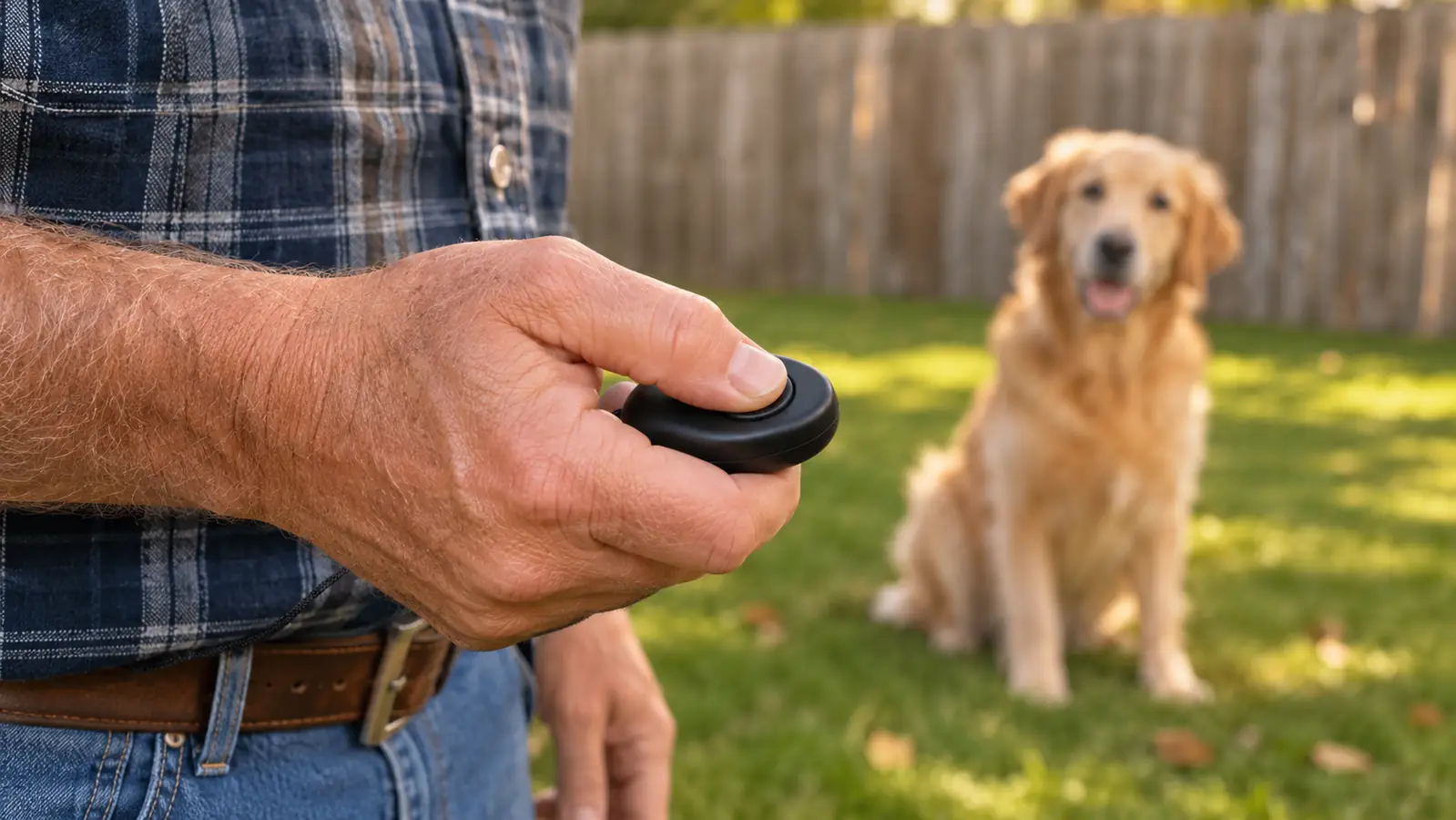
Step 2: Capture the Sit Instead of Pressing On It
I never push a dog's back end down. It works in the moment, and it teaches the dog that hands near the hips are something to lean away from. Instead, I wait. A dog sits a dozen times an hour on her own, and the clicker lets you catch it. Stand still with food in your hand, watch her, and the second her rear touches the floor, click and treat.
June figured this out in about four minutes. The first sit was an accident. The third one was a decision. Once I was getting a sit within a few seconds of standing still, I added the word. Say sit, pause half a beat, wait for the rear to land, click, treat. The order is cue, behavior, click, reward. The click always comes after the behavior and before the food, and the word always comes first.
Keep the sessions short and end while she is still offering the behavior. I stop at maybe eight or ten reps. If she starts lying down to beat me to the click, that is a sign to reset, take a break, and come back in an hour. Lying down is not defiance, it is a short cut she invented because the floor is more comfortable than waiting. A dog who is guessing is fine. A dog who is guessing wildly means the picture got muddy somewhere, and the fix is fewer reps with better timing, not more reps with louder words. I learned that one the hard way on a rainy Saturday in March, when I pushed for one more round and got a dog who would not sit at all for the next two days.
Step 3: Put Stay on a Duration Ladder
Stay is not one behavior, it is three things stacked: duration, distance, and distraction. Almost every dog I have met who can hold a stay for a minute in the kitchen falls apart at six feet, because the trainer practiced all three dimensions at once. I build them one at a time, starting with duration, since duration is the only one you can practice without moving.
The ladder looks like this. Ask for a sit, wait one second, click, treat. Then two seconds. Then three. When she can hold three seconds nine times out of ten, go to five. I count out loud under my breath, which sounds silly and keeps me honest, because it is easy to stretch a three second hold into six when you are the one holding the leash and hoping. I click while she is still holding, never after she breaks. That is the part that matters. The click has to land during the good behavior, or you are paying her for standing up.
Two weeks in, June held a sit at the front door for eleven seconds while I carried in groceries. Eleven seconds is not a brag-worthy number. It is the number where she stopped guessing and started waiting.
Progress is not a straight line. June had a week where she could hold for twenty seconds on Tuesday and could not hold for two on Thursday. Nothing was wrong with her. I had been practicing in the same spot at the same time with the same treats, and she had learned the spot, not the behavior. I moved to a different room and started the ladder at one second again. That reset took about a day and a half, and this time it stuck.
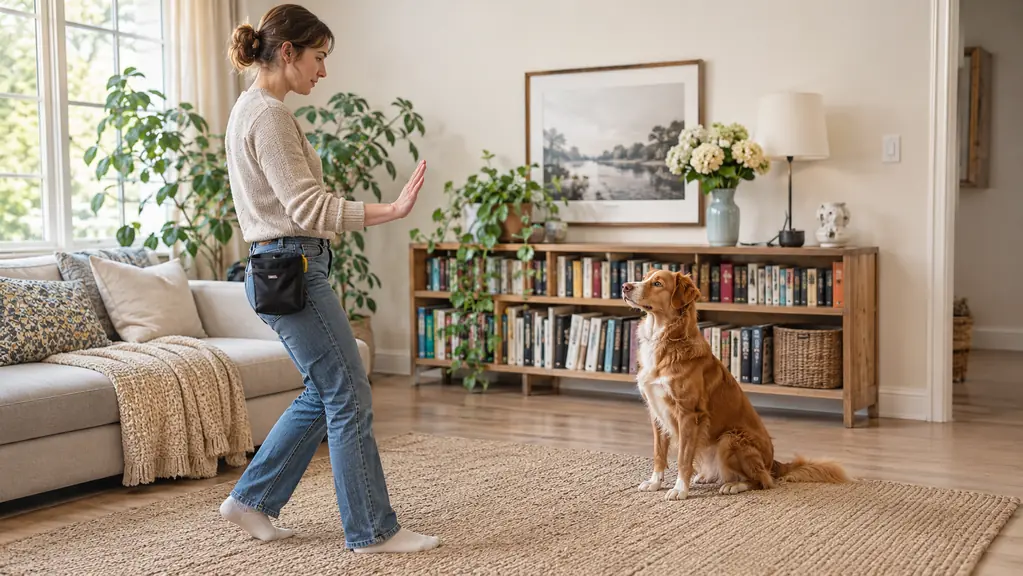
Step 4: Add Distance, Then Distraction, Never Both
Once she is holding reliably for ten seconds, start moving. One step back, click, return to her to deliver the treat. Returning matters. If the treat always arrives at your body, the dog learns that coming to you is part of the job, and the stay quietly turns into a recall. Deliver where she is holding.
Take one step back for a week if that is what it takes. Then two. Then three. When you can get six or eight feet away and back without her breaking, add one distraction at a time: a dropped spoon, a door opening, a person walking past the fence. I treat distraction as its own separate ladder, and I pull distance back to almost nothing while we work on it.
The dropped spoon was a disaster the first time. She broke, I clicked late, and she got paid for standing up. We went back to two seconds and no spoon for the rest of that session, and the next day I dropped the spoon while she was already holding, not as a surprise but as background noise she could ignore. By the end of that week the spoon did not move her. A door slamming still did, so the door got its own week.
This is where the clicker earns its keep. A dog breaking a stay is usually not defiant, she is unsure when the job ends. The click tells her, in the exact second she is correct, that this is the thing. The sound beats your voice because it does not change with your mood and it does not have to travel across a room to be understood. If you have wondered whether a marker word would do the same job, I wrote about that comparison in the clicker versus verbal marker piece, and the short version is that both work if you are consistent. I like the clicker because I cannot accidentally put a tone of voice in it.
Step 5: Install a Release Word and Practice It in Real Rooms
A stay with no release is a dog who has to guess when she is free, and guessing leads to creeping. Pick one word and never use it for anything else. I use free. Sit, hold, and then free means the job is over and the treat is coming. I practice the release far more often than I practice the stay, because a clean release is what keeps the stay from turning into a slow crawl toward me.
Then take it into real rooms. The front door with a delivery arriving. The kitchen while I am moving around. The backyard with the neighbor's dog carrying on behind a fence. Each new place starts the ladder over: short duration, small distance, click early and often. That is not a setback, it is how the behavior generalizes.
The front door took the longest. I set up six reps with the door closed, then six with it open a crack, then six with me standing on the porch. Nineteen days from the first click to a stay she held while I carried in two bags of groceries. I did not plan it that way, that is just when it stopped being work for her. The mail carrier still gets a bark, but she barks from a sit now, which I count as a win.
One more thing about rewards. I keep the food small and I keep it good. Half a pea of chicken or cheese, deducted from her dinner if we have done a lot of reps. Sessions should look like a game, not a transaction. When I notice myself getting short with her, the session is over. The clicker is a tool for being clear, and it does not work if the person holding it is annoyed.
What Else Helps
Timing is the whole skill, and timing is easier with a marker that sounds the same every time. The Starmark Pro-Training Clicker uses a stainless steel clicker element that will not rust, which matters in a house where the thing lives in a coat pocket through a Kansas winter. It is water resistant, measures about 2.3 by 1.5 by 0.8 inches, and weighs a little over a third of an ounce, so it does not turn into a lump in your palm during a ten-minute session.
A word on what a clicker will not do. It will not teach the dog for you, and it will not fix a stay that has been practiced three times. The tool is a marker, and a marker only works if the reward behind it is real and the sessions are frequent. Ten minutes twice a day for three weeks will do more than an hour on a Saturday, every time.
If you are deciding between a clicker and a marker word, or wondering whether you need the gear at all, the two pieces I mentioned above cover both questions in more detail. And if you are working with a dog who has a bite history or serious fear issues, a clicker is not the answer, and a qualified trainer who uses positive methods is. There is no shame in that. I needed help with June's window barking and I have never regretted the call.
Ten minutes, twice a day, one clear sound
You do not need a training degree to teach sit and stay. You need timing, short sessions, and a marker that means exactly one thing. The Starmark Pro-Training Clicker is small enough to live in a coat pocket and built to stay there.
Amazon Check Today's Price on Amazon →