Recall is the one cue that has to work when everything else is falling apart. June, my three-year-old mixed-breed rescue, will sit for a squirrel. She will not always come for one. That gap is the whole problem, and it is not a stubbornness problem. It is a practice problem.
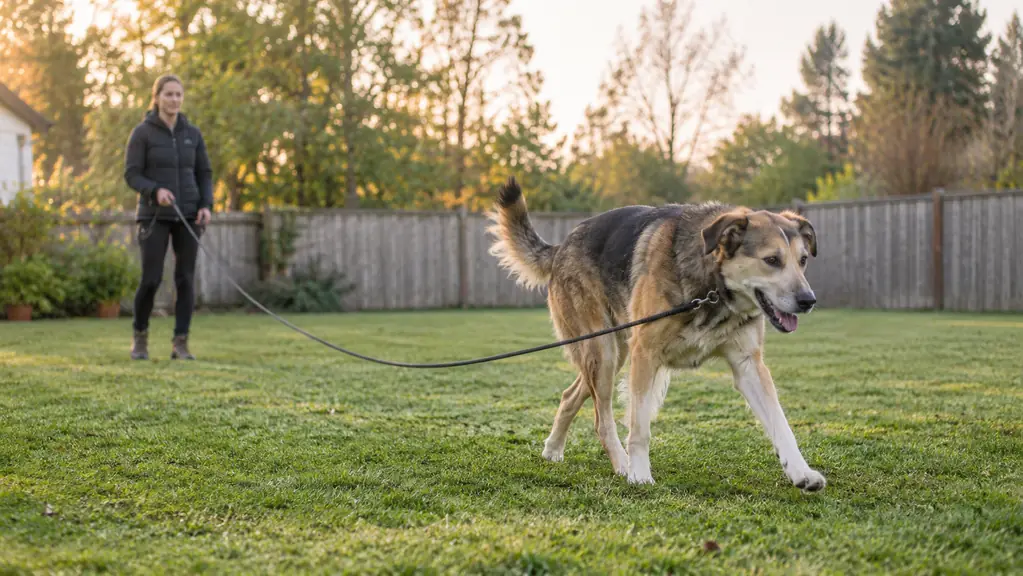
Think about how recall usually gets taught. You stand in the kitchen, say her name, she wanders over, you hand her a piece of chicken. Fine so far. Then you take her to an open field, unclip the leash, call her once, and watch her pick a smell over you. She is not being defiant. She has practiced coming back from four feet away a few hundred times, and she has practiced ignoring you from forty feet away exactly once. Dogs get good at whatever they rehearse. A long line lets her rehearse the right thing at a distance where it actually counts, without the risk of her rehearsing the wrong thing near a road. I use the Hi Kiss training lead for this work, 30 feet of flat nylon, and it has done more for June's recall than any treat upgrade I have tried.
Here is the sequence I would follow if I were starting over tomorrow with a dog who already knows how to ignore me.
The thirty feet where recall actually gets learned
3/4 inch nylon, a swivel-style bolt snap that resists twisting, and long enough for a real test. This is the line June learned on.
Amazon Check Today's Price on Amazon →Why Most Recall Training Fails
The usual failure is not a bad dog. It is a training ladder with the middle rungs missing. People practice recall at two feet in the kitchen and then expect it at fifty feet in a park with ducks. There is no bridge between those two situations, so the dog guesses, and her guess is usually correct: the park is more interesting than the person.
The second failure is repetition without consequence. Saying come, come, come while the dog sniffs a bush does not teach the dog to come. It teaches her that the word is a thing humans say while she is busy. Every cue you say out loud and do not follow through on loses a little value, and you cannot buy that value back with better treats. You get it back by only saying the word when you can make it true.
Before Step One: Set Up the Line Right
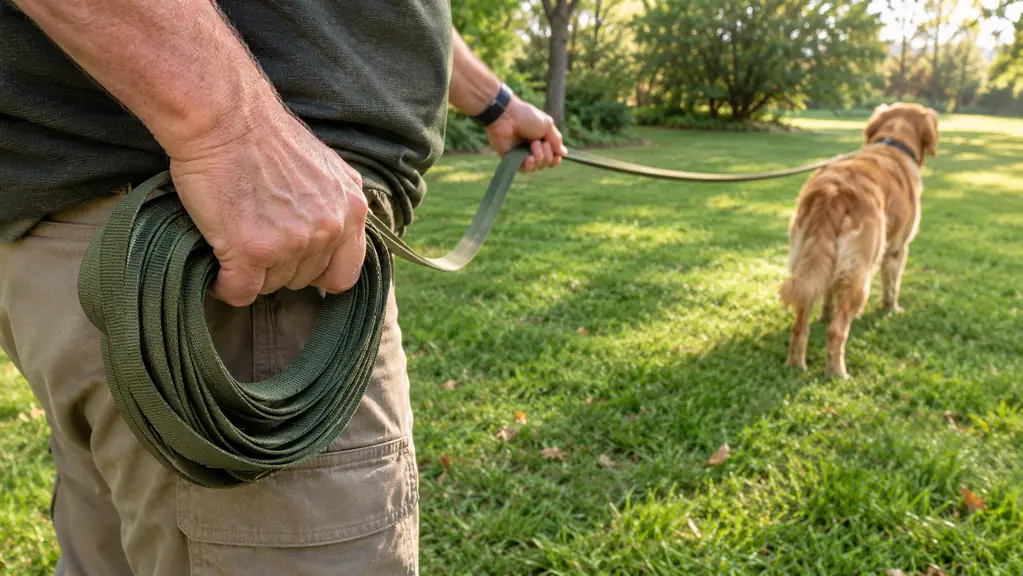
A long line is not a retractable leash with extra length. A retractable keeps constant tension on the dog and has a brake that can jam or burn your hand. A training lead is a fixed length of flat nylon with a snap at one end and nothing mechanical to fail. The Hi Kiss lead measures 3/4 inch wide by 30 feet long, it is made of nylon, and it uses a swivel-style bolt snap that resists twisting. It weighs about five ounces, which matters, because the dog drags a good part of it around the yard.
Thirty feet is the right starting length for a dog June's size, roughly 48 pounds. It is long enough that she can make a real choice twenty feet out and still be safe, and short enough that I can gather it back in a few seconds. The snap closure clips to a harness, and I use a harness rather than a collar for this work. A dog hitting the end of any line at speed should not take that jolt on the throat.
Before you clip anything on, walk the yard. Look for fence gaps, gates that do not latch, and anything a line can wrap around. Then put on closed shoes and a pair of gloves. Nylon moving fast across bare skin leaves a mark, and I learned that the ordinary way, on a cold morning, with a foster dog who spotted a rabbit before I did.
Step 1: Charge the Cue Indoors, Six Feet at a Time
Pick one word. I use 'come.' Not the dog's name, because you will say her name a hundred times a day for reasons that have nothing to do with recall. The cue has to mean one thing and only one thing: get to the person, right now, and get paid for it.
Start in the hallway with no line and no distractions. Say the word once, then take two steps backward. When she reaches you, reward at your feet, not out in front of your knees where she can grab the food and leave. Ten repetitions, twice a day, for about a week. My sessions with June run ten minutes and I stop while she still wants more. Ending early is not laziness. It is how the cue stays valuable.
The discipline here is not saying the word when you cannot back it up. If she is asleep, do not call her. If she is eating, do not call her. If you are already late for work, do not call her. You are building a bank account of trust in one word, and every unanswered call is a withdrawal.
Step 2: Move Outside With the Line Attached
Once she beats you to the hallway every single time, clip the Hi Kiss lead to the harness and go into the fenced backyard. Let the last ten feet drag on the grass. Walk backward, say the word once, and reward the moment she arrives at your feet.
The first few sessions, keep the distance silly short. Six feet. The point is not to test her. The point is to make coming to you the easiest, best-paid behavior in the yard. If she gets there and you are still fumbling in your pocket, you have taught her that arriving is a coin flip, and a coin flip loses to a good smell every time.
Stand still while she eats the reward, then release her with a word of your own, something like 'go sniff.' If the only thing that happens after a recall is more training, she will start dodging the cue. Coming to you should be the doorway to something she wanted anyway.
Step 3: Add Distance, Then One Distraction at a Time
Distance first. Let out another five feet, call once, reward. Keep going until she is coming from twenty feet in a quiet yard with nothing else going on. That might take two weeks or it might take two months. June took about five weeks, and she was already two years old with a long history of deciding I was optional.
Then add one distraction. One. A person standing still at the far end of the yard. A food bowl set down on the deck. A toy lying in the grass. If she breaks toward it, do not repeat the cue. The line is already doing its job. Wait a beat, make yourself more interesting, back up, and reward the instant she turns her head. Repeating the word teaches her that the word is background noise.
The pattern is always the same: easy, then slightly harder, then easy again. If she fails twice in a row, you moved too fast. Shorten the distance, remove the distraction, and end the session on a win so you both walk inside feeling like it worked.
Step 4: Handle the Line So Nobody Gets Hurt
The long line is equipment, and it deserves the same respect as a hot pan. Gather it in loose loops at your side and never wrap it around your hand. If thirty feet of nylon goes tight with a running dog on the end, a looped hand is how people break fingers.
Keep the line low and clear of the dog's legs, and let it drag on the grass when you are not using it. When you need to stop her, step on the line instead of grabbing it, and let it slide under your shoe. If she is already at a dead run, letting go is safer than holding on. A loose dog in a fenced yard is a problem you can fix. A burned hand is not.
Watch the wrap. A dog can circle a tree, a lawn chair, or your own ankles in about a second and a half. If the line goes around something solid, walk to the dog rather than pulling against it. When you are finished, check the snap and the stitching. Nylon is durable, but it is not indestructible, and a chewed line is a broken line waiting to happen.
Step 5: Proof It in New Places, Then Fade the Line
A recall that only works in your own backyard is a party trick. When the yard version is solid, take the line somewhere new at a quiet hour. A park at seven in the morning. The parking lot of a closed business. Let her sniff for a few minutes, then call once from ten feet and pay well.
New places reset the difficulty, and you should expect her to act as if she has never heard the word in her life. That is normal, not failure. Go back to short distances and rebuild for a few sessions. Every new location is a new skill until proven otherwise.
Fading the line is the last step, not the first. I let the line drag on the ground for a week or two before I unclipped it, and only inside a fenced area. Even now, June stays on the line anywhere near a road, a parking lot, or livestock. The line is not a beginner tool you graduate from. It is the seatbelt.
A dog who gets called and does not come has just practiced not coming. There is no neutral version of that moment.
What Else Helps
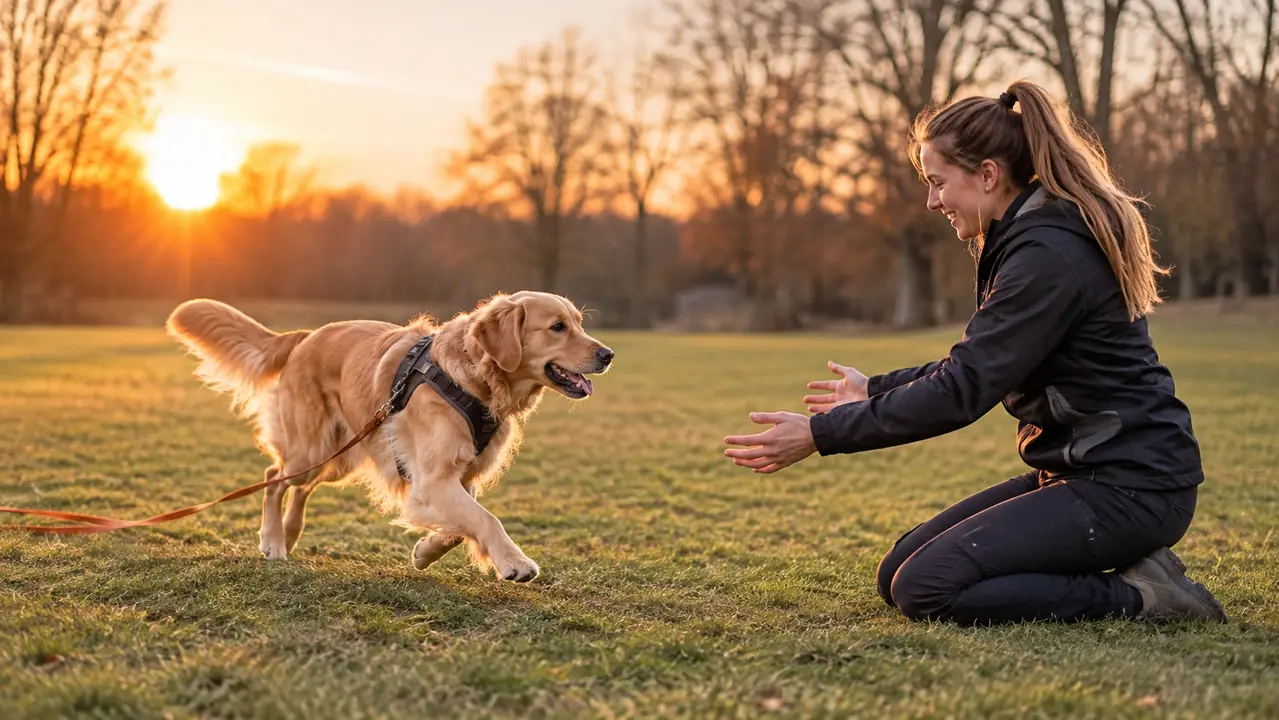
Reward value beats reward quantity. June will work for kibble in the hallway and will not cross a field for it. When I need a real recall, I use actual chicken or cheese, cut into small pieces, and I use the good food only for recall. That food comes to predict the best part of her day, which is the entire mechanism.
Never call your dog for something she dislikes. If it is bath time, nail trimming, or the end of the park, go get her instead of using the word. Save the cue for things that end well, and never let it become the sound that announces a bath.
Get everyone in the house on the same word and the same rules. One person saying come and another saying here is two half-trained cues, and the dog is not the one who is confused. Keep sessions short, twice a day, and stop before either of you gets sloppy.
And be honest about what a product can and cannot do. The Hi Kiss lead does not teach recall. It gives you a safe way to practice recall at a distance, which is the part most people skip because it feels risky without one. The teaching is still the rewards, the timing, and showing up twice a day. I have used the Hi Kiss lead on every foster dog that has come through this house, and it has held up. That is all I ask a piece of nylon to do.
Thirty feet of nylon, two short sessions a day
Recall is built at a distance, not in the kitchen. The Hi Kiss training lead is 3/4 inch wide, 30 feet long, and light enough for a dog to drag. Give the practice somewhere to happen.
Amazon Check Today's Price on Amazon →