
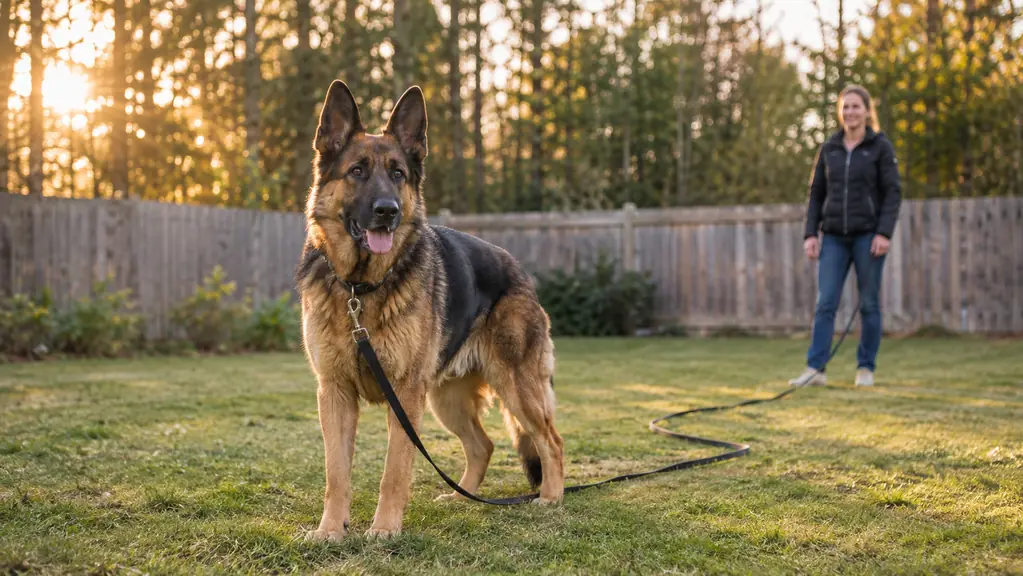
I bought a retractable leash before I bought anything else. June was eighteen months old when I adopted her, a forty-eight pound mixed-breed rescue who pulled hard enough to make my arm ache, and the retractable felt like the obvious answer: press a button, get more line, press again, take it back. It took me most of a year to understand that a retractable keeps a little tension on the dog at all times, which means a dog who already pulls keeps getting paid for pulling. The Hi Kiss 30 foot training lead works the other way around. It is a fixed length of 3/4 inch nylon with a swivel-style bolt snap on the end, and it teaches by handing the dog slack.
Short answer first, since that is what you came for. If the problem is recall or pulling, the Hi Kiss lead is the better tool and it is not close. Thirty feet of line on the ground lets a dog learn what a loose leash feels like, gives you room to practice a real come from a real distance, and gives you a physical backstop that stops a dog without yanking a neck. If the problem is none of those things, if your dog already walks politely and you just want a tidy walk around the block, a retractable is easier and I will not argue with you.
| Hi Kiss 30 Foot Training Lead | Retractable Leash | |
|---|---|---|
| Length control | Fixed 30 feet. You gather the line in loops or let it drag. | Trigger lock sets almost any length in a second. |
| Recall practice | Dog drags the line, you step on it and reward the turn back. | Housing adds drag, and the dog feels the mechanism on every step. |
| Line tension | Slack when the dog is close, so a loose line becomes normal. | Constant light tension, which pays the dog for pulling. |
| Hand and leg safety | 3/4 inch webbing is easy to see and easy to grab. | Thin cord burns hands and cuts across legs. |
| Shortening mid-walk | Loop it over the hand or step on it. Takes practice. | One thumb press. |
| Storage | Coils into a bag at 5.29 ounces. | Bulky handle, but self-contained. |
| Best use | Recall, distance work, fenced yard, camping. | Casual walks with a dog who already has manners. |
Where the Hi Kiss 30 Foot Training Lead Wins
Here is the mechanism, and it matters more than any feature list. A retractable leash pays out line only when the cord is under tension, so the dog learns that leaning forward earns forward movement. Every step is a small lesson in pulling. The Hi Kiss lead has no mechanism at all. The line lies on the grass behind June, and when she stays inside thirty feet there is nothing pulling on her. A loose leash becomes her normal state instead of a rare compliment. That single difference is why I stopped fighting the tool and started making progress with the dog.
Recall is where the length earns its keep. In a fenced backyard, thirty feet is enough distance to make come a real behavior instead of a formality performed two feet from my knees. I stand near the gate, June sniffs the far corner by the fence, and I call once. If she comes, she gets food and a small party. If she does not, I walk down the line and step on it. Stepping on 3/4 inch webbing stops her without a jerk, without a correction, and without her collar taking the load. Then I wait, she turns around, and we try again from a shorter distance. The first time I tried this, in March, I made the mistake of calling from the porch steps while June was mid-sniff at the compost pile. She ignored me for a full thirty seconds. I counted. So I walked the line down, stepped on it about eight feet from her, and stood there like a person waiting for a bus. When she finally turned, I rewarded the turn, not the earlier silence. Two weeks later she was checking back on her own before I called.
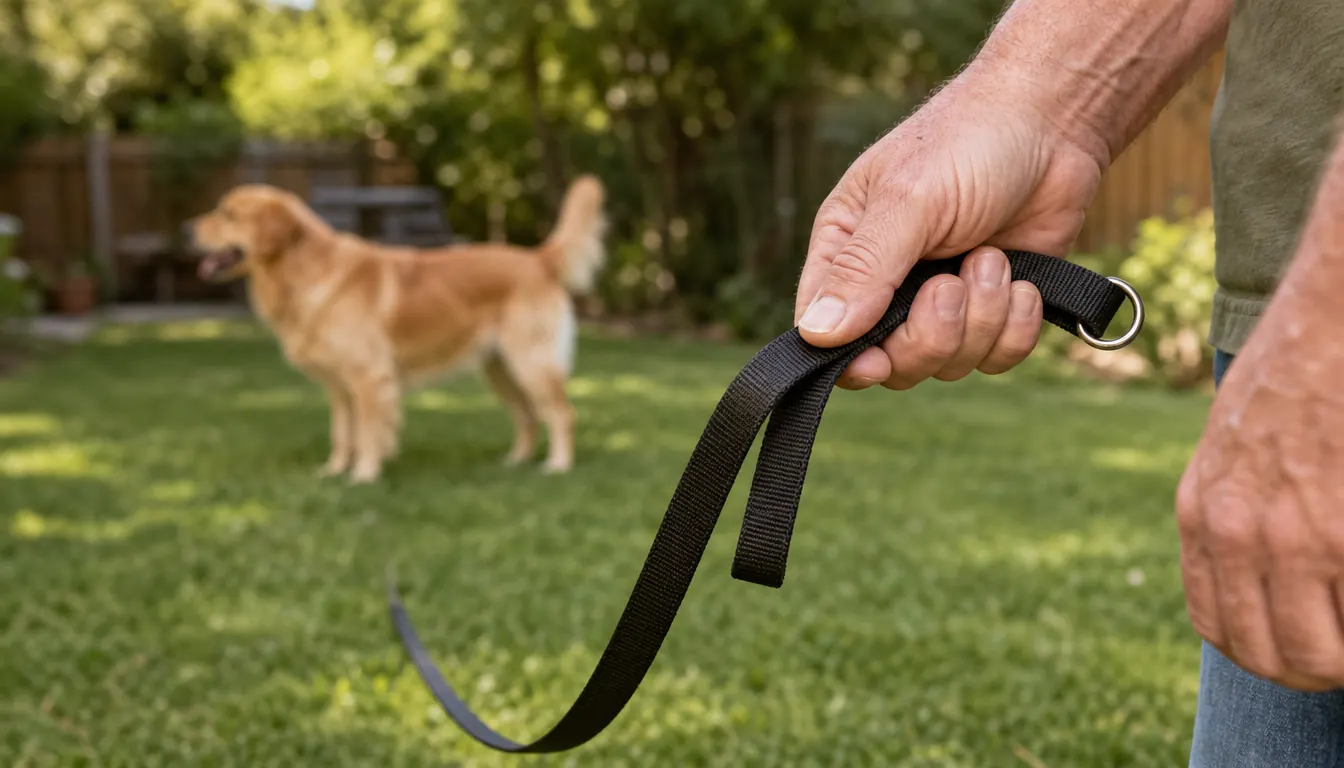
The hardware is unglamorous in the way I want hardware to be. The swivel-style bolt snap resists twisting, so the line does not corkscrew into a braid every time June circles. The webbing is 3/4 inch wide, wide enough to spot in tall grass and wide enough to grab without wrapping anything around my fingers. The whole lead weighs 5.29 ounces, so it disappears into a jacket pocket when we are done. None of that makes a dog come when called. It just means the tool is never the reason the training fails.
Where a Retractable Leash Wins
A retractable leash does one thing better than any long line: it shortens on demand. When June and I round a corner and a car is backing out of a driveway, my thumb moves and she is at four feet. With the long line I have to gather thirty feet of wet nylon in loops while also holding a treat pouch and also watching the car. I have gotten faster at it. I have not gotten fast. On a sidewalk with traffic, that difference is real and I am not going to pretend otherwise.
There is also the plain tidiness of it. The retractable is self-contained. The handle holds the line, the line does not drag through mud, and nothing has to be hung over the porch rail to dry when we come in. Mine lives in the car for vet parking lots and the pet store, both places where I want June close, quiet and quick. Used that way, a retractable is a fine management tool. It only becomes a problem when it is asked to do a training job it was never built for.
Slack teaches faster than a trigger ever will
The Hi Kiss 30 foot training lead does the one job a retractable cannot: it lets your dog feel a loose line. Fenced yard, food rewards, ten quiet minutes at a time.
Amazon Check Today's Price on Amazon →What 30 Feet Actually Changes at Home
Distance changes the emotional temperature of a session. When June was on a six foot leash in our yard, every exercise happened inside my shadow, and she was mostly reading me instead of making a choice. At thirty feet she has room to wander, sniff, and decide. That decision is the whole point. A recall practiced at four feet teaches a dog to come because you are standing right there. A recall practiced at thirty feet teaches a dog to come because coming is worth more than whatever she is sniffing.
The drag is the quiet part. The line trails behind the dog, so she feels a small weight that is not attached to a person. When she reaches the end, nothing yanks. The line simply stops, and she learns where the edge of the world is. I have watched June test that edge, feel the stop, and turn back on her own without me saying a word. That is the difference between a dog who is restrained and a dog who is choosing. The choosing is what survives when the leash comes off. I measured it once out of curiosity. From the gate to the far fence is a little over thirty feet, which means June can reach the compost pile and not the neighbor's driveway. That is the exact margin I wanted when I chose this length instead of the twenty foot version.
It also gives me a backstop that does not involve my voice. If June blows off a recall to chase a squirrel, I do not shout and I do not reel her in. I step on the line, wait for her to stop, and then walk to her instead of calling her back to me. Walking to her keeps come from becoming the word that means the fun ends. The line makes that possible because there is something to step on. This is not a complicated idea and it needs no special method, just a long piece of nylon and the patience to use it slowly.
The first time June hit the end of thirty feet of nylon and nothing jerked her backward, she stopped, turned around, and looked at me. That look is the whole reason I kept going.
How I Use It With June
We work twice a day, about ten minutes each session, in the fenced backyard, with a pouch of tiny food rewards. The sessions are short because June is three years old and still gets distracted by the neighbor's gate, and because ten minutes of real focus is worth more than forty minutes of me repeating myself. I start with the line gathered to about fifteen feet and let it out as she succeeds. By the end of a good week she is working at the full thirty. Bad weeks happen. I shorten the line and we start over. The pouch holds about forty pea-sized pieces of chicken, and when the pouch is empty the session is over. That rule keeps me honest. In January I let a session run long because June was doing well, and by the end she was blowing off the tenth recall while I was still asking for it. Now the timer on the stove goes off at ten minutes and we stop while she still wants more.
The first exercise is not come. It is walking together on a slack line while I change direction. If June follows my turn without the line going tight, she gets food. If the line goes tight, I stop moving. She has to come back and give me slack before we go anywhere. The Hi Kiss lead makes this legible, because thirty feet of webbing draped on the grass is either tight or it is not. There is no arguing with a taut line.
The second exercise is the recall, and the order matters. Say the name once, then the word come, then run backward a few steps like a person who has lost their mind. June thinks it is a game. She gets food at my feet rather than snatched from my hand, and then she is released to go sniff again. Releasing her is the part people skip. A recall that ends the fun is a recall the dog learns to avoid, and a dog who avoids recall is a dog who stays on the line.
The Tradeoffs Nobody Mentions
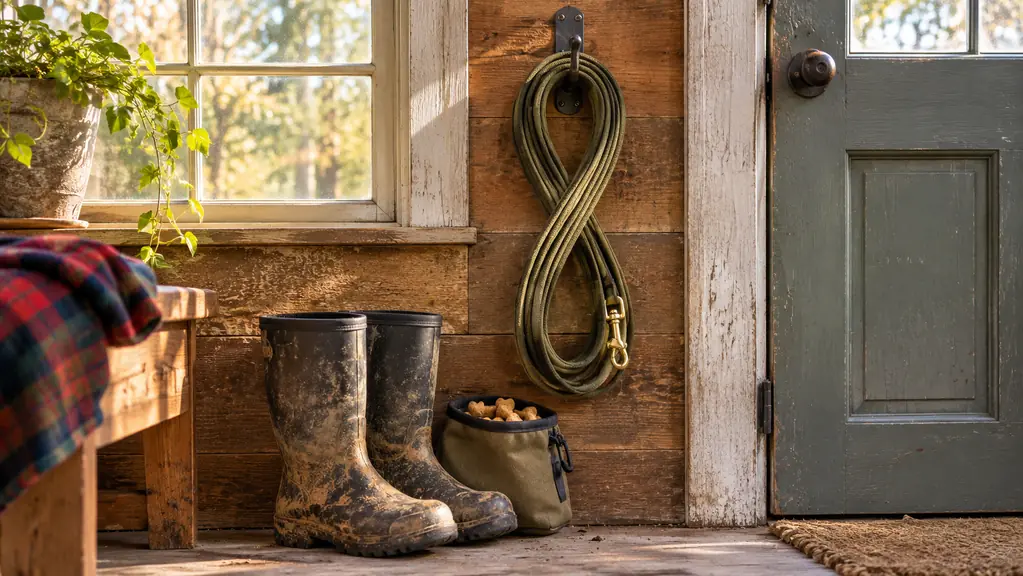
A long line is a management job. It tangles around chair legs, it knots when it is coiled wet, and it collects mud, burrs and whatever else is in the yard. In our first month I spent more time untangling than training. The first coil I ever made took me four tries. Wet webbing does not want to hold a shape, and I hung it over the rail in a loose bundle instead, which meant the next morning I spent five minutes picking apart a knot the size of my fist. The figure eight fixed it. So did a hook by the back door, high enough that June cannot reach it. Never wrap any part of a leash around your wrist. Palms only, and let the line run if a dog bolts.
Thirty feet is also too much line for some spaces. In an unfenced front yard, or on a narrow sidewalk, the length is a liability and a six foot leash is the better call. And while webbing sliding through grass is harmless, webbing sliding across a bare leg at speed is not. I keep the line away from anyone else in the yard and I gather June in before we go through the gate. The tool is only as safe as the person holding it.
Who Should Buy Which
Buy the Hi Kiss 30 foot training lead if you are teaching recall, working a long line in a fenced yard, camping with a dog who needs room to move but not freedom to leave, or if you are simply tired of a dog who pulls against a tool that pays out more line the harder she pulls. Buy it if you are willing to spend ten minutes a day and use food. Do not buy it expecting the lead to teach anything on its own. It is a length of nylon. The training is the work.
Stick with a retractable if your dog already walks politely, if your walks are on paved sidewalks with traffic and driveways, or if you need to shorten and lengthen quickly and often. Keep one in the car for the vet and the pet store. Just do not use it as your recall trainer, and do not clip a retractable to a collar on a dog who lunges. That combination is where people get hurt and where the tool gets blamed for doing exactly what it was built to do.
Thirty feet, ten minutes, and a pocket full of treats
The Hi Kiss training lead gives June room to make a choice, and gives you a line to step on when the choice is wrong. Fenced yard, food rewards, and the rest is repetition.
Amazon Check Today's Price on Amazon →