
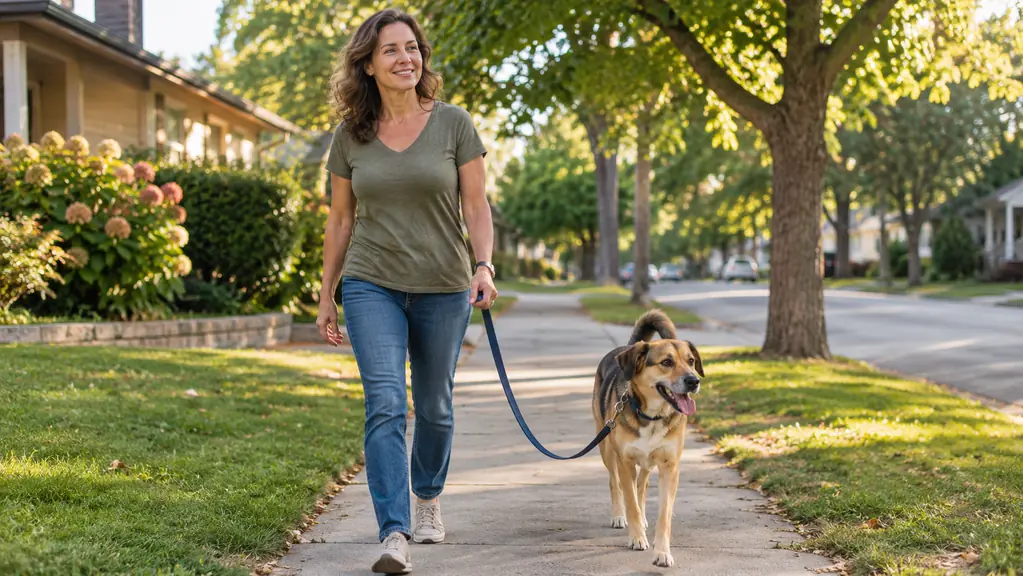
June came home with me at eighteen months old with a list of habits already installed. Door dashing. Barking at the front window. And the one that made me dread our evening walk: pulling. Not a gentle tug toward an interesting smell, the kind you can laugh off. A full-body lean into the leash that turned my shoulder into a rope tow by the third block. I am forty-four, I work in a school office, and I am on my feet enough as it is. By the time we got home I was not enjoying my dog. I was recovering from her.
I tried what people suggest at the park. Hold the leash shorter. Say no. Turn around and walk the other way. Some of it bought me three good steps. None of it lasted past the next squirrel. What finally changed things was the least dramatic option available: a front clip harness and a boring amount of repetition. The PetSafe Easy Walk moved the leash from June's back to her chest, and for the first time I had a two-second window after every lunge where she was not winning. That window is where all the actual training happened. Everything below is how I would do it again from day one, with the mistakes I made left in so you can skip them.
Move the leash to the chest and the pulling loses its grip
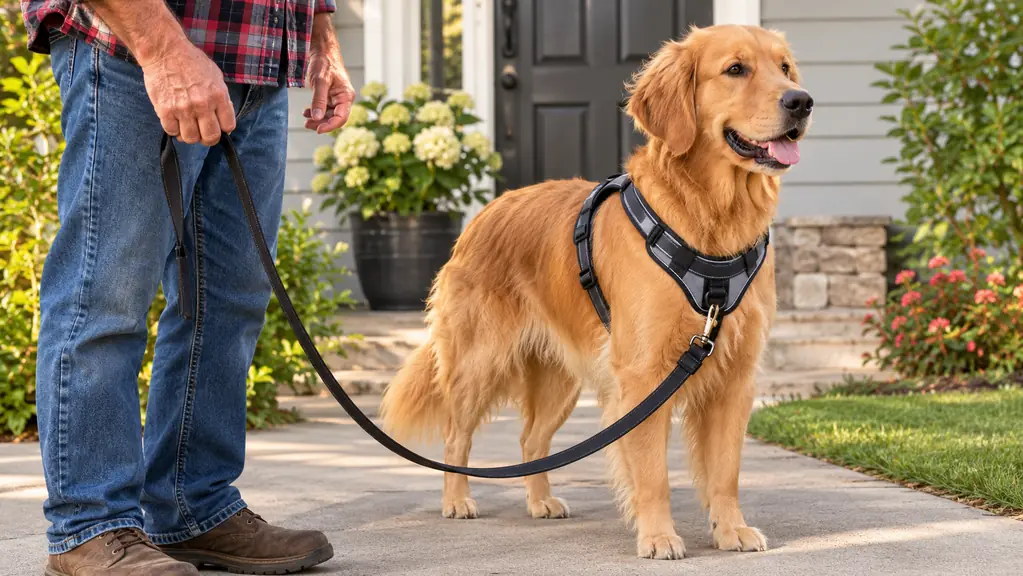
The PetSafe Easy Walk puts the leash ring on your dog's chest instead of the back, so a hard lean turns into a gentle swing back toward you. The Martingale loop eases across the shoulders rather than snapping tight at one point. Medium fits dogs from 20 to 50 pounds, which is exactly where June sits at 48.
Amazon Check Today's Price on Amazon →Why a Front Clip Changes the Walk
A harness with the leash on the back is a sled dog setup. That is not an insult to the harness, it is just physics. The dog leans forward, the pressure lands across the chest and shoulders, and the dog pulls harder into it because that is what the body is built to do. Sled teams wear exactly that geometry because it works. If your dog is dragging you down the sidewalk, you have accidentally built a one-dog sled.
Clip the leash to the chest and the same lean produces a different result. As the dog moves forward, the attachment point rotates and the front of the body swings back toward you. The dog is not being corrected. The dog is being turned. That is the whole mechanism, and it is why a front clip harness buys you time to teach instead of a fight to win.
PetSafe builds this one around a Martingale loop that crosses the chest, so when June leans the loop takes up gradually across her shoulders rather than biting into a single spot. It was designed by a veterinary behaviorist back in 2004, and the basic shape has not changed much since, which I take as a good sign in a category full of reinventions.
The Five Steps, In Order
Step 1: Fit it before you clip a single leash to it
A front clip harness that fits badly is worse than no harness at all. It rubs behind the front legs, it twists sideways when the dog leans, and the dog learns to hate the sight of it. So the first session is not a walk. It is a fitting, done in the kitchen, with food.
The chest strap should sit across the breastbone, well below the throat. Two fingers should slide under every strap without a fight, and nothing should be tight enough to leave a mark after five minutes. The belly strap goes behind the front legs, not across the ribs. PetSafe makes the belly strap a different color from the rest of the harness, which sounds like a small detail until you are crouched on a dark driveway at 6:40 in the morning trying to work out which strap goes where.
June is 48 pounds. The Medium is rated for 20 to 50 pounds, so she sits near the top of the range, and I check the fit every couple of weeks, more often in winter when her coat is thicker. The harness is nylon and hand wash only, so it gets rinsed in the sink and hung over the back of a chair rather than thrown in with the towels.
Step 2: Make the harness the best part of the day
For the first week I did not walk June in the harness at all. I put it on, fed her four pieces of chicken, and took it off. Then I did it again that evening. Ten minutes, twice a day, same as everything else we work on.
The snap closures make this easy. The harness goes on without threading legs through loops, so there is no wrestling and no reason for the dog to brace. Same order every single time, same cheerful voice, food the second the snap closes.
By day four June was pushing her head toward the harness instead of backing away from it. That matters more than it sounds. A dog who is relaxed while you put the gear on is a dog who can still learn something at the other end of the leash. A dog who is already braced is not.
Step 3: Start indoors with the leash on the chest ring, going nowhere
Once the harness stopped being a big deal, I clipped a light leash to the ring on the chest and let June drag it around the living room while I made coffee. No goals. Just the feeling of something attached at the front.
Then I picked the leash up and stood still. That was the entire exercise. June wandered, hit the end of the line, felt the gentle turn, and came back. Every time she came back and the leash went slack, I marked it with a word and paid her with something better than her dinner.
The temptation is to skip this and go straight outside. Please do not. The living room is where the dog learns what the pressure at the chest actually means, in a place with no squirrels, no other dogs, and no neighbor watching you stand still for four minutes. Patience is much easier to find indoors, and the dog needs a few hundred repetitions before the meaning sticks.
Step 4: Outside, a tight leash means the walk stops
Out on the sidewalk the rule was simple and I never broke it. If the leash is tight, we are not moving. I stop, plant my feet, and wait. Not a jerk, not a pop, not a correction. Just a person who has become a fence post.
The instant June turned her head back, or stepped toward me, and the leash dropped slack, I said yes and put food right at my knee. Timing is the whole skill here. The reward has to land while the leash is loose. Pay her after she has already surged forward again and you have paid for the surge.
The first walks were slow. Genuinely, embarrassingly slow. We covered maybe a quarter of our usual route, and a neighbor asked whether June was injured. But this is exactly where a front clip harness earns its keep. When June lunged, she turned herself instead of pulling me off balance, so I could stand there calmly instead of bracing against forty-eight pounds of opinion. The harness did not teach her anything. It made the two seconds after each lunge quiet enough for me to teach her something.
We practiced ten minutes in the morning and ten in the evening, and we always stopped while she still wanted more. Ending on a good repetition is worth more than grinding to the end of the block.
Step 5: Add distance and distraction in layers
Once the sidewalk in front of the house was solid, we moved one block. Then to the corner. Then past the park at a distance, then closer to the park, then the parking lot beside the park. Each new place counted as a reset, and I expected the pulling to come back in the new spot. It did, for a day or two, and then it did not.
Pick one cue and use it the same way every time you need to move on. Ours is let's go, said once, followed by one step. If June braces, I stop again. The rule never changes, which is the only reason it works. A rule that applies except when you happen to be running late is not a rule the dog can learn.
Expect a rough week around week three. Ours arrived the day a neighbor brought home a puppy and started walking it on our route. For four days June was a different animal. I went all the way back to standing still, paid heavily for slack, and we recovered.
Progress is not a straight line. Having gear that made the walk manageable is the only reason I kept showing up through the wobble instead of going back to being towed.
The harness did not train June. It bought me two calm seconds after every lunge, and two seconds was enough to teach her what I wanted.
What Else Helps
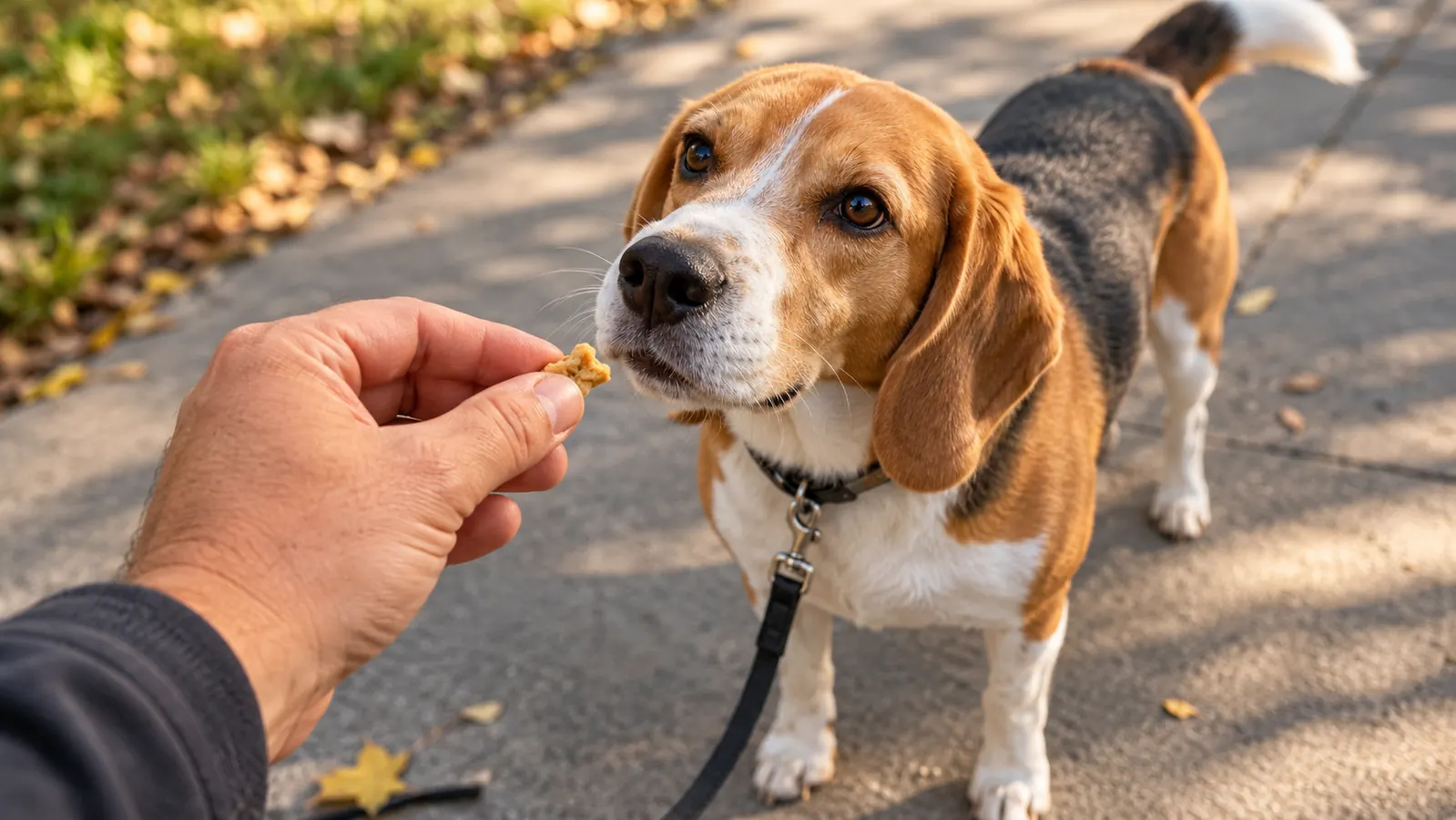
A plain five or six foot flat leash, not a retractable. A retractable leash teaches a dog that pulling pays out more line, which is the exact opposite of the lesson you are building. A treat pouch on your hip so the food arrives faster than the dog does. And food that is genuinely worth working for, kept separate from dinner so it stays interesting.
Practice at the door before you ever leave the house. June used to explode through an open door. We spent a week on sit, wait, one step out, then back inside if she surged. That week saved a hundred walks, because a dog who starts a walk calm stays calm longer.
Give the dog a real chance to burn energy before the training walk. Three minutes of fetch in the fenced backyard takes the sharpest edge off, and a dog who has already run is a dog who can think. This is not cheating. It is setting the lesson up to succeed.
And if the pulling started suddenly rather than being a lifelong habit, get a vet check before you buy any gear at all. Discomfort changes behavior, and no harness on earth fixes a sore neck or an aching tooth.
What a Front Clip Harness Won't Do
It will not fix barking, lunging at other dogs, or a dog who is genuinely frightened of something on the route. Those need a different plan, usually built with a trainer who uses positive methods. It also will not work if you clip the leash to the back ring. Plenty of poor reviews on every front clip harness come from people who used it like a regular harness and got regular results.
And it does not replace the training. If the leash stays tight and the walk keeps moving forward, the dog learns that pulling works, and the harness becomes a slightly awkward way to pull. The gear makes the lesson possible. You still have to teach it, which means stopping, waiting, and paying for slack several hundred times before loose becomes the dog's default.
The walk you actually want starts with one change of attachment point
Medium fits dogs from 20 to 50 pounds. The harness is nylon and hand wash only, and it ships with a quick start guide and a one year manufacturer warranty. Give it ten minutes twice a day for two weeks and see what your sidewalk feels like.
Amazon Check Today's Price on Amazon →