
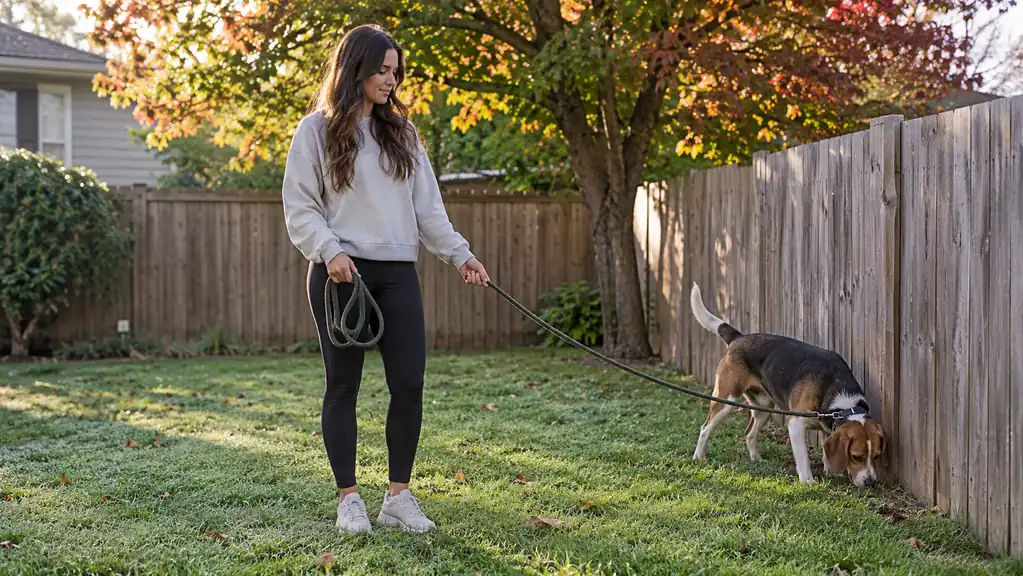
Most mornings I walk two dogs. Same animal, same forty-eight pounds of mixed-breed rescue, but two entirely different creatures depending on what is clipped to her collar.
On the six-foot leash, June is a freight train with opinions. She leans, she coughs against the collar, she drags me past the neighbor's fence like I am a kite she is tired of flying. On the thirty-foot Hi Kiss training lead she is a dog again: nose down, working the fence line at her own pace, swinging back toward me when I call because coming back has finally become worth her while.
We adopted June at eighteen months. By then she had already decided the world was a thing to be barked at, and the shelter notes said pulling, door dashing, window barking. All three were true. For the first two months I did what most people do, which is walk the same loop on the same short leash and hope the dog grows out of it. She did not grow out of it. She got stronger.
Then I bought a retractable. I want to be honest about that, because I have since read a hundred comments from people who did exactly the same thing and felt foolish. It gave June twenty feet of line and me no control at all. She hit the end at a dead run, the handle spun in my hand, and the cord burned a stripe across my knuckles that took a week to fade. I put it in the garage and left it there.
Six weeks of short-leash walking taught June nothing about coming when called. The first week on thirty feet taught her more than the previous six months combined, because for the first time she had a reason to come back.
You cannot practice a recall at six feet
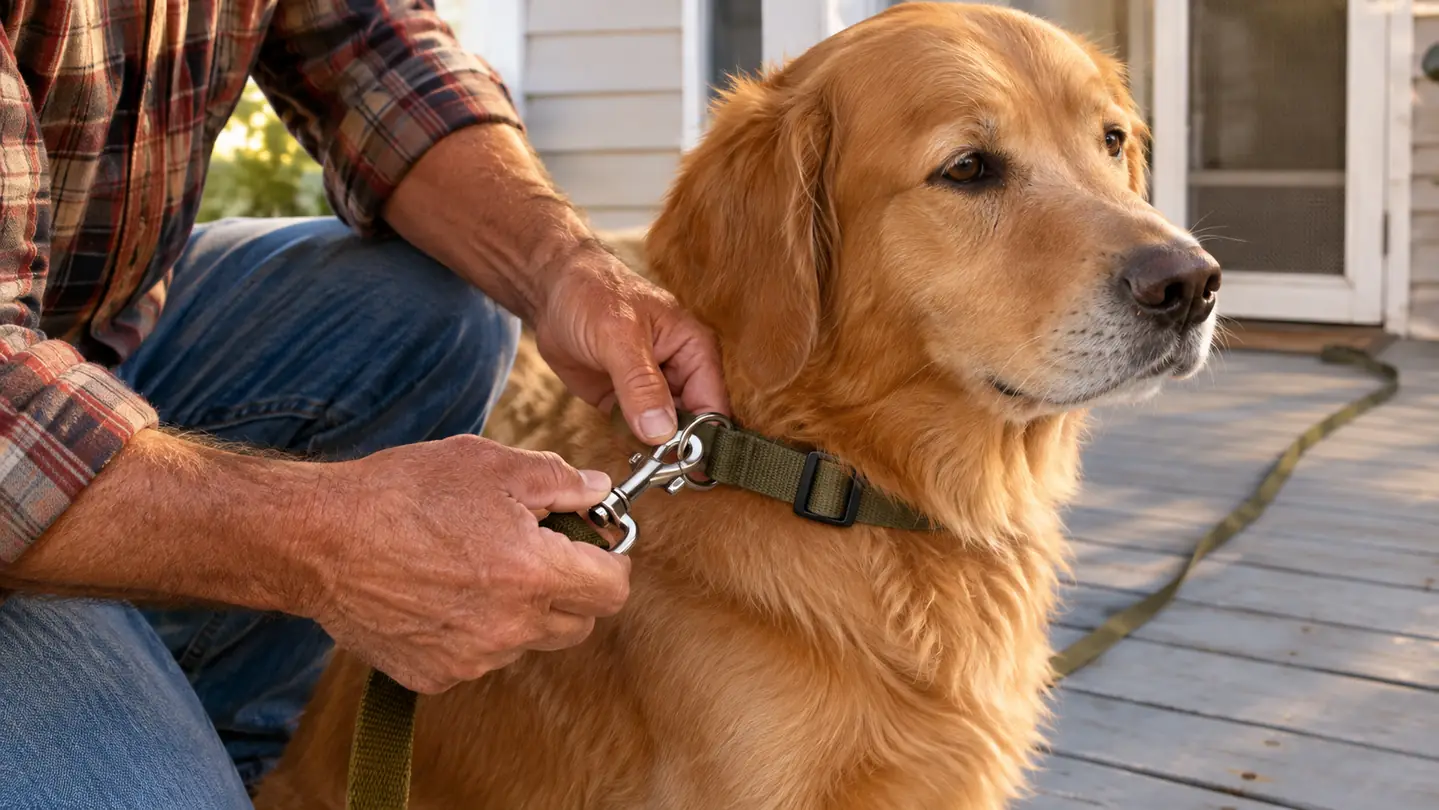
The Hi Kiss training lead is one piece of nylon, three-quarter inch wide, with a swivel-style bolt snap that resists twisting. It comes in 15, 20, 30, 50 and 100 foot lengths. For a fenced backyard and a medium-sized dog, 30 feet is the one I would buy again.
Amazon Check Today's Price on Amazon →A long line is not a retractable, and that distinction is the whole point. The Hi Kiss lead is a single length of nylon, three-quarter inch wide and thirty feet long, with a swivel-style bolt snap on one end that resists twisting when the dog circles. It weighs 5.29 ounces, so June barely notices it hanging off her collar. There is no brake, no spring, no handle that winds. The line is either in your hand or dragging behind the dog, and that is exactly what makes it useful.
Our routine now is ten minutes in the morning and ten minutes after dinner, which is what our trainer recommended and what my schedule can actually support. Mornings are the boring one. I stand in the middle of the yard, let the line out, and pay every check-in. June goes to the fence, sniffs, comes back, gets a piece of string cheese. Out, sniff, back. Twenty repetitions of something that looks like nothing and is actually the entire recall.

Evenings are the fun one. I toss a treat into the grass and say find it, and she puts her nose down while I walk backward and call her name. The long line means she can be twelve feet away and still succeed, which is the whole trick. A dog who is never more than six feet from you never has to choose to come back. A dog at the end of thirty feet of nylon has to make a decision, and when she makes the right one, you get to pay her for it.
None of this is frictionless. The line tangles in the shrub row along the back fence, and I have spent more time untangling three-quarter inch nylon out of a burning bush than I care to admit. Wet, it gets heavy and slaps against your leg. If June bolts for the gate, my hand takes the load, so I wear a leather glove on my right hand. And it is not a tie-out. The one time I wrapped the end around a porch post to answer the phone, she circled it twice and I spent five minutes unwinding her.
People ask why I do not just use the long line on our neighborhood walks, and the answer is that there are two dogs in this house. The one on the sidewalk needs to be four feet from my hip, because sidewalks have cars and rabbits and a mail carrier she has opinions about. The one in the backyard needs thirty feet and a reason to come back. Same dog. Different job. The Hi Kiss lead handles the second job without a motor, a brake, or a battery.
What I'd Tell You If We Were Sitting at My Kitchen Table
If we were sitting at my kitchen table with coffee going cold, here is what I would tell you. The lead is not training. It is a piece of nylon that makes training possible, the same way a fence makes it possible to let a dog off leash without losing her. Get the 30 foot length for a normal backyard and skip the 100 foot unless you have acreage, because a hundred feet of line is a lot of line to gather up in the rain. Never tie it to anything. Never wrap it around your wrist. Quit while she still wants more. June still pulls on the sidewalk. She still barks at the window when the delivery truck rolls past. But she comes when I call her in the yard, from thirty feet away, nine times out of ten, and six months ago I would not have believed that number.
Thirty feet of nylon, ten minutes twice a day
That is the whole system. The Hi Kiss training lead comes in 15, 20, 30, 50 and 100 foot lengths, and the 30 foot is the one that fits a fenced backyard and a medium-sized dog.
Amazon Check Today's Price on Amazon →