
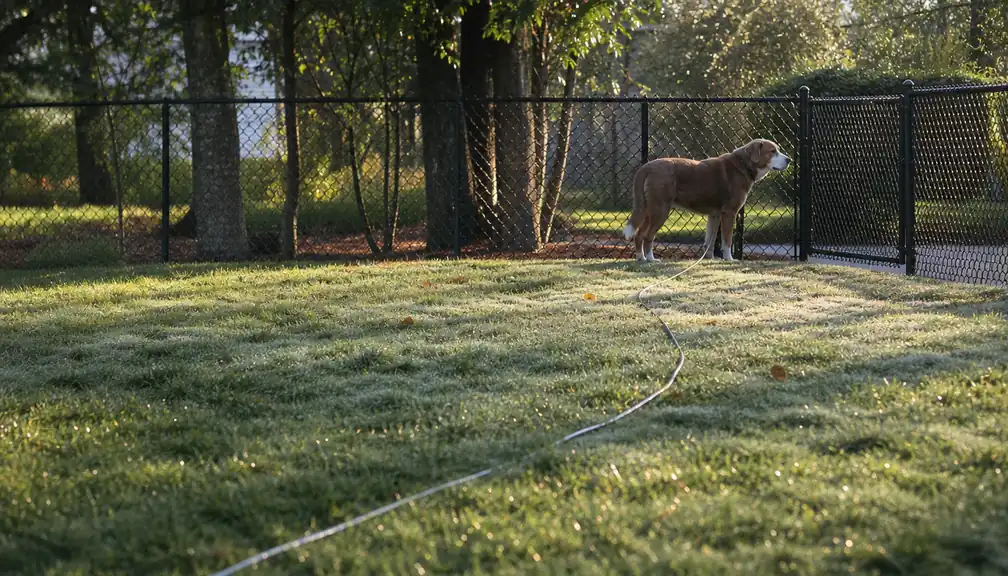
The first time I clipped a long line onto June's harness, she bolted to the back fence, hit the end of it, and stood there looking back at me like I had rearranged the furniture. She is a three-year-old mixed-breed rescue, about 48 pounds, and she came to me at eighteen months with a leash habit that had already been rehearsed a thousand times. I had spent a year doing short-leash work in the driveway. Six feet of webbing, very controlled, very tidy, and completely useless the moment she was in open space, because she had never been taught what to do out there.
That gap is what the Hi Kiss 30 foot training lead is built to fill. I have been using it for about seven months, mostly in my backyard outside Wichita and on a quiet stretch of park grass on weekend mornings. I run two sessions a day, roughly ten minutes each, with a pouch of cut-up chicken in my jacket and no illusions that a piece of nylon teaches a dog anything by itself. This is the honest version of that stretch of time, including the parts where the lead made my training harder and the parts where I had to change how I work because of it.
The Quick Verdict
A plain, dependable long line for recall work, if you accept that thirty feet of webbing is a skill the handler has to learn before the dog learns anything.
Amazon Check Today's Price →Six Feet of Leash Cannot Teach a Recall. Thirty Feet Can.
This is the exact line I use twice a day in my own backyard with a dog who used to ignore me at ten feet. Light, nylon, and it swivels so it does not twist into a cable.
Amazon Check Today's Price on Amazon →How I've Used It
My routine is unglamorous. Ten minutes before I leave for work, ten minutes after supper, both sessions in the backyard with the same pouch of chicken and the same rules. June wears a harness, the lead snaps onto the back ring, and I let her drag it. That is the entire setup. The lead is not there to steer her. It is there as a safety net so I can ask for a recall at twenty-five feet without any real chance of her reaching the alley behind the house. When she comes, she gets paid right away. When she does not come, I do not reel her in like a fish. I walk toward her, reset, and try again at an easier distance.
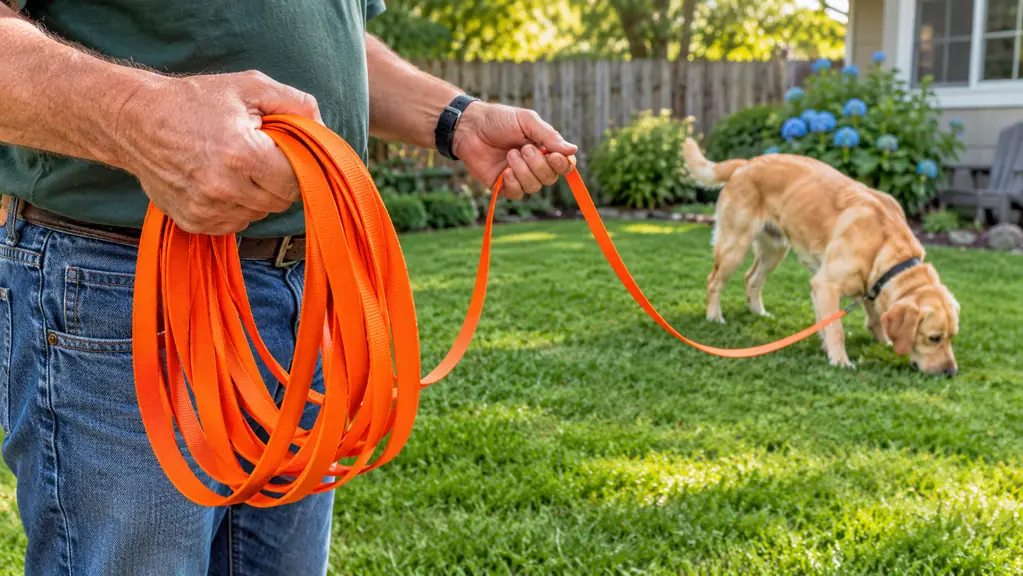
The first two weeks were mostly about me learning to manage the line. Thirty feet of webbing is a lot of rope for one person to hold, and if you gather it wrong you will spend more time untangling than training. I fold it into loose loops now, hand over hand, and I keep two loops in my left hand at all times so I have line to feed out instead of line to grab at. That sounds obvious written down. It took me most of a month to stop fighting it, and I still catch myself holding on too tight when she moves fast.
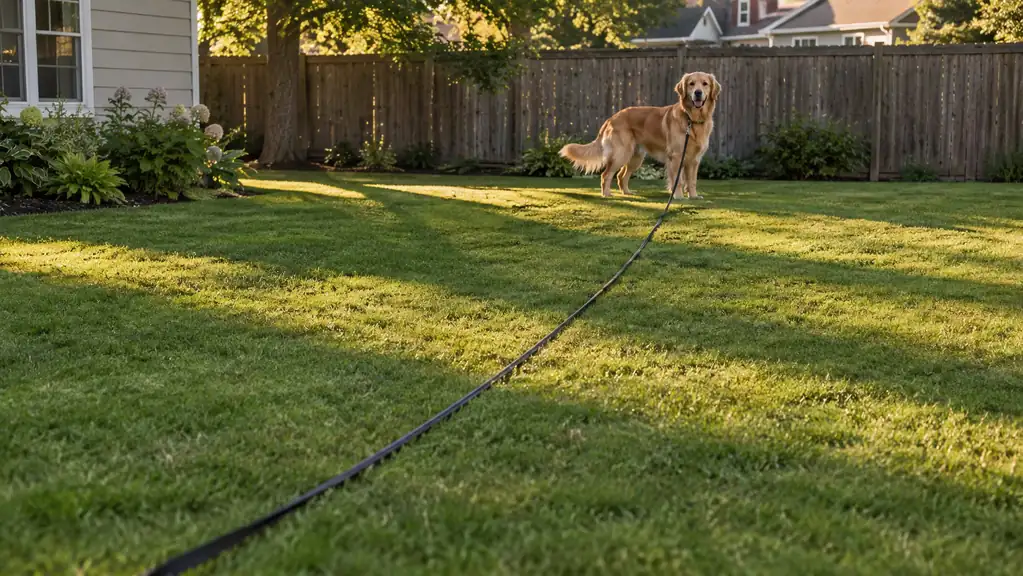
The other thing I learned is that the lead only works if it stays slack. If I keep tension on it, June leans into it exactly the way she leaned into a six foot leash, and we are back to the pulling habit she arrived with. So for most of the session the line is trailing on the grass with a big lazy loop in it, and I am standing there doing nothing, which is much harder than it sounds. The Hi Kiss lead bought me the room to do nothing. That is the entire value of it, honestly. Room to not intervene.
What Thirty Feet Actually Changes
On a six foot leash, every training decision happens inside a box. June can smell one thing, and then she has to come back. On thirty feet she can make a real choice. She can check the fence line, drift toward the gate, circle the maple, and actually want to be somewhere. When I call her away from all of that, I am asking her to leave something she wants, which is a far better rehearsal for the real world than a tidy heel down a driveway. Distance is what turns a command into a decision.
I measured the yard, because I am that person. It is about forty feet deep, so at the full thirty feet June can get most of the way to the fence and I still have room to step back and let the line go slack. When we use the same lead at the park, the drop-off in her response at the far end is obvious. At ten feet she comes nearly every time. At thirty feet, on a good day, maybe three out of four. That number is the reason I keep practicing instead of declaring victory. The lead showed me exactly where her recall falls apart, which no short leash had ever done.
The length also changed how I talk to her. On a short leash I was constantly narrating, correcting, chattering away. With the long line I say come once, and then I shut up and wait. If she ignores me, the line keeps her from wandering off and rewarding herself for it, and then I walk out and bring her back without any drama. Nothing about it is exciting. It is repetition with a safety net, and after several months she started turning around before I finished the word. Not every time. Enough times that I noticed.
The lead is not there to steer her. It is there as a safety net, so I can ask for a recall at twenty-five feet without any real chance of her reaching the alley.
The Nylon, The Width, and How It Feels in the Hand
The Hi Kiss lead is 3/4 inch wide and thirty feet long, which lands in a useful middle ground. It is wide enough that it does not cut into my hand the way thin cord does when June makes a sudden turn, and narrow enough that it does not feel like I am holding a seatbelt. The whole thing weighs 5.29 ounces, and that matches what it feels like in practice. Light enough that June forgets it is back there, heavy enough that it does not blow around in the wind and knot itself on the grass.
Nylon is the right material for this job and the wrong material for a couple of others. It does not soak up water the way cotton does, so a wet morning does not leave me dragging a soggy rope around the yard. The listing says the nylon will outlast cotton leashes, and after seven months of Kansas humidity, dew, and one unfortunate encounter with a mud puddle, I have no reason to argue with that. It has kept the same length and the same stiffness. No fraying at the snap end, no stretching that I can measure.
The tradeoff is that nylon has no give at all. When June hits the end of the line at a full run, the stop is abrupt, and the first few times it happened I felt terrible about it. That is a handling problem, not a product defect, and I fixed it by watching her body instead of her face. Now I call her before she reaches the end, and I keep her closer for the first five minutes of a session while she burns off the initial excitement. A thirty foot line is a tool you have to think ahead with. It does not forgive a slow handler.
One more note on the width. At 3/4 inch it is comfortable for the first twenty minutes and a little grippy by the end of a session, especially once the dew soaks into the outside of the weave. That is not a complaint about the material so much as a reminder that thirty feet of line gets handled far more than six feet ever does. If your hands bother you on cold mornings, wear a glove. This is a working line, not a walking leash, and it behaves like one.
The Snap, The Twist, and the Failure Points
The lead attaches with a snap closure on a swivel style bolt snap, which is the detail I did not fully appreciate until I had used it for a while. June spins. She circles left, doubles back, changes direction without warning, and a fixed snap would have the webbing twisted into a cable inside ten minutes. The swivel lets the line turn with her, so I spend a lot less time shaking out kinks and a lot more time actually training. Small thing. It adds up over two sessions a day, seven days a week.
The snap is easy to work one handed, which matters more than it sounds when the other hand is holding a bag of chicken. It has never opened on its own in seven months of daily use. I check it before every session anyway, because it is the one part of any long line where a failure stops being an inconvenience.
The failure points are the ones you would expect from a long piece of webbing. It picks up burrs and grass seed, so I wipe it down every couple of weeks. The handle end gets dragged through mud, because that is what happens when thirty feet of line lives on the ground. If you coil it wet and leave it in a hot garage, it will smell like a hot garage. None of that is a design flaw. It is what nylon does when it lives outdoors, and it is the same story with every long line I have handled.
The Problems Nobody Mentions
Here is the part I wish someone had told me in the first week. A long line is a tripping hazard, and not only for the dog. I went down once, in the dark, on wet grass, because I stepped over the line instead of walking around it. Nothing broke and June thought it was a game, but I bought shoes with actual tread after that and I keep our sessions inside the mowed part of the yard. If you are going to use thirty feet of webbing, you are signing up to watch your feet.
The second problem is that the Hi Kiss line finds every tree, bench, and fence post within range. June loves a figure eight around the maple in the back corner, and every single time it wraps I have to walk out and unwrap her. That is not the product's fault. It is the cost of doing recall work in a yard with obstacles. If your space is cluttered, hold a few extra loops and accept that you are working at fifteen feet instead of thirty. The skill is the same. The distance is not.
The third problem surprised me. Thirty feet gives June distance, and distance gives her things to react to. She is a rescue who barks at the window, and on the long line she can spot a squirrel or a delivery van from much farther out than she ever could on a short leash. That means I have to be more attentive, not less. I started using the lead in the driveway first, in a boring, squirrel free zone, before I took it into the open yard. That order of operations mattered more than I expected it to.
What I Liked
- 3/4 inch nylon webbing is wide enough to hold without cutting into your hand on a sudden turn
- Thirty feet gives a dog real room to make choices, which is what recall practice actually needs
- The swivel style bolt snap keeps the line from twisting into a cable when the dog circles
- Stays light at 5.29 ounces, so the dog stops noticing it is attached after the first few sessions
- Nylon handles dew, mud, and repeated wet mornings without soaking up water like cotton
Where It Falls Short
- Thirty feet of webbing is a tripping hazard on wet grass, especially in low light
- No give in the material, so a dog that hits the end at speed stops hard
- Wraps around trees, posts, and furniture constantly in a cluttered yard
- The handle end drags through mud and needs cleaning far more often than a standard leash
- Not a substitute for supervision, since the snap is the one part that matters and it needs checking
Who This Is For
This is for the owner whose dog already understands a treat and a marker word, and who needs somewhere to practice beyond a six foot box. It suits a medium dog like June, about 48 pounds, in a fenced yard or a quiet park at an off hour. It suits the person who will put in ten minutes twice a day for a few months and will not expect the lead to do the teaching. And it suits anyone doing recall work, scent games, or simply letting a dog be a dog in a space bigger than a sidewalk. If you have been training on a short leash and wondering why your dog's recall falls apart outdoors, this is the missing piece of the setup.
Who Should Skip It
Skip it if your dog has a bite history or a strong prey drive and no reliable response at ten feet, because thirty feet is not where you want to find that out. Skip it if you have wrist or shoulder trouble, since managing the line is more physical work than a standard leash. Skip it if you want gear that walks the dog for you, because this lead does the opposite of that. And skip it if you are not going to check the snap and clean the webbing, because a long line that lives outside and never gets looked at is a long line waiting to give out at the worst moment.
Thirty Feet of Slack Is Where Recalls Get Built
June went from ignoring me at ten feet to turning around before I finished the word. The lead did not teach her that. It gave me the room to teach her that.
Amazon Check Today's Price on Amazon →