June used to hear the treat bag rattle from three rooms away. That was the problem. By the time I fished a piece of kibble out of the ziplock in my jacket pocket, she had already stood up, already forgotten what she had done, and was nosing at my hand for the rest of the bag. I was rewarding her, technically. I was also teaching her that rewards arrive late, mysteriously, and mostly by accident.
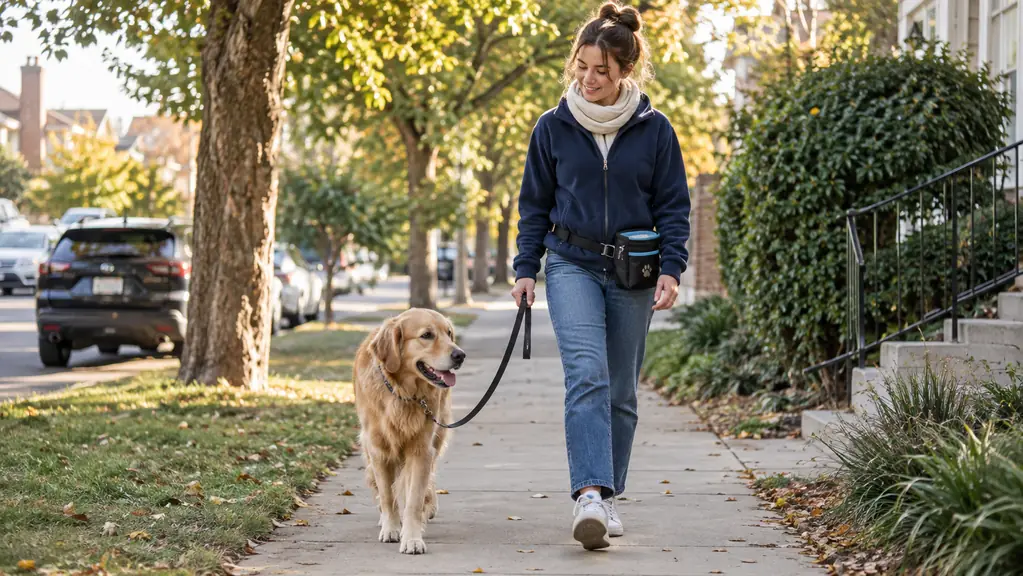
I tried the coat pocket. I tried a plastic baggie clipped to a belt loop, which split open in the rain. I tried holding three treats in my left hand for an entire walk, which left my left hand smelling like liver and my right hand doing all the leash work. What changed things was not a new training method. It was a piece of gear. The Mighty Paw Dog Training Treat Pouch sits on my hip with a magnetic closure and four compartments, and it lets me get a treat from bag to dog in about a second, without looking, without stopping, and without unzipping anything. That one second is most of the difference between a dog who learns and a dog who is guessing.
Reward the sit while the sit is still happening
The Mighty Paw pouch holds up to 2 cups of treats across 4 compartments, adjusts from 30 to 52 inches, and stays shut when it tips over. Today's price is on the listing.
Amazon Check Today's Price on Amazon →Step 1: Decide what actually counts as a reward
Most of the training trouble I see in my own kitchen is not a stubborn dog. It is a boring reward. June will sit for a piece of her regular kibble in the living room when nothing is going on. She will not sit for kibble when the mail carrier is on the porch. Same dog, same cue, different value. If the reward is not worth working for in that moment, you are not training, you are asking.
So before you clip anything to your waist, sort your treats into three rough tiers. Tier one is ordinary kibble, for skills she already knows in quiet rooms. Tier two is something soft you can break into pea-sized pieces, for new skills and busy sidewalks. Tier three is the good stuff, small bits of boiled chicken or cheese, and it only comes out for the hard things: the front door, the window, the moment a loose dog appears at the end of the block.
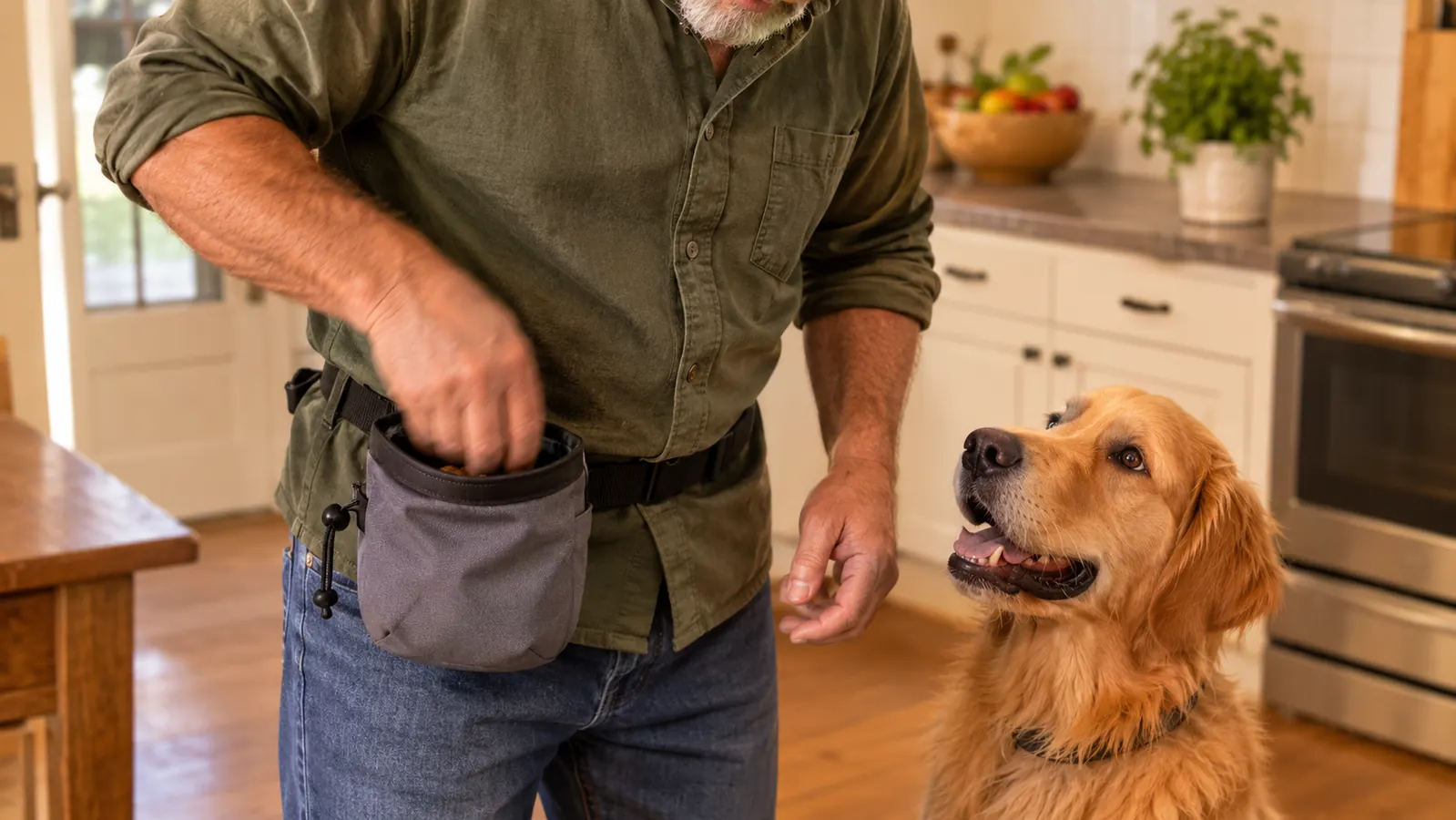
This is where the pouch earns its keep before you have trained a single thing. The Mighty Paw pouch has four compartments, so I keep kibble in one, soft treats in another, and the chicken in a third, and I never have to dig. June can tell the difference by smell, which means she also knows when the good one is coming. Over a 10 minute session that sorting saves me twenty small fumbles. Twenty fumbles is a lot of lost lessons.
Step 2: Load it and fit it before the walk starts
The strap on the Mighty Paw pouch adjusts from 30 to 52 inches, and the setting that works for me is not the one I expected. I wear it at hip height, cinched so the bag sits just behind the hip bone, closer to the back than the front. When it hangs in front, June cuts in and starts mugging the bag on every walk. When it sits behind the hip, my hand slides back, grabs a treat, and comes forward again without breaking stride.
Load it before you put it on, not while the dog is spinning at the door. The whole point is that the reward is faster than the dog's attention span, so the bag has to be ready before the session starts. I fill mine in the kitchen, check that the magnets have closed the top, and then clip it on. Twice now I have bent over to pick up a dropped leash and had the bag tip sideways. The magnetic closure held both times. That sounds like a small thing until you are the person picking kibble out of wet grass in the rain.
Then do a dry run with no dog involved. Stand in your kitchen and practice getting a treat from the bag to a spot about knee height in front of you, without looking down. Time it. If it takes more than a second, the bag is in the wrong place, or you have overfilled it, or both. I did this while the kettle boiled three nights in a row, and by the fourth night my hand knew where the opening was. That is the entire skill. The pouch does not train your dog. It buys you the second you need to train your dog.
Step 3: Mark the exact moment, then pay it
A reward only teaches if the dog knows what it is being paid for. That is what a marker is for. Pick one word, say it once, and mean it. I use 'yes.' The order is: dog does the thing, you say yes at the instant the behavior happens, then the treat arrives within about a second. Not yes and then a pause while you hunt for a treat. Not treat first and then yes. The marker is the promise. The treat is the payoff.
The pouch is what makes that order possible. My old routine was: June sits, I say yes, then I unzip a jacket pocket, dig past a set of keys, pull out a baggie, open it, and hand her a treat. That is four seconds. In four seconds June has stood up, sniffed a leaf, and made a reasonable guess that sitting had nothing to do with anything. With the pouch, the sequence is: she sits, I say yes, my hand is already moving, and she is chewing before she stands. The lesson lands because the timing lands.
Where you deliver the treat matters too. If you want a dog who walks at your side, feed at your side, near the seam of your pants. If you want a dog who stays sitting, feed low, between the front paws. If you want a dog at the door who is not launching herself through it, feed behind you, away from the door. All of that is easier when the treats live on your hip instead of in a drawer across the room, because you can place the reward in the right spot without thinking about it.
Step 4: Pay for the boring behavior, not just the tricks
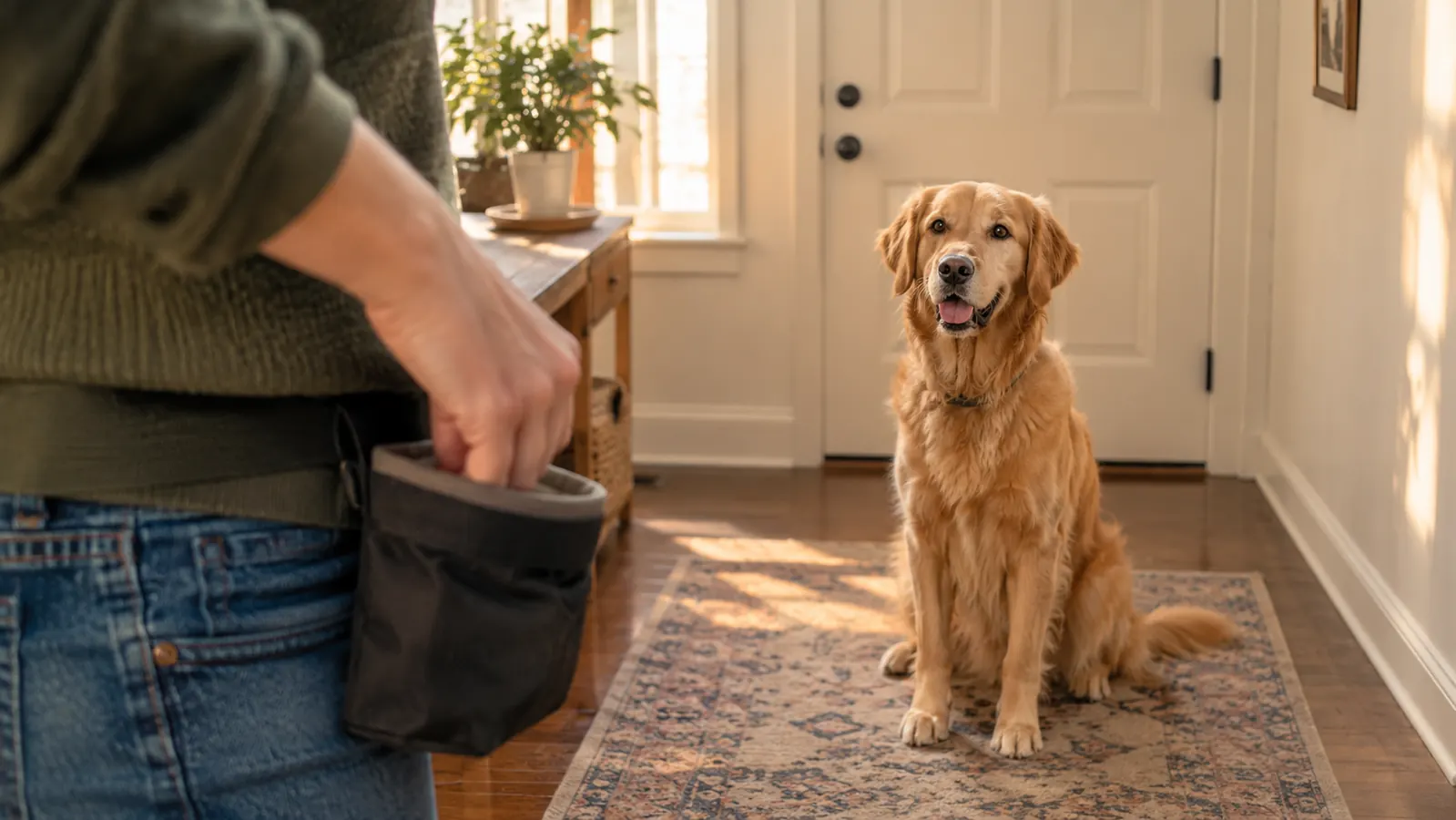
Sit and shake are the easy part. The behaviors that actually change your week are the quiet ones. June used to bark at the window at anything that moved, and every attempt I made to stop it involved noise, which just added to the noise. What worked was catching the half second she turned her head away from the window and paying for that. It felt absurd the first week. She would look away, I would say yes and hand her a piece of chicken, and she would look right back at the window. Then, slowly, the look-aways got longer.
This is where a pouch worn all evening, not just during formal sessions, starts to matter. Capturing calm requires you to be ready in the exact moment the dog offers it, and dogs do not offer it on a schedule. Four compartments means I can keep low-value kibble in the pouch during dinner and pay for small stuff without running to the kitchen every time. When June settled on the rug while I did the dishes, she got a quiet yes and a kibble delivered between her paws. When she stood up and barked, nothing happened. Nothing is not punishment. Nothing is just information.
The rest of my routine is short. About 10 minutes in the morning, about 10 minutes in the evening, plus the odd capture during the day. Any longer and I can see her attention go, and a distracted dog in a training session learns sloppy habits. If she is still fired up when the timer ends, I finish with something easy she already knows, pay it, and stop. Ending on a win costs one treat and protects the next session.
Step 5: Fade the pouch out on purpose
A treat pouch is scaffolding, not a permanent fixture. The end goal is a dog who behaves because the behavior works in normal life, not because a bag is on your hip. So plan the fade from the beginning. Once June is getting a behavior right most of the time, I stop paying every single rep. Two out of three. Then one out of three. Then the reward becomes something else: the door opening, the leash coming off the hook, being let out into the yard. Life rewards are strong and they cost nothing.
The fade does not mean quitting cold. If I drop treats entirely the week June gets good at something, the behavior usually slides within a few days and I end up rebuilding it from the start. What works better for us is keeping the pouch for new skills, hard environments, and anything involving the front door, and going to pocket treats or no treats at all for skills that are already solid in the living room. The pouch is simply where I go when the difficulty goes up.
One practical note: I keep the pouch loaded and hanging by the door, because door dashing is our weak spot and the moment arrives fast. When the bell rings, I clip it on before I touch the handle. That single habit has done more for June's door manners than any of the elaborate protocols I read in the first year.
What Else Helps
Change one thing at a time. I spent a month trying to fix pulling, door dashing, and window barking at once, and all three got worse, because I was giving unclear information and then blaming the dog for not sorting it out. Pick one behavior per week, set the pouch up for that behavior, and let the others wait. A dog learning three things at once learns none of them well.
Count your treats before you start. If the pouch is stuffed with two cups of kibble and the session ends with the bag empty, you are not training, you are feeding. Fifteen or twenty rewards is plenty for a new skill. The other thing that helps is a written note on the fridge with the one cue you are working on, because I forget under pressure and start mixing three cues into one sentence, which is exactly how a dog ends up confused and you end up frustrated.
A reward that lands two seconds late is not a reward. It is a coincidence your dog has to guess at.
Clean the thing out, too. Kibble dust and soft treats turn into a smell that follows you around the house, and a bag that smells like old food in the wrong way gets more mugging, not less. I rinse the inside and let it dry overnight, then reload in the morning. The poop bag holder on the outside has saved me more walks than I want to admit, mostly because I finally stopped patting my pockets at the far end of the block.
The reward has to arrive while the dog still remembers earning it
The Mighty Paw pouch holds up to 2 cups across 4 compartments, adjusts from 30 to 52 inches, and closes with two magnetic clasps. Today's price is on the listing.
Amazon Check Today's Price on Amazon →