For two years, my training treats lived in the front pocket of whatever I happened to be wearing. In summer that meant dog hair and a fine grit of kibble dust worked into the seam of my jeans. In winter it meant a jacket pocket deep enough that June had already lost interest and wandered toward the window by the time I fished out a piece of chicken. The treats were never the problem. How I got them to her was the problem.
So I bought the Mighty Paw Dog Training Treat Pouch, the model with the magnetic clasp, and I have worn it almost every day since. Not a week of testing for the sake of writing a review. Months of it. Two short sessions a day with June, every walk, and every foster dog that comes through our house from the shelter where I volunteer on weekends. What follows is what actually held up, what annoyed me, and who I would hand it to.
The Quick Verdict
A quiet workhorse of a treat pouch. The magnets close on their own, four compartments keep chicken away from kibble, and the strap fits over a winter coat. It is not waterproof, and the opening is stiff for the first week.
Amazon Check Today's Price →The pouch that ended the kibble-dust pocket
Holds up to two cups of treats, closes itself when you let go, and stays put through a whole session.
Amazon Check Today's Price on Amazon →How I've Used It
June is a 3-year-old mixed breed rescue, about 48 pounds, adopted at 18 months. She came to us with a leash habit that could tow me off a curb, a door-dashing problem that worried me more than the pulling, and a running commentary for every dog that walked past the front window. I am not a trainer. I am a school office manager in Wichita with a fenced backyard and about 20 minutes a day to give. Any gear I keep has to survive that, not a product photo shoot.
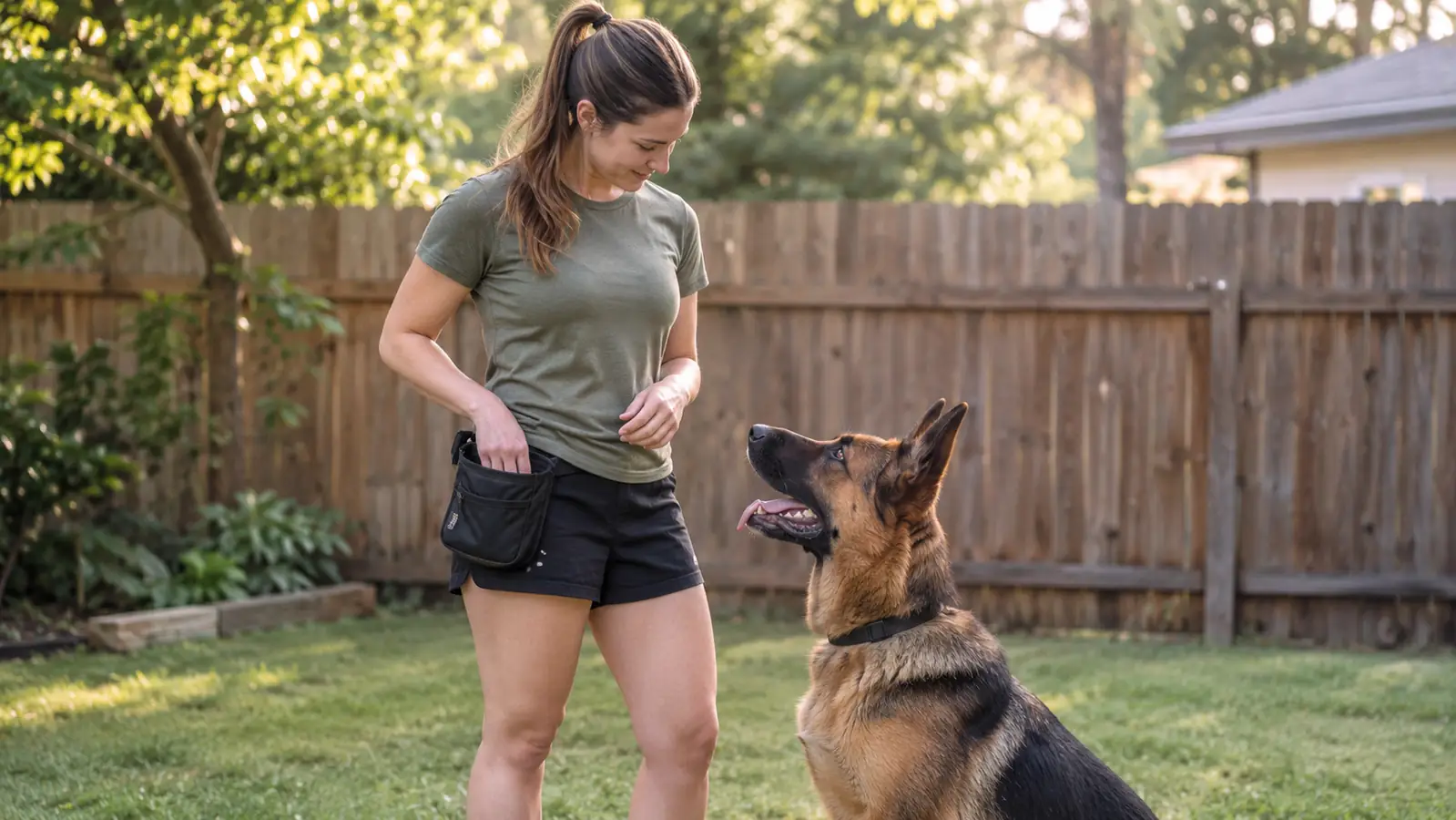
A session in our house looks like this. Ten minutes before I leave for work, ten minutes after dinner. Sit. Wait at the door. Loose leash in the hallway. Name response in the kitchen while the kettle runs. That is somewhere between 30 and 50 rewards per session, which means the pouch gets opened and closed 60 to 100 times a day. Nothing else I own gets handled that much, which makes it a decent thing to test by accident.
The foster dogs are the harder test. They arrive with no idea what a marker word means and they go home in a few weeks, so every session with them is a beginner session and every reward has to be immediate. The pouch made that part easier than it used to be, mostly because I stopped losing five seconds to a pocket every single time.
Before the Mighty Paw pouch I tried three other setups, and each failed for its own reason. A zip-top bag inside my jacket kept the treats from drying out, but the plastic crinkled every time I opened it and June learned to read that sound before the bag was even open. A fanny pack worn in front sat at the wrong angle, so half the kibble slid into a bottom corner my hand could not reach without me looking down. A drawstring bait bag on my belt swung against my thigh on walks and bounced hard enough to spill. By the time I ordered this one, I had decided the real problem was me being disorganized. It was not. It was that none of those three stayed in one place and none of them opened on their own.
I wear the pouch on the long setting of the strap, which adjusts from 30 to 52 inches, cross-body over a hoodie in summer and over a bulky coat in January without resizing. It stays where I put it, through bending down for a poop bag, through a jog to catch up with June, and through one memorable lunge at a squirrel.
What the Four Compartments Actually Hold
The main compartment takes up to two cups of treats. I have never needed two cups for a 10-minute session, so I fill it about a third of the way and still have room to get my hand in without scraping my knuckles. Two cups is a full training day plus a walk, which means I refill once in the morning and once at night and never mid-session.
The other compartments are the part I did not expect to use. I keep high-value rewards in one, the chicken or the cheese, and ordinary kibble in another for the easy repetitions. A third holds dry treats for whichever foster dog is with us, since they are usually on a different food than June. Three reward values, three places, no mixing, and no greasy kibble clumping into the cheese. If you have ever rewarded a dog with a piece of cheese that had kibble stuck to it, you know why this matters.
On a typical morning I load it in a set order. A third of a cup of kibble in the main compartment, five or six pieces of cut-up chicken in the small one, and a handful of the foster dog's own food in the third. The fourth pocket gets my phone on weekends, and a standard phone drops in far enough that the top half does not hang out. The whole load takes about 90 seconds at the kitchen counter, and I do it while the kettle heats, which is the only reason it gets done at all.
There is also a built-in poop bag holder. Before, I clipped a dispenser to the leash handle and listened to it swing and rattle for an entire walk. Now there is one thing to grab at the door instead of three, and I have not walked out without a bag in months, which is a small improvement that turned out to be the one I notice most.
The pouch gets opened and closed 60 to 100 times a day. Months in, the magnetic clasp still shuts itself when I let go.
The Magnetic Clasp, and a Dog Who Jumps
The magnetic clasp is why I bought this pouch and why I kept it. You let go and the two sides pull together and close. Not always neatly, and the opening is stiff enough for the first week that you have to help it, but it closes. That sounds minor until you have spent a winter with a top-loading bag that stayed open every time you jogged three steps to catch up with a dog.
June jumps when she is excited, and she is excited often. Front feet against my chest, nose swinging toward my hip. In months of that, I have spilled treats twice, and both times it was my own fault for bending over before the clasp had shut. The pouch did not pop open on its own. I did.
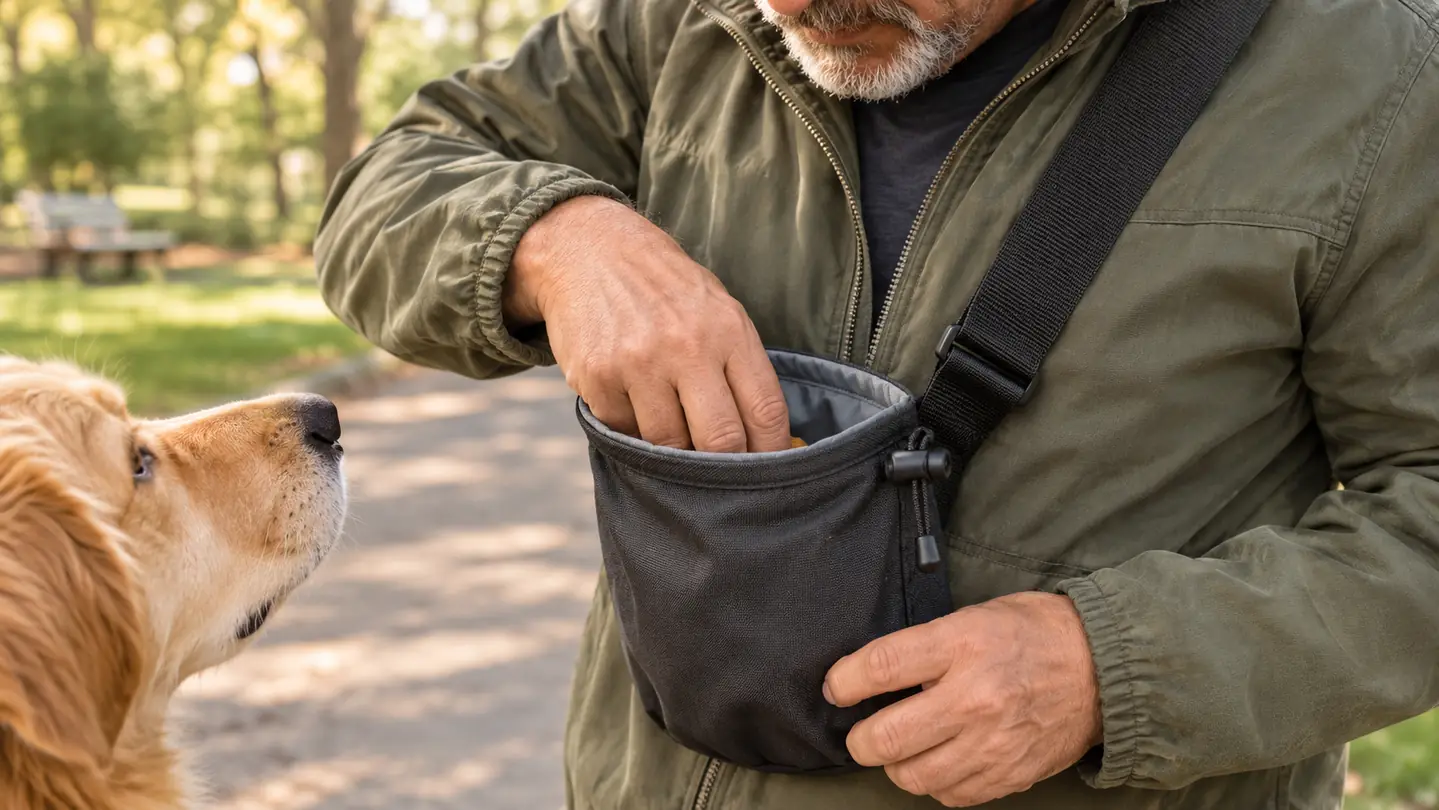
Getting a treat out one-handed matters more than I can explain to someone who has not trained a dog. When June is mid-pull and I want to reward a check-in, I have about two seconds. I reach in, take a piece, and the top falls shut behind my hand. No looking down, no fumbling, no losing her attention to the sound of a zipper.
One more detail about the clasp. It does not hold itself wide open, which is the trade-off for it closing on its own. I spread it with two fingers when I load it in the morning, let go, and it shuts. If you are used to a pouch that stands open for the whole session, that will feel like a step backward for about three days.
The Door Dash Work
The door dashing is the reason I bought a pouch at all. The routine we use is simple. I put a hand on the door, June sits, I reward. I open the door an inch, she holds the sit, I reward. Twenty repetitions a night for a few weeks. That kind of work lives or dies on how fast a reward arrives after the behavior, and the pouch cut my delivery time from a fumbled pocket dig to something close to immediate.
I am not going to tell you the pouch trained my dog. It did not. Repetition and a lot of boring evenings did that. What the pouch did was remove the five seconds of scrambling that used to happen between the sit and the reward, and five seconds is long enough for a dog to decide the sit was not what earned the chicken. The tool made the consistency possible. June did the rest.
The worst of that work happened in February, when the sidewalk was still icy and a proper walk was not happening. Twenty repetitions of hand on the door, sit, reward, in the front hallway, twice a day for two weeks. Roughly 560 repetitions, and I counted them because counting kept me from quitting on a Tuesday night. By the end of the second week she was holding the sit while I opened the door a full foot. The pouch did not do that. But 560 repetitions without a fast reward would have been 560 repetitions of her guessing.
It also fixed something I did not realize was a problem. When the treats are in a pocket, I ration them without thinking, because getting one out is work. When they are in a pouch at my hip, I reward more, and more rewarding is almost always the right direction with a dog who is still learning.
Months In: What Held Up and Where It Falls Short
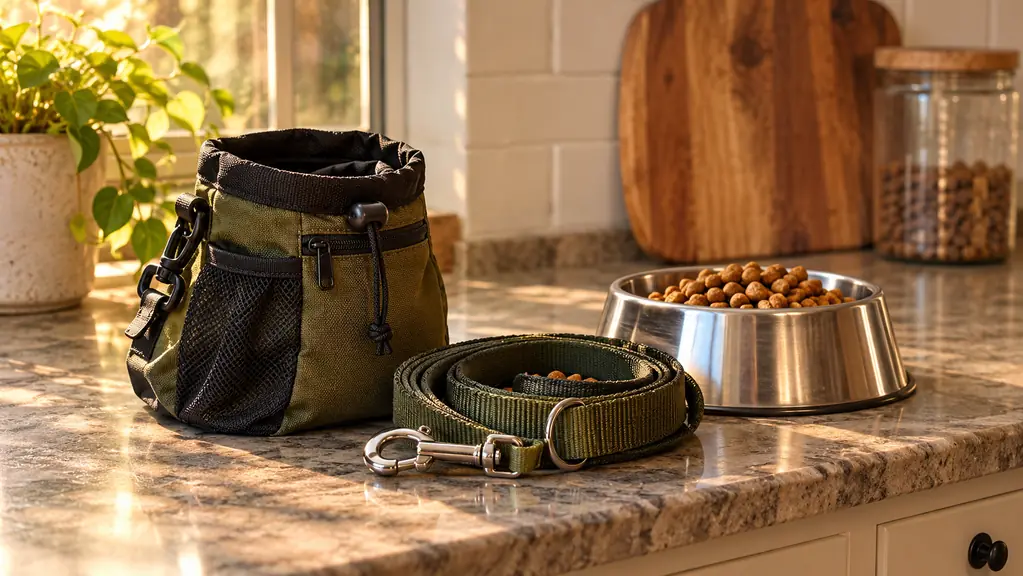
The body is polyester and weighs 8.8 ounces empty, light enough that I forget it is on. The seams around the main compartment, which take the most stress from my hand going in and out all day, have not frayed. The strap has not slipped from where I set it. I have machine washed it twice on cold in a mesh bag and air dried it, and it came out structurally intact both times.
The strap hardware is the part I expected to fail first, since the adjuster carries a full pouch hanging off one shoulder. Months in, the slide still holds where I set it and the clip has not bent. The pouch itself has one small scuff on the lower corner where it rubs against the seatbelt in the car, and that is the entire list of cosmetic damage after roughly eight months of daily use. The mesh bag I wash it in came apart before the pouch did.
What has not held up is the smell. Polyester holds onto chicken grease. After a few weeks the inside of the pouch had an odor that June found fascinating and I found unpleasant. A wipe with a damp cloth every couple of days keeps it in check. The Mighty Paw pouch is also not waterproof, so a wet bag of kibble left in a warm car overnight is something you only do once.
The other complaint is the break-in period. The opening does not fold back easily for the first week or so, and if you have arthritic hands, or you are training a dog that needs rapid-fire rewards, that first week will irritate you. It softens. It just does not start soft. A silicone pouch is easier on day one and harder to keep shut for the next thousand sessions.
What I Liked
- Magnetic clasp closes on its own the moment you let go
- Main compartment holds up to two cups of treats
- Four compartments keep reward values separate
- Strap adjusts from 30 to 52 inches and fits over a winter coat
- Built-in poop bag holder means one thing to grab at the door
- Light at 8.8 ounces, and it survived two machine washes
Where It Falls Short
- Polyester holds the smell of chicken and needs regular wiping
- Not waterproof
- Opening is stiff for the first week
- Four compartments is more checking than a single bag
Who This Is For
This is for the person running short, frequent sessions at home and on walks, who needs a reward within reach in under two seconds and is tired of pockets full of kibble dust. It suits a household with more than one dog, or one dog with more than one reward value, because the separate compartments earn their keep fast. If you train 10 minutes twice a day like I do, you will use every part of it.
Who Should Skip It
If you train once a week at a class and hand out treats from a small bag, this is more pouch than you need, and four compartments will just be four things to fill. If you work in wet weather or near water regularly, the lack of a waterproof lining is a real drawback. And if you want something you can rinse and forget, silicone is the better fit. The short version of a longer comparison is that silicone cleans better, and this one stays where you put it and shuts on its own.
How It Compares to a Silicone Pouch
I have used both, and the difference comes down to two things. Silicone wipes clean in seconds and never holds an odor, which matters if your dog works in mud or rain. What silicone does not do as well is stay open when your hand is going in and shut the moment it comes out. The magnetic clasp on the Mighty Paw does that by itself, and over months of daily handling I came to value it more than easy cleaning.
The second difference is capacity. Two cups in the main compartment covers a full day of sessions and a long walk. The silicone pouches I have used hold a good handful and no more. For short bursts with high-value food, a handful is plenty. For a two-hour outing with a dog who is still learning, the extra room is the difference between finishing the walk with treats and finishing it with an empty bag and a dog who has stopped checking in.
If your coat pocket is still the treat storage system, this is the fix
Four compartments, up to two cups of treats, a clasp that closes itself, and a strap that adjusts from 30 to 52 inches.
Amazon Check Today's Price on Amazon →