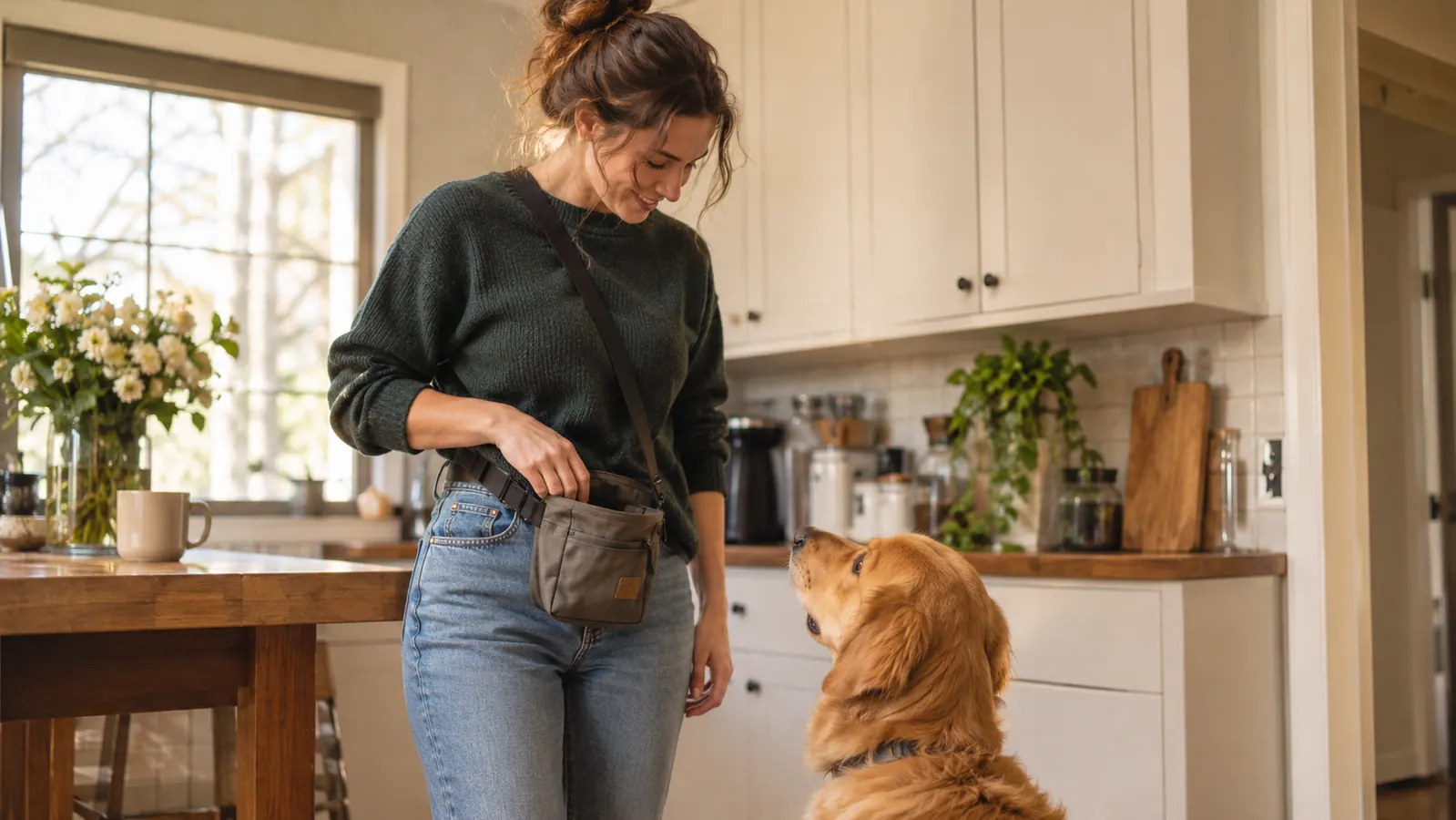
The short answer, after using both for a few months: the Mighty Paw treat pouch is the better tool for training at home, and a silicone squeeze pouch is the better tool for the two minutes you spend in the driveway. They are not really competing. One is a small bag you wear. The other is a cup you hold. I keep the Mighty Paw pouch on a strap across my body for a full ten-minute session with June, and I keep a silicone pouch in my jacket for quick recalls in the backyard. If you are only buying one and your dog is still learning, buy the one you can wear.
Worth saying plainly: neither pouch trains anything. My dog Juniper is a 3-year-old mixed-breed rescue, about 48 pounds, adopted at 18 months with a hard pull on the leash and a habit of dashing through open doors. What moved the needle for her was timing, repetition, and paying a reward fast enough that she connected it to the thing she had just done. The pouch matters because it decides whether that payment takes one second or four. Four seconds is a different lesson.
| Mighty Paw Treat Pouch | Silicone squeeze pouch | |
|---|---|---|
| Keeping treats in when you bend down | Two magnets pull the opening shut behind your hand | Mouth stays open until you squeeze it closed |
| Opening it with a leash in your other hand | Wants a small deliberate tug on the flap | One squeeze and it is open |
| Wearing it for a full session | Strap adjusts from 30 to 52 inches, over the shoulder or across the body | Clips to a waistband or belt, no shoulder carry |
| Holding a whole session's worth of treats | Up to 2 cups across 4 compartments | A small handful, refilled often |
| Wiping out peanut butter or wet food | Polyester body needs a hand wash and a full dry | Rinses under the tap in seconds |
| Covering the walk home | Built-in poop bag holder | Nothing built in |
| What it is actually for | Structured sessions at home or in a class | A handful of treats in a jacket pocket |
Where the Mighty Paw Treat Pouch Wins
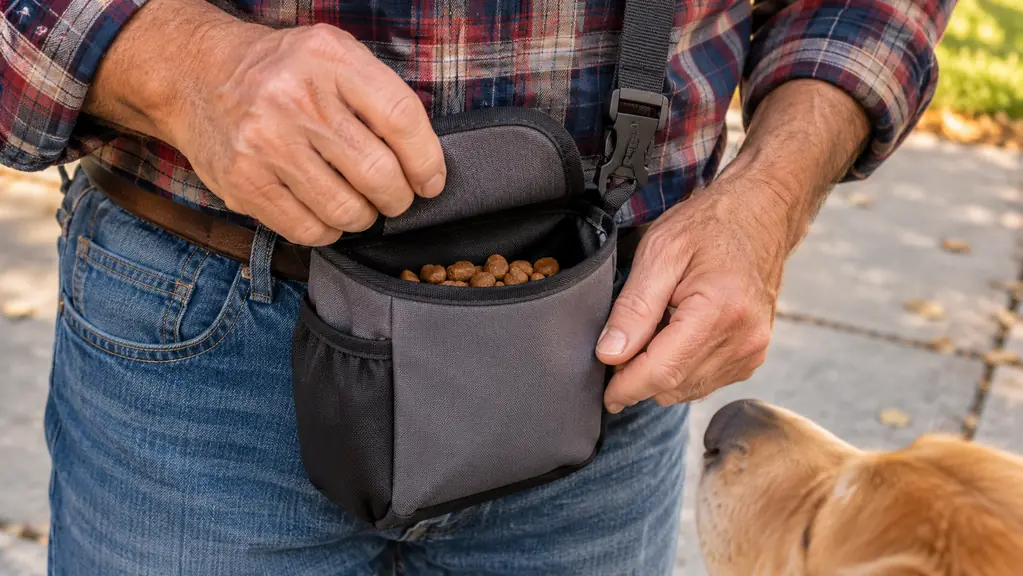
The magnetic clasp is the reason I switched. The pouch has two magnets at the mouth that pull the opening shut behind your hand. When I bend over to pick up a dropped treat, or crouch to reset June at the door, the pouch closes itself. My old open-top bag would tip and leave a trail of kibble across the kitchen floor. That sounds small until you have done it three times in one session and your dog has quietly learned that the floor is where food comes from.
The size is the second thing. The pouch measures about 7 by 5 by 2.5 inches and weighs 8.8 ounces, and it holds up to 2 cups of treats across 4 compartments. Two cups is more than I use in a day, which means I fill it once in the morning and stop thinking about it. The compartments also mean the high-value stuff, the little bits of chicken I save for door work, stays separate from the ordinary kibble. That separation is useful. You do not want to reach for the good reward and come up with a dry biscuit.
Then there is the strap. It adjusts from 30 to 52 inches, so it goes over one shoulder or across the body, and it stays where I put it while I am holding a leash, a clicker, and a door. There is a built-in poop bag holder on the side, which I did not think I would care about and now use on every single walk. The body is polyester, so it is not going to win a beauty contest after a winter of Kansas mud, but it wipes down and holds its shape.
The compartment I use most is the flat one at the back, sized for a phone and a set of keys. That matters more than it sounds. On a Tuesday morning in March I locked myself out of the house in the middle of door drills because I had set my keys down on the hall table and closed the door behind me. The pouch goes on before I call June now, and the keys go inside it. I have not been locked out since. Small gear decisions have a way of fixing problems you did not know you had.
Where a Silicone Treat Pouch Wins
The silicone pouch wins on speed with one hand. You squeeze the top and it opens wide, and it stays open while you shake a treat into your palm. When I am holding a leash with my left hand and June is at the end of it, the squeeze pouch is genuinely faster than the magnetic flap, which wants that small deliberate tug. Half a second is not nothing when you are trying to mark and reward a sit before she stands back up.
It also wins on wet food. If you use peanut butter, plain yogurt, or a soft liver paste as your high-value reward, the silicone pouch rinses clean under the tap in a few seconds. The Mighty Paw pouch has a polyester body, so anything greasy means a hand wash with dish soap and a full dry before the next session. I stopped putting wet food in it. I learned that the hard way on a Tuesday evening.
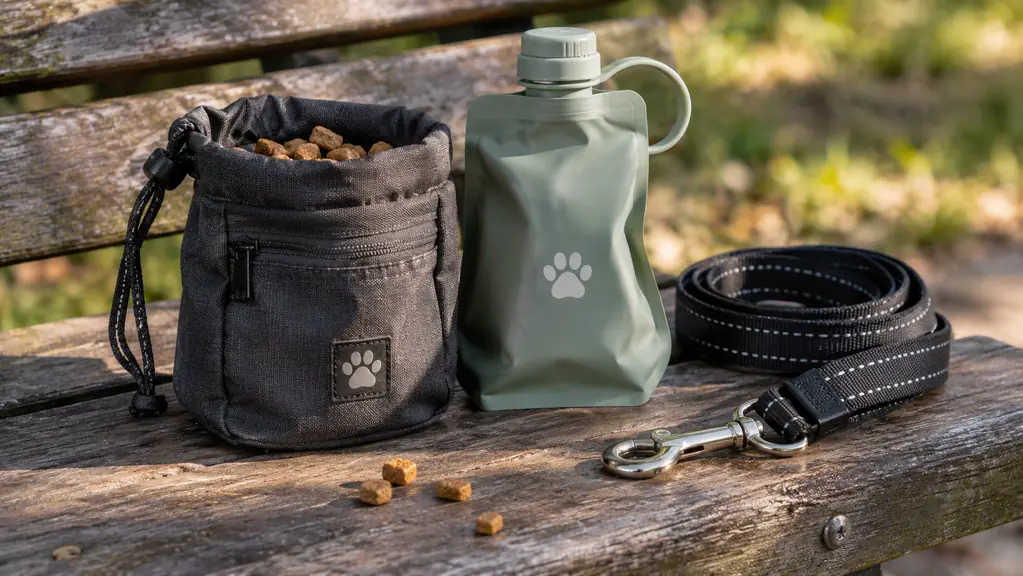
And it wins on pocketability. A small silicone pouch collapses as it empties and disappears into a jacket. The Mighty Paw pouch is a structured bag, which is exactly what makes it useful at home and exactly what makes it awkward on a five-minute bedtime trip to the yard. Different jobs, honestly.
I keep one in the pocket of my winter coat from November through March. On the nights when June only needs two or three reminders about waiting at the back door, that is the whole kit. Two pieces of cheese, one squeeze, done. There is no strap to adjust and nothing to buckle, and at nine at night in a cold yard that is the difference between doing the repetition and skipping it. I have skipped repetitions before. It always shows up later.
How Both Held Up Over a Few Weeks of Real Sessions
The silicone pouch is the one that aged faster. The seam at the top, where the two sides meet, started to look tired after a month of daily squeezing. It also holds the smell of whatever went into it last. Silicone always does. A rinse with hot water and a drop of soap helps, and leaving it open to air dry helps more. The day it became obvious was an unseasonably warm Sunday in April. I had left a few pieces of cheese in it overnight on the counter, and by morning the top would not stay closed unless I squeezed it. It still works. It just needs two hands now instead of one.
The Mighty Paw pouch has held up better because there is less to fail. Magnets do not wear out, the strap has not slipped, and the fabric has taken a few tumbles without a tear. It went through a muddy backyard season, a six-week class in a church basement with a slick floor, and one drop off the back step onto concrete. There is a scuff on the side that faces my hip and nothing else. I have washed it by hand maybe four times. The one wear item is the fabric itself, which has faded a little where it rubs. That is honest use, not damage.
The Parts I Do Not Love
The magnetic clasp needs a deliberate tug. If you are used to an open bag where you just reach in, the first week feels fussy. It gets better, but it never becomes invisible. There were a couple of sessions early on where I fumbled the flap while June was offering a beautiful sit, and the reward landed three seconds late. That was my fault, not the pouch's, but the pouch made the mistake possible.
The magnets are also strong enough that the flap snaps shut with an audible click. In a quiet church basement classroom that click carries further than you expect, and for the first two weeks I flinched every time I heard it. Nobody else in the class cared. I noticed it, then I stopped noticing it, which is roughly how every piece of training gear goes once it becomes part of the routine.
It is also not a pouch I would take to the lake. Polyester and magnets are fine in a Wichita backyard and fine in a training class, but sand gets into the compartments and does not come back out easily. And on very hot days, carrying a structured bag across the body is warmer than carrying a silicone cup. If your training happens outdoors in July, that is worth knowing before you buy anything.
What Ten Minutes Twice a Day Actually Looks Like
My routine is boring, which is the point. Ten minutes in the morning before I leave for the school office, ten minutes in the evening. The morning session is door work, because that is June's hardest behavior. I load the pouch, put it on, and stand by the front door. She gets a reward for a sit and a pause while I reach for the handle, and no reward if she pushes past me. The evening session is loose-leash work in the backyard, which mostly means changing direction a lot and paying her for following.
We work the front door in the same order every single time: a hand on the handle, a pause, a sit, a reward. The first week she beat me to the handle on every repetition and I had to reset her nine or ten times in a session. By the fourth week she held the sit for a full two seconds while I pulled the door open. Nobody watching would have called that dramatic. It was the most progress we had made on anything all spring, and it came from ten minutes, twice a day, for a month.
Two cups of treats sounds excessive until you count what a session actually costs. Ten minutes with a dog who is still learning might be 40 to 60 rewards, and if half of those are tiny, you are through a cup before you notice. That is why the four compartments matter more than they sound. I keep kibble in one, something better in another, and the bag holder does its job on the side.
How I Set Either Pouch Up Before a Session
Before I strap anything on, I decide what the reward is for that session. Kibble for repetition, real food for the hard stuff. Then I fill the pouch and put it on before I call June, not after. Calling her and then fussing with a zipper teaches her that her name means waiting. This is the one setup habit I would keep if I dropped everything else, and it applies to either pouch.
The other habit is emptying it. Treats left in a bag overnight go stale and the bag starts to smell, and a dog who can smell last week's chicken through the fabric is not paying attention to you. I dump whatever is left and wipe the inside with a damp cloth before I hang it up. Thirty seconds, and the next session starts clean.
What moved the needle for June was not the pouch. It was paying her within a second of the behavior, forty times in a row, and the pouch is the thing that made that possible.
The pouch I wear for sessions, not the one in my pocket
Two magnets that close themselves behind your hand, up to 2 cups across 4 compartments, a strap that adjusts from 30 to 52 inches, and a bag holder on the side. This is the setup that made forty rewards in ten minutes feel easy.
Amazon Check Today's Price on Amazon →Who Should Buy Which
Buy the Mighty Paw pouch if your training happens in one place for more than five minutes at a time. If you are working on door manners, loose leash, settling on a mat, or a polite greeting, you need a reward supply that lasts and does not end up on the floor. Buy it if you are tired of a bag that tips over, if you want your phone and keys on you, and if you would rather wear something than hold it.
Buy a silicone squeeze pouch if your training is a handful of treats at a time. Quick recalls in the yard, a reward for coming when called at the park, a few pieces of cheese in your jacket for a vet visit. Buy it if you use wet food or paste as your high-value reward, because cleanup will be easier. And buy it if you want something that disappears into a pocket.
If you can, own both. That is not a dodge. The silicone cup costs almost nothing and lives in my jacket, and the worn bag does the actual teaching. One is for the work, the other is for the moments in between.
Start with the one you can wear
Door dashing took ten minutes of daily repetitions to soften, and the pouch that stayed on my hip through all of them did most of the lifting. The silicone cup is in my jacket for everything else.
Amazon See the Mighty Paw Treat Pouch on Amazon →