

The first thing I noticed about the LUKITO Lick Mat was not the mat itself. It was the quiet. June, my 3-year-old mixed-breed rescue, had been circling the kitchen while I made coffee, which is her usual routine when she thinks a walk might be coming. I suctioned one of the two mats to the tile floor, spread a thin layer of soft treat across the textured surface, and pointed at it. She licked once, then settled into the work. For about six minutes, the house was calm. That is a small thing if you have a dog that already settles. It is a bigger thing if your dog is like June, who came to me at 18 months with a long list of habits we are still chipping away at: pulling on the leash, dashing out doors, and barking at the front window like the mail carrier is a personal enemy.
I am writing this as an honest review, not a victory lap. The LUKITO Lick Mat is a useful tool in our training routine, and I recommend it with conditions. It does not train your dog for you. It does not cure separation anxiety, leash pulling, or door dashing. It does not replace a good harness, a reward marker, or ten minutes of daily practice. What it does is give a dog a legal, low-stress job that keeps the mouth busy and the brain quiet. That has earned it a spot on our shelf. It has also earned a few honest complaints, and those are the part most reviews skip.
The Quick Verdict
A genuinely useful calming tool with strong suction cups and four textures, but it is not a chew toy, it will not stick to every surface, and the grooves take real cleaning.
Amazon Check Today's Price →A calmer pause is worth having on hand
If your dog needs help settling during grooming, bath time, or a crate break, the two-pack means one mat can be in use while the other is washed.
Amazon See availability on Amazon →How I've Used It With June
I keep the routine boring on purpose. I train with food rewards in two short sessions a day, about ten minutes each, and the LUKITO mat is not a training session by itself. It is what I give June when I need her to practice being calm while something else happens. I used it first on the kitchen tile while I cooked. Then on the side of the bathtub during a rinse. Then on the floor beside her crate while I folded laundry. The mat measures 7.87 by 7.87 by 0.31 inches and weighs 3.53 ounces, so it is light enough to move from room to room and thin enough to store in a drawer. The set comes with two mats and one spatula. I use the spatula to spread soft food into the four different textured surfaces, and I keep the second mat clean so there is no scramble between uses.
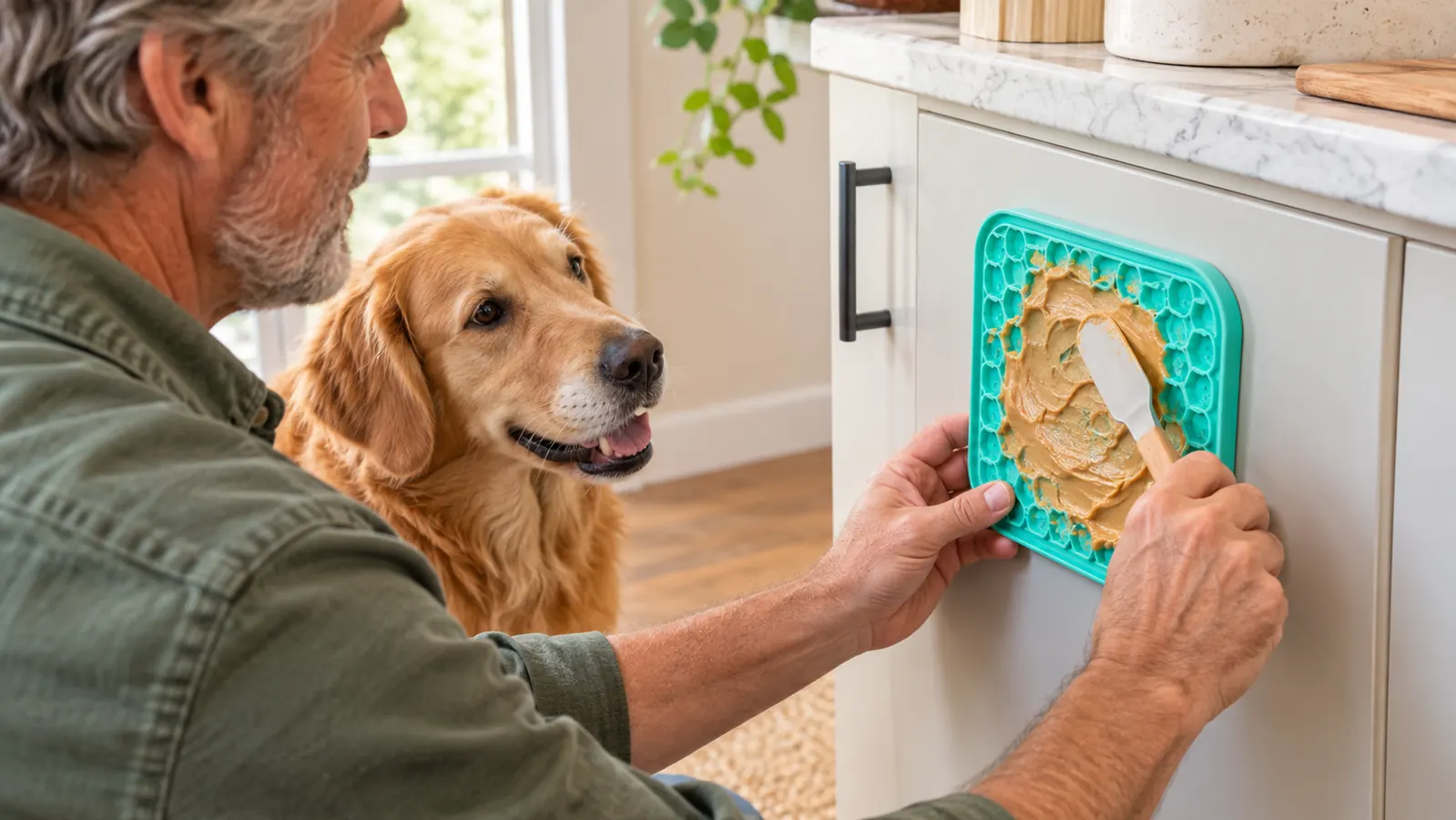
The suction cups are the feature that made me try it. There are 77 of them on the back, and when they hold, they hold well. The first time I pressed a mat onto the inside of the bathtub, June tried to paw it loose and could not. That mattered because bath time is the one place she turns into a wiggle machine. The second time, I pressed it onto a painted wooden cabinet door and it slid down within a minute. That was not the mat being bad. That was me asking the mat to do something suction cups cannot do. Smooth tile, glass, and non-porous surfaces work. Textured wood, grout lines, fabric, and bumpy plastic do not. If you test one spot and it lets go, move to another spot before you add food. A mat that falls while your dog is working is a quick way to teach your dog that the mat is a toy to chase.
June is about 48 pounds, and the mat is not a chew toy for a dog her size. The food grade silicone has held up to licking and to her pushing it around with a nose, and it has not been punctured. I still put it away when she is done. That is not because the material feels flimsy. It is because any soft silicone can be damaged by a determined chewer, and the listing does not call this a chew toy. The company describes it as a slow feeder and a licking pad. I treat it that way. If your dog likes to grab and shake a toy after licking, put the mat up before the shake starts.
What the LUKITO Lick Mat Actually Does
Licking is repetitive, and repetitive behavior can help a dog settle. I am not a veterinarian and I do not play one in this review. What I can tell you is what I see in my own house. When June is working at a lick mat, her breathing slows, her ears relax, and she stops scanning the room for the next thing to react to. That does not mean the mat treats anxiety. It means the mat gives her a safe, guided activity during a moment when she might otherwise pace, bark, or practice a behavior I am trying to reduce. That is a modest claim on purpose. A product that promises to fix behavior on its own is a product I would not trust.
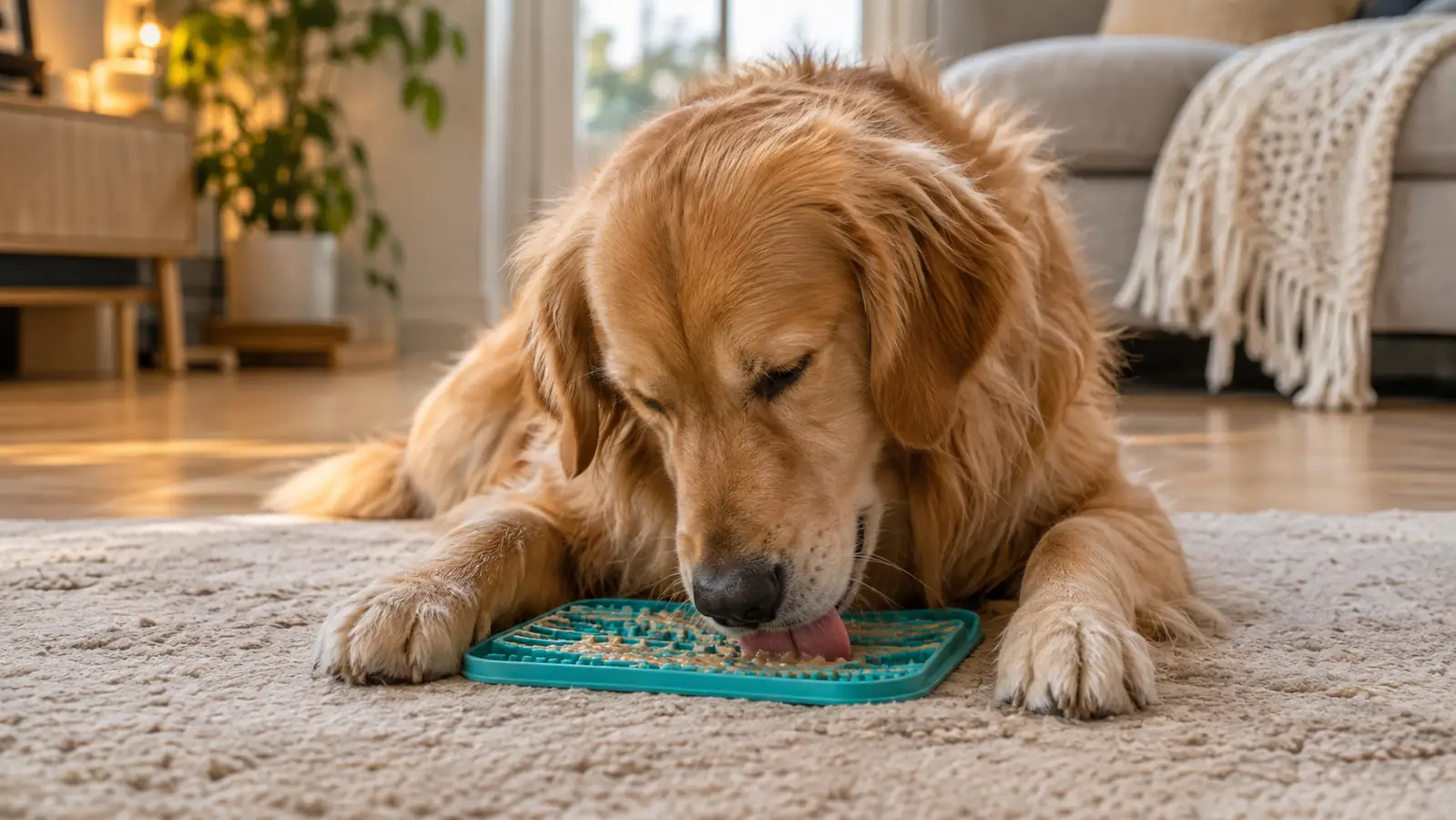
The two-pack matters more than I expected. I live in a house with a fenced backyard outside Wichita, and June is an indoor dog who follows me from room to room. One mat lives in the kitchen. One lives in the bathroom. I do not have to wash a single mat in the middle of a bath or move a wet mat across the house. The spatula is a small inclusion, but it helps. A thin, even layer of soft food pressed into the grooves takes longer to lick than a thick dollop sitting on top. The thick dollop disappears in two minutes and leaves a mess. The thin layer can stretch to six or eight minutes for June. That is enough time for me to finish a shower, trim a couple of nails, or get through a phone call without a barking soundtrack.
The Suction Cups Are the Whole Story
If you take one thing from this honest review, take this: the suction cups decide whether the LUKITO Lick Mat works for your routine. On a smooth surface, the 77 cups give you a stable mat that stays put while a dog licks. On the wrong surface, you get a sliding plate of soft food and a dog who learns to chase it. Before I trust a new spot, I press the mat down, count to ten, and give it a gentle tug. I do not add food until it passes. The bathtub wall passed. The kitchen tile passed. A smooth cabinet door passed. A painted wood door with a slight texture failed. A plastic storage bin lid failed. None of that is a defect. It is how suction cups work.
The mat is also thin, so it can be used on the floor. That is how June uses it most often. I press it to the tile in the kitchen, spread the food, and let her work while I stand at the counter. On a floor, the suction cups are less important, but the mat still helps. It does not tip like a bowl, and the food stays on the surface instead of being pushed into a corner. If you have a dog who gulps from a bowl and then looks for more, a licking pad slows the pace in a different way. It asks the dog to use the tongue instead of taking a mouthful. That is a useful change for a dog who eats too fast or needs a longer settling activity.
The Cleaning Test Nobody Warns You About
The grooves are the tradeoff. A smooth surface would be easier to wash. The four textured surfaces hold food, and soft food can dry into the corners. I hand wash both mats with warm water, a dish cloth, and a small brush. The listing says dishwasher safe and also says hand wash only, which is not the clearest instruction I have ever read. I chose hand washing because I want to see the food come out of the grooves. A quick rinse is not enough. If you spread peanut butter or soft cheese, get into the pattern with a brush, or you will find a smell the next time you open the drawer. The spatula helps with spreading, not with cleaning. Keep a bottle brush nearby if you use the mat often.
The two-pack makes the cleaning less annoying. One mat can be drying while the other is in use. That is the main reason I would choose the two-pack over a single mat. The material is food grade silicone, and it has not held onto odors after a proper wash. I have not put it in the dishwasher, so I cannot tell you how it survives a full cycle. I can tell you that hand washing takes about a minute per mat if you do it right after use. If you let the food dry for an hour, it takes longer. That is not a design flaw. It is the nature of a textured surface. The honest version of this review has to say that the cleaning step is real, and it is the part I would change if I could.
What Nobody Tells You About Timing and Treats
A lick mat is not a fix. The first time I gave June a thick layer of soft food, she finished in under three minutes and looked at me like I had forgotten the rest of the meal. The second time, I spread a thinner layer and pressed it into the grooves. That lasted closer to eight minutes. The difference was not the mat. It was how I loaded it. If you want a longer activity, use a thin, even spread and keep the food cool before you give it. I do not put the mat in the freezer, because the listing does not say it is freezer safe. I will say that a cold spread thickens and takes longer to lick. Check that the silicone is still flexible before you hand it over.
The bigger lesson is that the mat works best when it is attached to a routine, not used as a random distraction. I use it before a training session when June is already excited, not after she has practiced barking at the window for ten minutes. I use it during grooming, when I need her to hold still for a brush or a nail trim. I use it in the bathroom during a rinse. I do not use it every time she whines, because I do not want her to learn that whining produces a treat mat. That is not punishment. It is just being careful about what behavior gets rewarded. The mat is a tool for setting up a calm moment. It is not a remote control for a dog's emotions.
Where It Fits in Real Training
June came to me at 18 months with strong leash pulling, door dashing, and barking at the window. Those behaviors are not solved by a lick mat. They are solved by management, reward-based training, and time. The mat helps at the edges. Before a leash walk, I can give her a mat with a thin spread while I put on my shoes. That gives her something to do instead of pacing at the door and rehearsing the dash. After a training session, I can give her a mat while I put the treats away. That gives her a calm landing instead of a sudden drop from high energy to nothing. The mat is not the lesson. It is the pause between lessons.
Bath time is where the mat has been most useful. June does not love water. She tolerates a rinse because we have practiced it with treats, but she would rather be anywhere else. I press one mat to the tub wall, load it with a thin spread, and let her lick while I work. The suction cups hold on the smooth tub surface. I keep a hand on her harness and keep the water low. The mat gives her a job, and a dog with a job is usually a dog who is not trying to climb out. I would not say it makes bath time easy. I would say it makes bath time possible without a second person. That is a real improvement in my house.
The Tradeoffs I Would Tell a Friend About
The first tradeoff is the warranty. The listing says there is no warranty. That is not unusual for a silicone mat, but it matters if you are hard on your gear. The second tradeoff is the cleaning. The grooves hold food, and a quick rinse will not get them clean. The third tradeoff is the suction. The 77 cups are strong on smooth surfaces and useless on textured ones. The fourth tradeoff is the size. At 7.87 by 7.87 inches, the mat is a good size for a 48-pound dog and a small area. It is not a full meal replacement for a giant breed, and it is not a bed. It is a surface for a spread. If you have a very large dog, you may need two mats side by side, which is another reason the two-pack makes sense.
I also would not call this a cat product just because the title says dogs and cats. The listing says it is for both, and I have no reason to doubt it. I just have not tested it with a cat. I can tell you that the mat is thin, the suction cups are strong, and the surface is shallow enough for a cat's tongue. That is as far as I will go. My review is about a dog. If you are buying for a cat, read the cat reviews and start with a small amount of food. The same rules apply: test the suction, keep the spread thin, and supervise the first few uses.
What I Liked
- Two-pack plus spatula means one mat can dry while the other is used
- 77 suction cups hold well on smooth tile, glass, and tub walls
- Four textured surfaces make a thin spread last longer
- Food grade silicone has held up to daily licking
- Light and thin enough to store in a drawer
Where It Falls Short
- No warranty listed
- Grooves need a brush, not a quick rinse
- Suction cups fail on textured wood, fabric, and bumpy plastic
- Not a chew toy and should be put away after use
- Care instructions say dishwasher safe and hand wash only
The mat did not teach June to settle. It gave her a place to practice settling while I did something else.
Who This Is For
This is for the owner who already uses reward-based training and wants a practical way to add a calm pause to grooming, bath time, crate time, or the edge of a training session. It is for the person who has a smooth tile floor, a glass shower door, or a smooth tub wall and who does not mind a one-minute hand wash. It is for the dog who likes soft food and needs a job that lasts longer than a bowl. It is also for the owner who understands that a product is a tool, not a fix. If that describes you, the LUKITO two-pack is a reasonable addition to the shelf.
Who Should Skip It
Skip it if your dog destroys soft toys and you cannot supervise every second. Skip it if your only available surfaces are textured wood, fabric, or bumpy plastic and you need the mat to stay in one place. Skip it if you want a product that will fix separation anxiety, leash pulling, or door dashing on its own. Skip it if you hate hand washing dishes with grooves. And skip it if you are looking for a chew toy. This is a licking pad. It is good at that job. It is not good at being something else.
If a calmer routine is the goal, start with the two-pack
Use one mat while the other dries. Test the suction on the surface you plan to use, spread the food thin, and keep the first sessions short.
Amazon See availability on Amazon →