

The mail truck comes at 11:40, six days a week. June hears it three streets away, and by the time I set my coffee down she is already at the front window, barking at a truck she cannot see. Ninety seconds of noise, and nothing I say gets through. This is the part nobody puts in the training videos: in that moment she is not ignoring me, she genuinely cannot hear me.
I tried the usual advice. Closing the blinds helped a little. Telling her to quiet down helped nothing and probably made it worse, because now the mail truck arrived with a side of me being loud too. What actually changed things was giving her a different job for her mouth when the trigger shows up, and the cheapest version of that turned out to be a lick mat. Mine is the LUKITO lick mat, a two pack that comes with a spatula. It has not stopped her barking. It has bought me the twenty quiet minutes I need in order to actually train through it, which is the whole point.
The twenty minutes of quiet that make the training possible
The LUKITO lick mat is a two pack of food grade silicone mats with 77 suction cups on the back and four different textured surfaces. Freeze one while the other is out, and use the spatula in the box to press the food down flat.
Amazon Check Today's Price on Amazon →Step 1: Figure out what your dog is barking at, and when
Barking is not one behaviour. It is at least four, and they need different responses. There is alert barking at something new in the yard. There is frustrated barking at a dog on the other side of the fence. There is bored barking at nothing in particular, usually around the same time every afternoon. And there is the barking that comes with real distress, which is a different conversation and may involve your vet. A lick mat helps with the first three and is not a treatment for the fourth, so be honest with yourself about which one you have.
For a week, write it down. Not in your head, on paper. Time, what the dog was doing right before, what appeared, how long it lasted, and what ended it. I did this with June in a notebook on the kitchen counter and the pattern was almost embarrassing. Nearly everything happened between 11:30 and 12:10, and again at 4:30 when school lets out and the neighborhood fills with kids walking home. Two windows. That was the entire problem, and I had been treating it like it was random for close to a year.
Once you have the pattern, you know when to have a mat loaded and ready. That single piece of information is worth more than any piece of gear, and it costs nothing but a notebook and a week of paying attention.
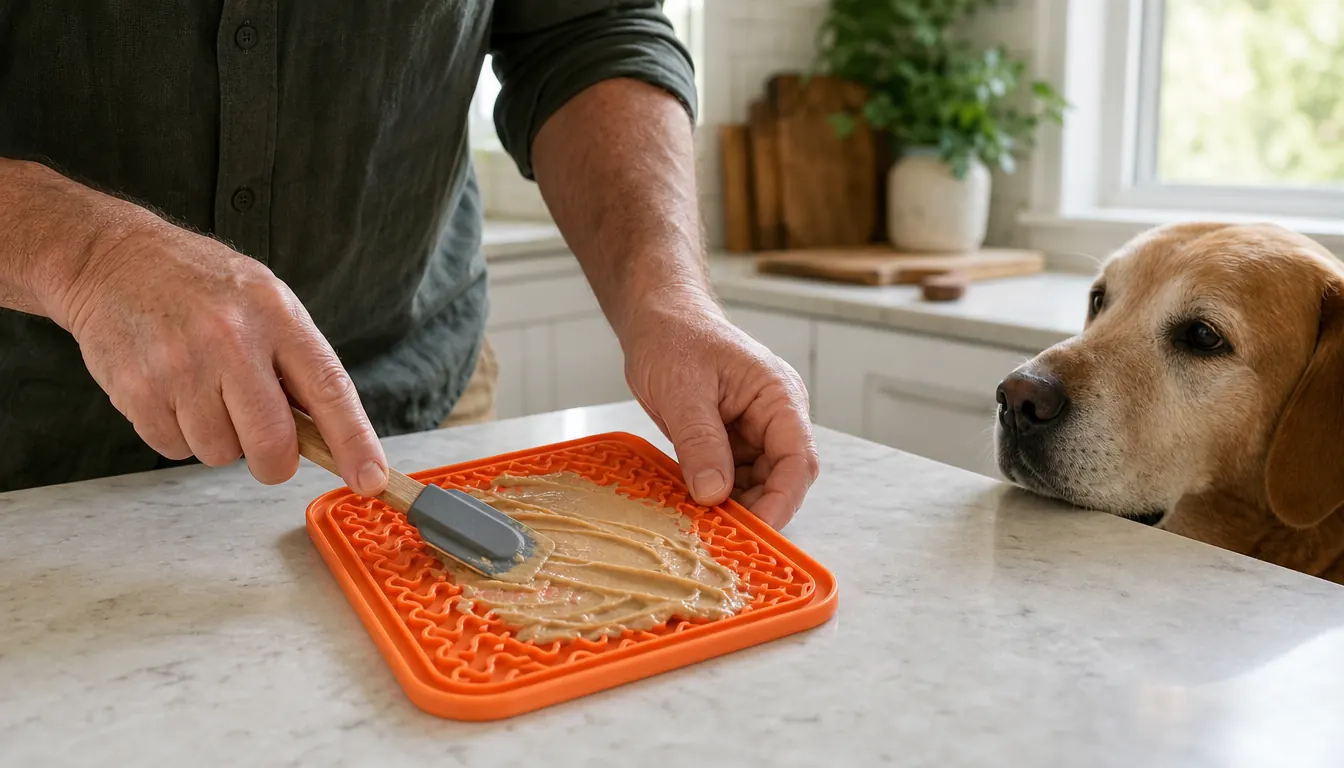
Step 2: Load the mat so the licking outlasts the barking
The mistake I made first was spreading peanut butter on the mat like I was making a sandwich. June finished it in ninety seconds, looked up, and went right back to the window. A lick mat only works as a settling tool if it takes real time, so the food needs to be spread thin and pressed down into the texture, not dolloped on top of it.
The LUKITO mat has four different textured surfaces, which matters more than it sounds. Thin, runny things like plain yogurt or a pureed vegetable go in the finer texture where they cannot slide off the edge. Thick things like canned wet food, mashed banana or a soft cheese go in the deeper grooves. Spread it with the spatula that comes in the box, push it down flat, and freeze the whole thing for at least half an hour. A properly loaded frozen mat takes my dog somewhere between fifteen and twenty five minutes. A room temperature one takes four.
Two things to get right. First, check any peanut butter or nut butter for xylitol, which is toxic to dogs, and skip anything with garlic or onion powder in it. Second, if your dog has a sensitive stomach, use the food they already eat, moistened, instead of introducing something new during a training week. Plain canned pumpkin and plain yogurt are the two I keep coming back to because they spread thin and freeze hard.
On the practical side, each mat is 7.87 inches square and about a third of an inch thick, 3.53 ounces, so they stack in the freezer door without taking over a shelf. The care instructions list it as hand wash only and also as dishwasher safe, which cannot both be true, so I rinse mine under the tap and it takes about thirty seconds. There is no warranty, which is worth knowing up front for something you are going to freeze and wash constantly.
Step 3: Stick it somewhere your dog can turn her back on the window
The LUKITO mats have 77 suction cups on the back. That is the feature that makes them useful and the feature people get wrong, because suction cups do not stick to a dirty surface, a textured surface, or a painted wall. Wipe the spot with a wet cloth and let it dry first. Tile, glass, the side of the bathtub and the refrigerator door all hold. A wooden floor or a rug will not.
Placement is the part that decides whether this works. Do not stick it on the window sill. If the mat is at the window, the dog is licking and watching the street at the same time, and the street always wins. Put it on the floor a few feet back from the window, or around the corner on the baseboard, or on the side of the tub if your dog barks in the bathroom while you shower. The goal is a spot where her head is down and her body points away from the thing that set her off.
Some dogs will try to carry the mat off. The suction cups solve that on a smooth floor, but tug a corner before you walk away to check the seal. And supervise the first several uses, because a dog who is new to this can decide the mat itself is a chew toy. If yours is a chewer, stay in the room until you know better.

Step 4: Put the mat down before the trigger, not after
This is the difference between training and bribery, and I got it wrong for weeks. If the mat appears after the barking starts, the dog learns that barking produces a frozen mat. If the mat is already on the floor when the mail truck arrives, the dog learns that the mail truck predicts something good, and her mouth is already busy when the noise begins. Same food, completely different lesson.
That means being ready about ten minutes before your dog's trigger window. Ours is 11:30. The mat goes down frozen, I sit at the kitchen table with a book, and the truck does its thing while June works at the mat. She still lifts her head. She does not get up. Two months in, she sometimes does not lift her head at all.
If a real mail truck is too much to start with, build down. Record the sound on your phone, play it at low volume from another room, and put the mat down before you press play. When the dog can lick through the low volume without stopping, raise it a little. Same idea for dogs passing the house: start with a friend walking past at the far end of the block, not a stranger at the fence. The mat goes down first, every single time, and the order matters more than the food does.
A properly loaded frozen mat takes June about twenty minutes. The mail truck is gone in ninety seconds. That gap is where the actual training happens.
Step 5: Take the mat away from the trigger as the barking fades
Once your dog can hear the trigger and go to the mat without being told, start fading. Weeks one and two, mat every single time. Week three, mat every other trigger. Week four, mat in the same room but fifteen feet back, so the dog has to choose to walk to it. By week six, June hears the truck, gets up, huffs once, and lies back down. That is not because the mat is doing something special. It is because the mail truck stopped predicting a fight and started predicting a mat.
Do not fade too fast, and do not stop entirely. I still freeze a mat two or three afternoons a week, especially when the weather is bad and the neighborhood is loud, or when we have had workmen in and out of the house all day. Behaviour that is not rehearsed drifts. Ten minutes of a frozen mat is cheaper than a week of barking.
Keep the mat in the routine even when nothing is wrong. If the only time it appears is when something stressful happens, it starts to predict stress instead of predicting calm. Ours comes out during my coffee on a normal Tuesday for no reason at all. That is deliberate, and it is the reason the mat still works on the days that are not normal.
What Else Helps
A lick mat is one tool in a set, and it works best when the rest of your setup is not quietly fighting it. These are the pieces that made the biggest difference for us, in the order I would do them.
Management first. Window film on the lower half of the front window, or blinds closed during the trigger window, removes the rehearsal entirely. A white noise machine near the front door takes the edge off sounds your dog can hear and you cannot. If June cannot see the truck, she has less to bark at, and every barking episode she does not practise is one less episode to undo later.
Exercise before the trigger window, not after. A tired dog is not automatically a quiet dog, that old line oversells it, but a dog who has had a real walk is working with a smaller tank of nervous energy at 11:40 than one who has been in the yard all morning. My ten minute sessions twice a day with June are mostly loose leash walking and a settle on a bed, and both of those make the barking work easier.
Then there is everything I would tell you not to buy. Bark collars, citronella spray, shaking a can of coins. They suppress the noise in the moment and leave the fear or the frustration exactly where it was, and they tend to make a dog who is already uneasy about the mail truck more uneasy. The barking comes back, often worse, and now the dog has learned that the mail truck also predicts a correction. That is a much harder thing to train out than barking.
And if the barking started suddenly, or happens at night, or comes with pacing, panting or destructiveness when you are out, talk to your vet before you buy anything at all. Sudden changes in vocal behaviour can be pain, a thyroid problem, cognitive change in an older dog, or separation distress, and none of those are solved with a mat.
Start with the two pack so one is always in the freezer
Two mats means one is frozen and ready before the trigger window while the other is being washed. Food grade silicone, 77 suction cups, four textured surfaces, and a spatula in the box.
Amazon See the LUKITO Lick Mat on Amazon →